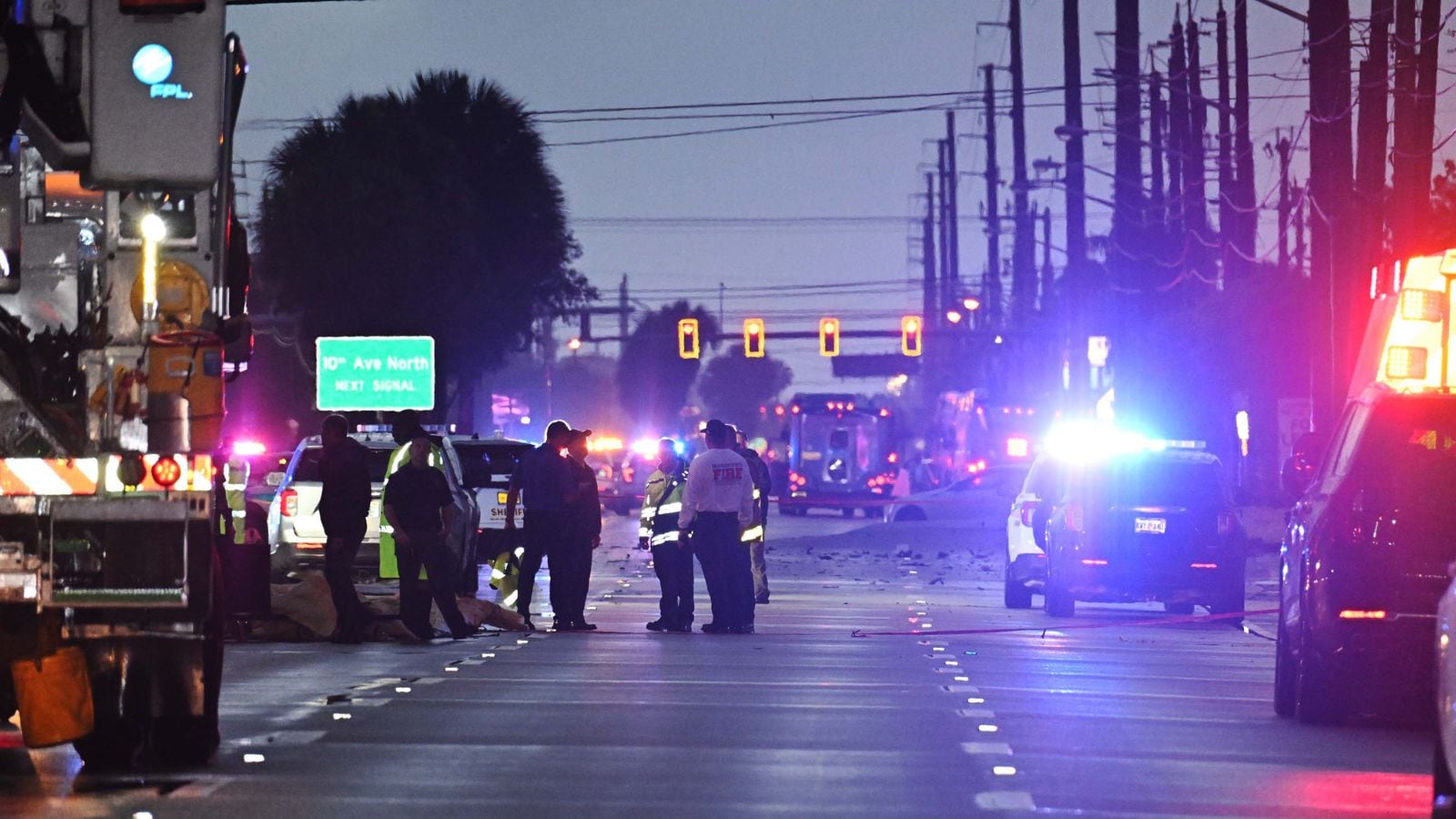
Nine lives ended in a wall of flame when a private jet plunged toward a busy South Florida thoroughfare, missing commuter traffic by yards before exploding on impact. Federal investigators from the National Transportation Safety Board (NTSB) immediately descended on the crash site to sift through charred wreckage and retrieve flight recorders. While early reports focus on the dramatic final moments, the tragedy highlights a recurring pattern of systemic vulnerabilities in private aviation operations, pilot workload management during critical low-altitude maneuvers, and the thin margin of error surrounding suburban air corridors.
Emergency crews arrived to find a scene of total destruction. The aircraft, operating under federal flight rules that govern charter and corporate transit, lost altitude rapidly during its approach sequence. Eyewitnesses described an abrupt downward pitch, followed by a wing dip and an immediate fireball upon contact with the terrain. None of the nine occupants survived the impact, and ground crews spent hours cooling the wreckage while preserving evidence for federal investigators.
Understanding why a multi-engine turbine aircraft suffers a complete loss of control requires examining the complex interaction between mechanical systems, crew decision-making, and environmental conditions.
The Fragile Physics of Final Approach
Private jet operations present a distinct operational profile compared to commercial airline flights. While airliners fly predictable routes into massive hubs with multiple redundant safety layers, corporate aircraft frequently land at smaller regional facilities embedded directly inside congested suburban areas.
During the descent phase, aircraft energy management is critical. Pilots must balance speed, altitude, and sink rate to keep the airplane within its safe flight envelope. A sudden loss of airspeed or an uncoordinated turn at low altitude can induce an aerodynamic stall. When a wing stalls close to the ground, altitude is insufficient for recovery.
Flight safety data indicates that low-altitude loss of control remains a leading cause of fatal accidents in non-airline civil aviation.
An engine failure during approach does not automatically cause a catastrophic dive. Modern multi-engine aircraft are designed to climb or maintain altitude on a single engine, provided the crew executes emergency checklists correctly and maintains a speed above the minimum control velocity. However, if an engine fails suddenly while the aircraft is flying slow and configured for landing, asymmetric thrust creates a severe yawing motion. If the pilot reacts by pulling back on the flight controls rather than lowering the nose to preserve airspeed, the aircraft can enter an unrecoverable roll.
Maintenance Standards and Operational Pressure
Federal regulations establish strict maintenance schedules for turbine aircraft, but execution varies across the industry. Part 91 operations, which cover private non-commercial flights, operate under different regulatory oversight than Part 135 commercial charter operators or Part 121 scheduled airlines.
OPERATIONAL REGULATORY COMPARISON

Part 91 (Private Operations)
- Flexible crew rest requirements
- Basic maintenance inspection cycles
- Pilot discretion on weather minimums for departure

Part 135 (Charter Operations)
- Mandatory crew rest minimums
- Enhanced maintenance oversight
- Strict weather minimums and operational specifications
Operational pressure often plays a silent role in private aviation mishaps. Unlike commercial flights operating on rigid schedules with dedicated dispatchers, corporate operations frequently accommodate last-minute schedule changes, challenging weather windows, and demanding passengers.
Pilot fatigue accumulates rapidly during irregular operating schedules. When flying into high-density airspaces surrounded by complex terrain or heavy ground traffic, high mental workload reduces situational awareness. A minor mechanical anomaly that would be manageable at 30,000 feet becomes a critical emergency when it occurs 500 feet above a highway.
Reconstructing the Flight Path
NTSB investigative teams approach crash sites with a methodical process designed to reconstruct the final seconds of flight without relying on initial speculation.
Investigators examine three main areas:
- Physical Wreckage: Control surface continuity, engine turbine blade deformation (which reveals whether engines were producing power at impact), and cockpit instrument settings.
- Recorded Data: Flight Data Recorders (FDR) and Cockpit Voice Recorders (CVR), alongside radar tracking data and broadcast ADS-B flight telemetry.
- Human Performance: Pilot training records, recent duty time, medical history, and pre-flight planning notes.
Radar telemetry often reveals early clues. A sudden drop in groundspeed combined with a rapid increase in vertical descent rate strongly suggests an aerodynamic stall or structural failure. Conversely, a steady descent path straight into the ground without speed loss can indicate pilot incapacitation or a flight control lockup.
Thermal damage complicates physical evidence gathering. High-impact fuel fires erase soft tissue and destroy delicate electronic components. Specialized laboratories use micro-CT scanning and metallurgical analysis to examine fuel injectors, control cables, and turbine shafts extracted from incinerated debris.
The Suburban Airfield Dilemma
The location of the South Florida crash highlights an ongoing urban planning challenge across the country. Airfields built decades ago on isolated rural land are now encircled by high-density residential neighborhoods and multi-lane arterial roads.
| Risk Factor | Impact on Flight Safety | Community Exposure |
|---|---|---|
| Encroaching Development | Limits off-airport emergency landing options | Exposes ground traffic to aviation incidents |
| High Noise-Abatement Routes | Requires steep or non-standard flight paths | Increases pilot workload during approach |
| Mixed Air Traffic | Combines slow training aircraft with fast jets | Elevates air traffic control complexity |
When an aircraft suffers a catastrophic failure over a populated corridor, pilots have virtually no options for a forced landing. Fields and open spaces that once served as safety buffers have been replaced by shopping centers and residential subdivisions. The margin between a controlled emergency landing and a ground tragedy comes down to mere feet.
Suburban airports face continuous scrutiny regarding safety corridors and noise abatement procedures. Steep descent profiles designed to keep aircraft higher over residential areas for noise reduction can force pilots to operate closer to the edge of the aircraft's performance envelope during approach.
Structural Gaps in General Aviation Safety
While commercial airline travel achieved historic safety records over the past two decades, private and general aviation safety metrics have plateaued. The technology exists to prevent many common causes of accidents, yet integration across the general aviation fleet remains uneven.
Angle of Attack (AOA) indicators give pilots direct visual warnings before an aerodynamic stall occurs. While standard in military and commercial airliners, many older private jets require aftermarket retrofits to install these systems. Similarly, synthetic vision systems and automated ground proximity warnings significantly reduce controlled flight into terrain, but installation costs and downtime discourage some aircraft owners from upgrading older airframes.
Training standards also vary. While simulator-based recurrent training is standard practice for professional jet crews, the frequency and rigor of this training depend heavily on insurance requirements rather than federal mandates. Simulating compound failures—such as an engine failure combined with a flight control glitch during a low-altitude turn—remains rare outside of top-tier flight academies.
The South Florida disaster serves as a stark reminder of aviation's unforgiving physics. Modern jet engines achieve remarkable reliability, but when multiple mechanical, environmental, or human factors align unexpectedly, the transition from controlled flight to catastrophic loss takes only seconds. Grounding future risk requires looking beyond the immediate crash site to address regulatory disparities, cockpit technology adoption, and the growing collision between expanding suburbs and regional flight paths.