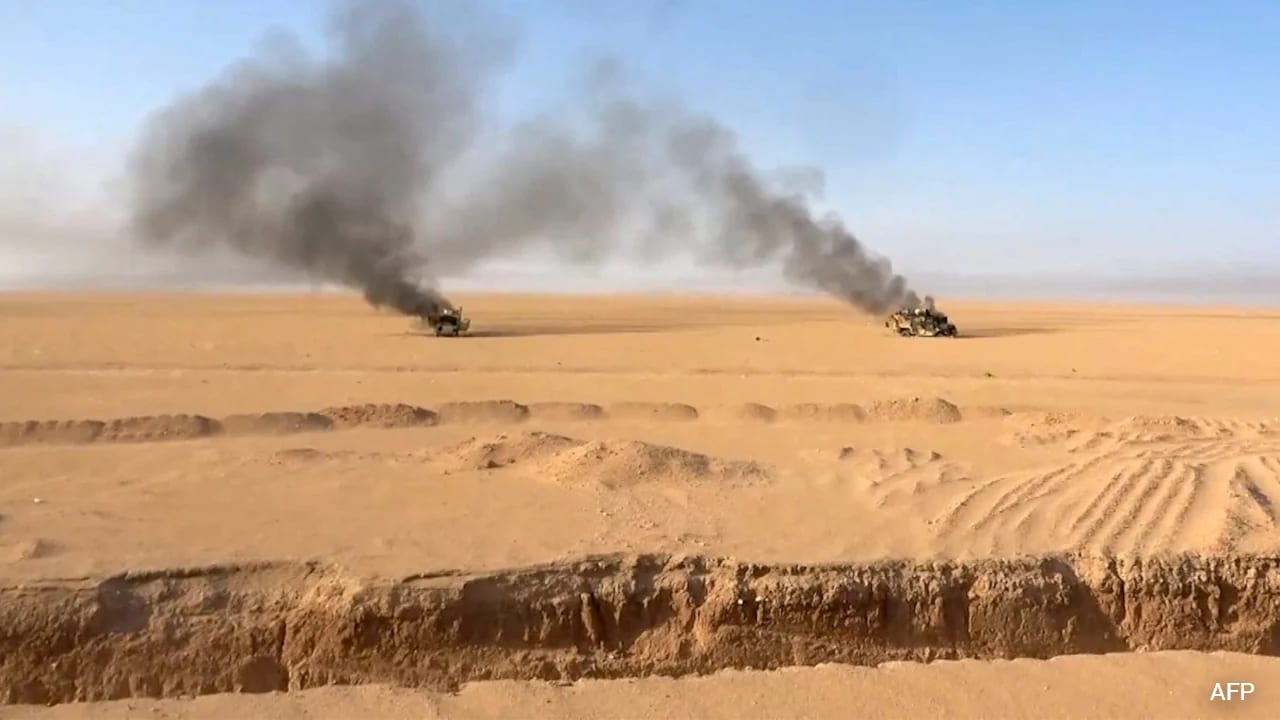
The scorched wreckage sitting upright in the dust of Marib governorate tells a story that Riyadh would prefer to leave unwritten. When Yemen's Houthi movement released footage featuring the charred tailfin of a Royal Saudi Air Force F-15, complete with a clearly legible roundel showing through the soot, it punctured an illusion of absolute aerial dominance that modern air forces spend billions trying to maintain. For decades, advanced fighter jets operating over irregular battlefields enjoyed an asymmetric immunity. They flew high, struck fast, and retreated to climate-controlled command centers while adversaries relied on inaccurate small arms fire or antiquated anti-aircraft guns. That era is coming to a messy, violent close. The claim that an F-15 was brought down by a locally modified surface-to-air missile is not merely a propaganda victory for an insurgent group; it is a stark indicator of how modern asymmetric warfare has weaponized ingenuity against high-end military hardware.
To understand why this specific loss matters, one must look past the flashy headlines and examine the engineering realities of air combat over Yemen. The aircraft in question, identified through open-source analysis of the wreckage as an F-15SR—part of the Royal Saudi Air Force’s upgraded legacy fleet—is a formidable, twin-engine strike platform. It is packed with countermeasures, sophisticated radar warning receivers, and defensive aid suites designed to throw off radar-guided threats. Yet, modern insurgent air defense networks have evolved beyond traditional radar reliance. They have adapted by integrating passive tracking systems, electro-optical sensors, and modified air-to-air missiles bolted onto improvised ground launchers.
When an aircraft relies on traditional radar warning receivers to alert the pilot of an incoming threat, those systems look for specific active radio frequency emissions from a hostile fire-control radar. If an adversary shifts tactics and uses passive infrared sensors or optical tracking to cue a launch, the pilot's cockpit might remain completely silent. There is no frantic buzzing of a radar lock-on warning. There is no automated dispensing of chaff and flares until it is far too late. The missile simply appears in the field of view, guided by heat signatures or visual tracking rather than active radar illumination. This operational shift neutralizes millions of dollars worth of onboard defensive avionics through low-tech, high-utility adaptation.
The silence from the Saudi Ministry of Defense following the incident highlights a chronic dilemma in modern military public relations. When a multi-million-dollar warplane goes down over hostile territory, military leadership faces a grim calculus. Immediate denial risks looking detached from verifiable imagery, while a prompt admission feeds enemy propaganda networks and raises awkward domestic questions about force protection and operational risk. Historically, coalitions fighting irregular forces choose institutional silence, letting the news cycle bury the wreckage while operational parameters are quietly adjusted behind closed doors. But silence does not erase the tactical reality on the ground. Every lost airframe alters the risk matrix for flight crews who must continue flying close air support missions over contested terrain.
The technological pipeline feeding the Houthi air defense network is another layer of the crisis that military planners struggle to counter. Over the course of the conflict, the group's technical cells have demonstrated a persistent ability to harvest components from unexploded ordnance, downed reconnaissance drones, and Soviet-era stockpiles, marrying them to modern digital triggers. For instance, legacy air-to-air missiles originally designed to be launched from aircraft rails have been successfully re-engineered into mobile surface-to-air batteries. These jury-rigged systems are modular, highly mobile, and difficult to target via pre-strike intelligence because they leave a minimal electronic footprint before activation. They move in small trucks, hide in complex terrain, and pop up only long enough to acquire a target of opportunity before disappearing back into the civilian populace or rugged cave networks.
This dynamic forces a painful re-evaluation of air power doctrine in asymmetric conflicts. For years, air superiority was treated as a binary state: you either owned the skies, or you did not. Today, the reality is granular and contested. An air force can control the high-altitude ceiling while remaining acutely vulnerable to localized, pop-up air defense ambushes during low-level operations or slow-speed maneuvers. When a strike aircraft drops down to identify targets visually, coordinate with ground forces, or counter low-flying threats like loitering munitions, it enters the envelope of these decentralized, low-signature systems. The margin for error shrinks to zero, and the physics of gravity care very little about the purchase price of the jet.
The broader geopolitical implications stretch far beyond the borders of Yemen. Militaries across the globe are watching these developments with deep unease. If improvised, low-cost networks can successfully challenge frontline fourth-generation fighters, the cost-benefit ratio of conventional air power begins to fracture. A multi-million-dollar asset traded away for a fraction of its cost in modified surplus hardware represents an unsustainable economic attrition rate for any conventional military force. Defense contractors are rushing to develop advanced missile warning systems and multi-spectral sensors for platforms like the F-15, but retrofitting an entire active fleet takes years of engineering, testing, and capital expenditure.
Until those upgrades are standard across all deployed airframes, flight crews will continue to operate under a very different kind of sky. The debris in Marib is a physical reminder that technological supremacy is never permanent. It can be chipped away, piece by piece, by an adversary willing to experiment, adapt, and exploit the blind spots of conventional military doctrine. The smoke may clear from the impact site, but the tactical paradigm shift it represents is here to stay.


