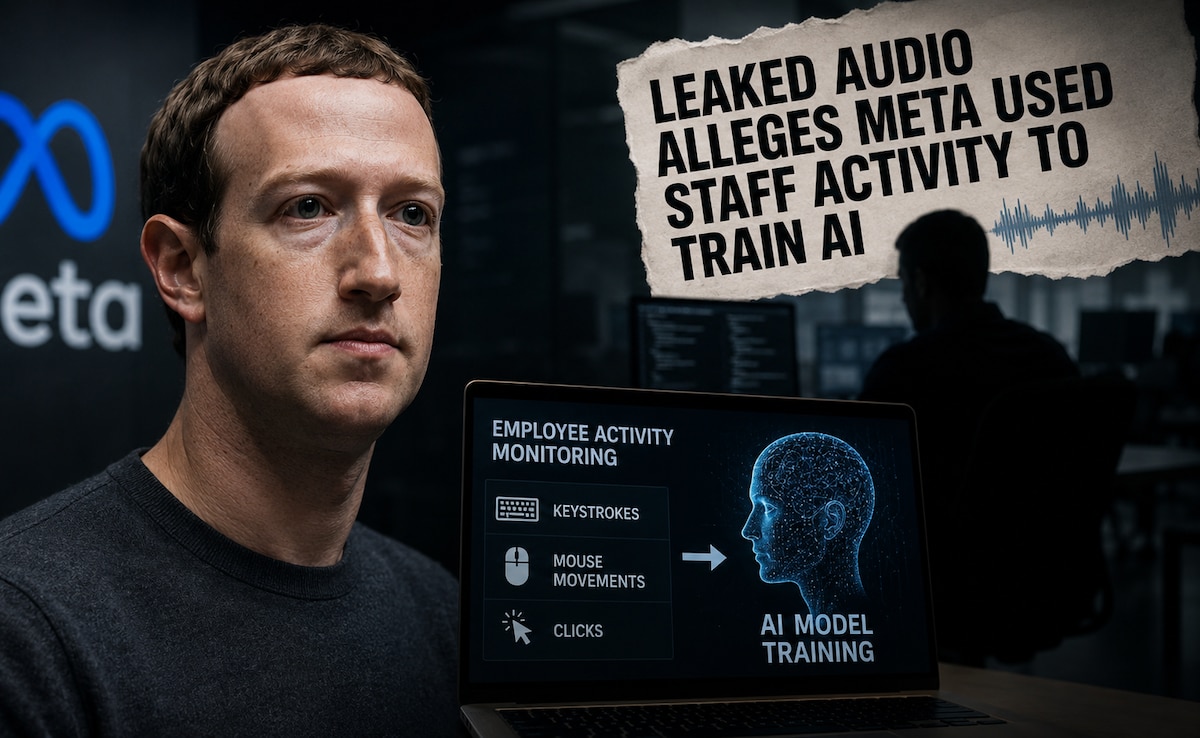
The viral rumor that Meta tracked its most brilliant engineers to train artificial intelligence models right before laying them off is not just a salacious social media conspiracy. It highlights a brutal, structural shift in how Silicon Valley treats human capital. Big Tech companies are actively using the daily work outputs, code repositories, and communication logs of their highest-paid employees to build the automated systems meant to replace them. This process, known as behavioral harvesting, transforms employee expertise into corporate training data, making workers the architects of their own termination.
This goes far beyond standard efficiency tracking or keystroke logging. It represents a fundamental rewrite of the employment contract in the tech sector.
The Mechanics of Enterprise Behavioral Harvesting
Tech companies do not need to plant spyware on laptops to monitor their staff. Every line of code committed to GitHub, every architectural decision documented in internal wikis, and every complex debugging session logged on enterprise servers serves as a high-quality data point. For years, this data was used for peer reviews and project management. Today, it feeds large language models designed to automate software engineering.
Consider how a modern AI coding assistant learns. It does not just read public repositories. It requires specialized, high-level problem-solving examples to master complex enterprise architecture. The daily output of a senior engineer pulling a $500,000 salary is the gold standard of training data. When these engineers solve highly specific infrastructure bugs or optimize databases, they create a step-by-step textbook for an AI.
The corporate incentive is clear. Human engineers are expensive, require healthcare, and demand equity. A fine-tuned model costs a fraction of a cent per query. By capturing the institutional knowledge of top-tier talent, companies build an intellectual property asset that persists long after the employee has been handed a severance package. It is a quiet extraction process that turns active labor into permanent digital infrastructure.
The Feedback Loop that Replaces You
The integration of internal data into corporate AI systems follows a predictable pipeline.
- Ingestion: Internal codebases, Slack discussions, and project roadmaps are indexed and cleaned.
- Fine-Tuning: Models are trained on these proprietary datasets to learn the specific coding style and architecture of the company.
- Evaluation: The AI-generated code is tested against human benchmarks to see where it falls short.
- Replacement: Once the model achieves a specific competency threshold, management adjusts team headcounts downward.
This creates a bizarre environment where working harder and documenting your processes more clearly accelerates the timeline of your own redundancy.
Why General Efficiency Metrics are a Smoke Screen
When tech executives talk about structural efficiency and flattening organizations, they usually point to traditional performance management metrics. They talk about lines of code written, tickets closed, or project shipping velocity. This is a deliberate diversion.
The real value lies in the tacit knowledge—the intuition that tells a veteran developer why a specific system architecture will fail under a heavy load. Historically, this knowledge was safe because it lived entirely inside a human brain. Now, widespread internal documentation mandates and mandatory code commentary requirements serve as a giant vacuum cleaner for this intuition.
"Enterprise software development is no longer just about building a product; it is about documenting the building process so thoroughly that a machine can replicate the logic next quarter."
This shift explains why recent tech layoffs did not just target underperformers. In many waves of corporate downsizing, highly respected, technically brilliant engineers were cut alongside experimental teams. If layoffs were strictly about current productivity, purging top-tier technical talent would make no sense. But if the goal is to transition from a human-heavy operational model to an AI-centric infrastructure, keeping expensive talent around after their workflows have been thoroughly mapped becomes a financial liability.
The Legal and Ethical Gray Zone of Employee Data Ownership
To understand how tech giants get away with this, look at the fine print of standard employment agreements. When an engineer signs an employment contract in Silicon Valley, they routinely sign away all rights to intellectual property created during their tenure. This traditionally meant the company owned the software the engineer built.
Now, companies interpret that ownership to include the behavioral metadata generated while building the software.
[Employee Activity Logs] -> [Internal AI Pipeline] -> [Proprietary Code Model] -> [Staff Reduction]
There are currently no labor laws that prevent a company from using an employee's Slack messages, code reviews, or design documents to train an AI model intended to eliminate that employee's role. Unions in other industries, such as Hollywood, fought bitter battles to prevent studios from using actor likenesses and writer scripts to train generative models. The tech sector enjoys no such protections. Software engineers are largely un-unionized, leaving them entirely exposed to the aggressive optimization strategies of corporate executives.
The defense from leadership is predictable: everything produced on corporate machines belongs to the shareholders. While legally sound, this argument ignores the psychological toll on the workforce. It breeds an environment of deep mistrust, where engineers actively withhold insights, write deliberately obscure code, or minimize documentation to protect their value.
The Long Term Risk to Innovation
This strategy contains a massive, structural flaw that corporate executives are ignoring in their rush to cut costs. AI models are backward-looking. They learn from historical data. They replicate patterns that have already been established by human minds.
By clearing out senior engineering staff and relying on models trained on past work, companies risk locking their technical infrastructure into a permanent state of stagnation. An AI can regenerate variations of the architecture it was trained on, but it cannot invent a fundamentally new paradigm to solve a novel hardware constraint.
The Threat of Model Decay
When human experts are removed from the loop, the internal codebase begins to experience a form of technical debt accelerated by AI generation.
- Loss of Context: The engineers who understood why a system was built a certain way are gone.
- Model Drift: As the codebase evolves via AI generation, subsequent models are trained on AI-generated code rather than human-optimized code, leading to a degradation of quality.
- Inflexible Architecture: The system becomes brittle, unable to pivot when market demands or security environments change.
The immediate financial quarters following a mass layoff always look excellent on paper. Headcount expenses drop significantly, while productivity metrics appear stable because automated systems keep the existing infrastructure running. The real crisis hits two to three years later, when the company needs to build a completely new platform from scratch and realizes there is no one left who knows how to do it.
Survival Strategies for Modern Tech Professionals
The reality of the modern tech workplace demands a tactical shift from employees. Relying solely on technical brilliance is no longer a viable long-term career strategy. If your output can be completely captured by a text editor and an IDE, it can be used to train your replacement.
To maintain relevance, professionals must shift their focus toward roles and responsibilities that require high levels of real-time negotiation, cross-functional orchestration, and physical-world execution. You must become the person who decides what needs to be built, rather than just the person who writes the code to build it.
Diversifying your skill set away from pure execution toward strategic direction is the only way to build a defensive moat around your career. The moment your primary value proposition becomes the volume of high-quality documentation you leave behind, you have already entered the pipeline for automated replacement. Treat your institutional knowledge as currency, and be keenly aware of how, where, and why you distribute it within an enterprise ecosystem.