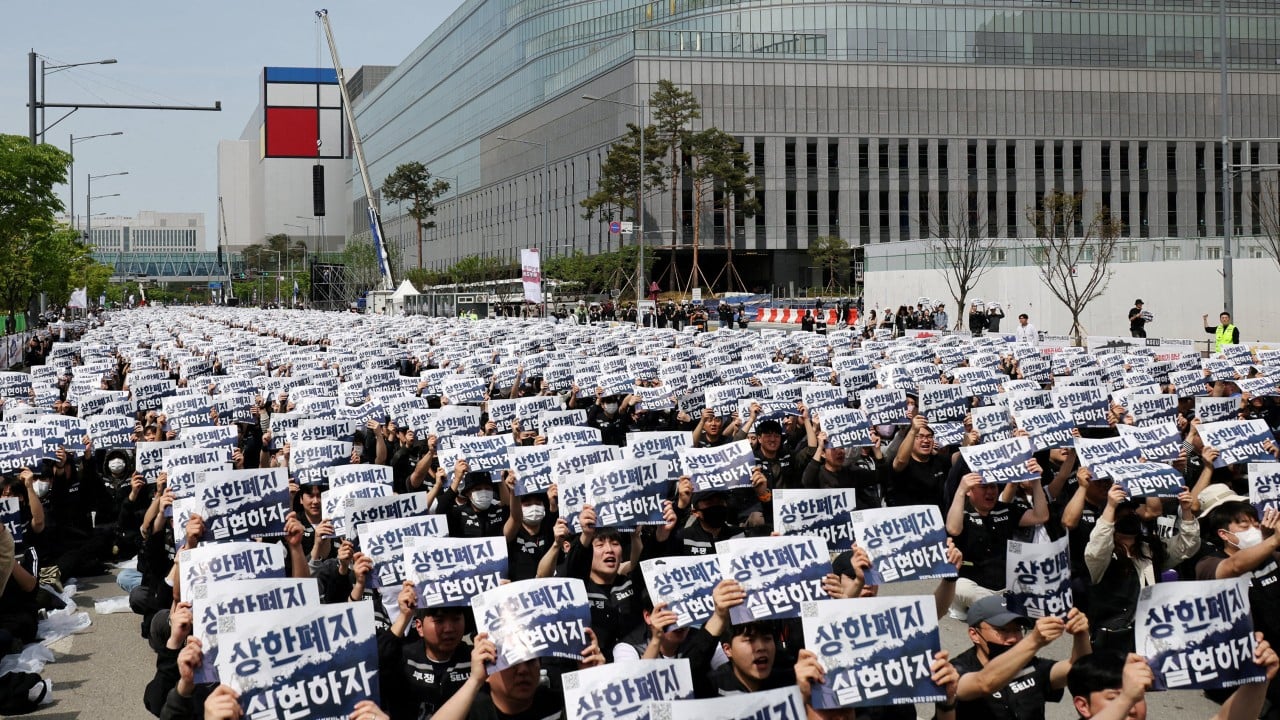
The South Korean government is prepared to deploy a rare, draconian legal mechanism to halt a looming 18-day general strike at Samsung Electronics, fearing a complete paralysis of the global technology supply chain.
Prime Minister Kim Min-seok announced that the state will explore all options, explicitly including emergency arbitration, to block the walkout scheduled for May 21. Under South Korean labor law, this emergency intervention acts as a legal circuit breaker. Once invoked by the labor minister, it strips the union of its right to strike for 30 days, forcing both management and workers into binding state-led mediation. The government’s justification is stark. A single day of shutdown at Samsung’s semiconductor hubs could trigger up to 1 trillion won ($667 million) in immediate losses, with systemic damages potentially ballooning to 100 trillion won if complex, highly sensitive production lines are forced into months of stagnation.
While superficial reporting frames this as a routine corporate wage dispute, the reality is a high-stakes standoff over the spoils of the artificial intelligence boom and a fundamental ideological rift regarding corporate structure.
The Ghost of 2005 and the Nuclear Option
The South Korean state has not touched its emergency arbitration powers in 21 years. The last time Seoul invoked this measure was in 2005, during a crippling strike by pilots at Asiana Airlines. Reviving it now signals absolute desperation within the current administration.
The mechanism itself is aggressive. If the National Labor Relations Commission (NLRC) fails to bridge the gap during the mandatory 30-day cooling-off period, a three-member arbitration committee steps in to draft a binding contract. Neither the executives nor the union can reject it.
Organized labor is already reacting with fierce hostility. The country’s two major umbrella unions, the Korean Confederation of Trade Unions (KCTU) and the Federation of Korean Trade Unions (FKTU), released blistering statements accusing the government of using economic panic to strip workers of their constitutional rights to collective action. By framing a corporate bonus dispute as a national emergency, labor leaders argue that the state is setting a dangerous precedent that effectively outlaws strikes at any major South Korean conglomerate.
Yet, from the state’s perspective, Samsung is not a normal company. It represents roughly 22% of South Korea’s total exports and accounts for more than a quarter of the country’s domestic stock market value. The government’s panic is less about corporate profits and more about a terrifying metallurgical reality inside the fabrication plants.
Why a Semiconductor Halt is Not a Normal Factory Strike
If workers at an automotive assembly plant walk off the line, the machines stop, the chassis sit idle, and production resumes when the shift returns. A advanced semiconductor factory operates on an entirely different physical plane.
Samsung’s facilities in Pyeongtaek and Giheung run hundreds of continuous precision chemical, physical, and lithographic processes. Silicon wafers move through automated tracks over a span of up to five months to become finished memory or logic chips.
[Wafer Input] -> [5 Months of Continuous Chemical/Lithographic Steps] -> [Finished AI Chips]
                        ^
             (Any Stoppage = Instant Ruin of Wafers)
If the power grid fluctuates or the technicians monitoring the cleanrooms walk out, the entire batch of wafers currently inside the multi-billion-dollar machinery is instantly ruined. Contamination or temperature variations kill the delicate circuitry. Prime Minister Kim pointed out that a sudden halt means disposing of every single wafer in progress. Purging the specialized machines, recalibrating the extreme ultraviolet (EUV) lithography equipment, and ramping production back to baseline metrics would take months.
The AI Divide and the Logic Chip Trap
The underlying fury driving the National Samsung Electronics Union (NSEU)—which has seen its registration swell past 43,000 members—stems from how the company plans to distribute its recent financial windfall. Driven by insatiable global demand for high-bandwidth memory (HBM) and enterprise data center infrastructure, Samsung’s first-quarter operating profit for 2026 skyrocketed to 57 trillion won.
The workers want their cut. Specifically, the union demands the removal of the current 50% annual salary cap on bonuses and insists that 15% of the semiconductor division’s total operating profit be funneled directly into an immutable employee bonus pool. Management has countered with a 10% profit-sharing model and a one-time lump-sum payout.
But the deepest corporate fissure is internal. Samsung is attempting a highly unusual, incredibly difficult strategic feat. It wants to remain a one-stop shop for semiconductors. Unlike specialized rivals such as Micron or SK Hynix, which focus primarily on memory, or TSMC, which rules pure-play foundry manufacturing, Samsung wants to do it all. It designs logic chips, manufactures memory, and runs a contract foundry business to build processors for companies like Tesla and Nvidia.
To mollify its workforce after blockbuster quarters, Samsung leadership offered its memory chip employees historic bonuses—upwards of 607% of their base salary—to beat the packages offered by arch-rival SK Hynix. However, executives offered drastically lower bonuses to the 23,000 employees working in the logic chip and contract foundry divisions, which have bled money over consecutive quarters due to yielding challenges and low utilization rates.
The union’s core argument is built on solidarity across these divisions. The engineers and technicians operating the foundry lines work in the exact same physical complexes as their memory-producing peers. They argue that penalizing the logic workforce for broader corporate strategic failures will trigger an exodus of talent to competing firms, completely derailing Chairman Jay Y. Lee’s stated goal to make Samsung the global leader in logic chips by 2030.
Global Fallout and the Loss of Supplier Trust
The timing of this labor crisis could not be worse for South Korea’s geopolitical standing. The American Chamber of Commerce in Korea took the unusual step of issuing an open warning, stating that prolonged labor instability at Samsung would severely dent South Korea’s reputation as a stable, predictable node in the global electronics supply chain.
In the hyper-competitive theater of AI infrastructure, tech giants cannot afford a month-long blip in memory supply. If Samsung’s output of DRAM, NAND flash, or HBM wavers even slightly, spot market prices will spike globally. Major clients will not wait for state mediation to finish; they will immediately reallocate their procurement contracts to alternative suppliers in Taiwan, Japan, and the United States.
The May 18 emergency mediation talks at the National Labor Relations Commission represent the absolute last opportunity for an autonomous resolution. If these talks collapse, the labor minister will likely pull the trigger on emergency arbitration before the May 21 strike deadline.
While that legal maneuver will temporarily keep the cleanroom lights on and freeze industrial action for 30 days, it is a band-aid on a deep, structural wound. Forcing thousands of highly specialized engineers back to work under the threat of state prosecution does not cultivate the obsessive, precision-driven execution required to win a global semiconductor war. It merely delays a systemic reckoning over how the creators of the world's most vital hardware are compensated in the age of artificial intelligence.