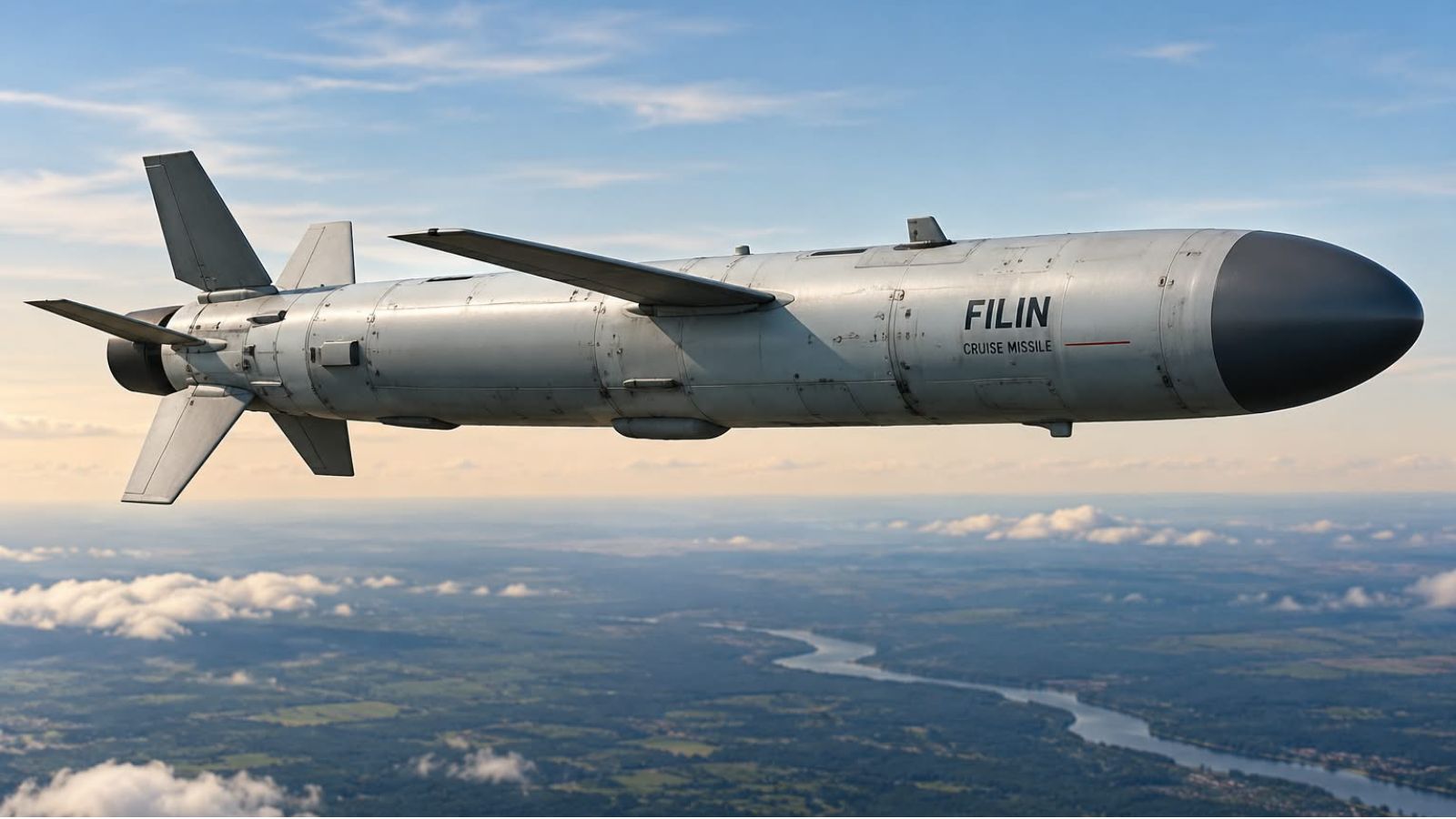
Russia’s Filin is a newly deployed, ground-launched subsonic cruise missile engineered for cheap mass production rather than traditional precision-strike prestige. Ukrainian military experts and drone specialists are sounding the alarm because the weapon bridges a lethal tactical gap. It flies faster and hits harder than Russia’s jet-powered Shahed variants, yet costs a fraction of legacy cruise missiles like the Kh-101. By combining a Russian-built turbojet engine, a 3D-printed composite airframe, and dozens of sanctioned Western and Chinese microchips, Moscow has built an expendable strike weapon designed to bankrupt and overwhelm Ukraine’s air defense network.
First documented on the battlefield in late summer 2026, the Filin represents a quiet doctrinal shift in Moscow’s long-range bombardment campaign. For four years, Russian planners relied on a bifurcated strike model. At the high end sat multimillion-dollar strategic cruise and ballistic missiles—weapons like the Kh-101, Kalibr, and Iskander—capable of carrying massive 400-to-500-kilogram warheads but severely bottlenecked by complex manufacturing and high unit costs. At the low end sat propeller-driven Shahed-136 drones, cheap enough to launch in nightly swarms but slow enough to be hunted down by mobile pickup-truck machine gun teams, electronic warfare units, and interceptor drones.
The Filin erases the middle ground between those two extremes.
Anatomy of an Expendable Cruise Missile
When Ukraine’s Main Directorate of Intelligence (HUR) published an interactive teardown and component database of recovered Filin debris in October 2026, the physical architecture revealed a weapon stripped of every traditional aerospace luxury. Measuring roughly 3.5 meters in length with a 3-meter wingspan and a maximum takeoff weight of just 210 kilograms, the Filin is barely larger than a heavy loitering munition.
Its fuselage is molded from carbon fiber and fiberglass, with internal structural mounts produced via industrial 3D printing. Traditional aerospace manufacturing relies on precision-milled aluminum alloys, specialized tooling, and skilled machinists—all of which create severe production bottlenecks under wartime sanctions. Composite molding and additive manufacturing bypass those choke points entirely. A decentralized network of light industrial workshops can churn out airframe shells without requiring heavy defense-plant infrastructure.
Launch mechanics follow the same philosophy of operational simplicity. Unlike air-launched cruise missiles that require strategic bombers like the Tu-95MS to take off from distant airfields—giving NATO intelligence and Ukrainian early-warning networks hours of advance notice—the Filin is fired from ground-based launch rails using a solid-propellant booster rocket. Once the booster burns out and drops away, a compact turbojet engine takes over for sustained flight.
The payload is modular. Depending on the mission profile and target distance, Russian forces fit the airframe with either a 50-kilogram or 100-kilogram warhead. HUR forensic analysis confirmed three distinct warhead configurations:
- High-explosive fragmentation for soft infrastructure, electrical substations, and exposed troop concentrations.
- Penetrating munitions designed to punch through reinforced concrete roofs and hardened shelters.
- Thermobaric charges engineered to maximize blast overpressure inside enclosed industrial facilities and urban structures.
Why Ukrainian Air Defense Specialists Are Sounding the Alarm
The panic among Ukrainian defense analysts is not driven by wonder-weapon hysteria. It is driven by cold interception math.
Over the past two years, Ukraine built an ingenious, multi-tiered air defense architecture specifically tailored to counter slow-moving drones without depleting scarce Western surface-to-air missiles. Mobile fire groups equipped with heavy machine guns, thermal sights, and anti-aircraft autocannons routinely shredded propeller-driven Shaheds flying at 180 kilometers per hour. Even when Russia introduced jet-powered variants like the Geran-5, Ukrainian interceptor drones and short-range air defenses adapted to target speeds capping out around 370 miles per hour (roughly 600 kilometers per hour).
The Filin breaks that interception envelope. Russian specifications claim a top speed approaching 800 kilometers per hour (nearly 500 mph) and a maximum operational range between 600 and 1,200 kilometers. At 800 kilometers per hour, a Filin crosses a sector in less than half the time of a standard Shahed. Mobile machine-gun teams on pickup trucks have virtually zero chance of acquiring, tracking, and engaging a small composite target moving at high subsonic speed.
Ukrainian drone specialist Serhii Sternenko warned publicly in October 2026 that mass deployment of this class of weapon would make previous jet-Shahed waves look minor by comparison. His colleague, electronic warfare expert Serhii "Flash" Beskrestnov, highlighted another operational headache: deployment flexibility. Because systems in this lightweight category do not require elaborate drone ports or strategic bomber runways, they can be dispersed across mobile ground launchers—and related variants can even be adapted for helicopter or unmanned aerial vehicle (UAV) launch platforms.
Flight profile versatility compounds the detection problem. Intelligence assessments indicate the Filin can hug the terrain at extremely low altitudes to stay beneath ground-based radar horizons, or climb up to 6 kilometers (3.7 miles) to conserve fuel on long-range transits before diving onto its terminal target. Low-flying, low-radar-cross-section composite bodies slip through radar gaps, forcing Ukrainian commanders to make an impossible choice: expend multimillion-dollar Patriot, IRIS-T, or NASAMS interceptors on a cheap composite missile, or let a 100-kilogram warhead slam into critical power grid infrastructure.
The Reynolds R500 Engine and the Physics Reality Check
Beneath the alarmist headlines, however, technical analysts have spotted a critical engineering discrepancy in Moscow’s claims. The Filin is powered by the Russian-made R500 turbojet engine, manufactured by Reynolds LLC—the exact same powerplant previously recovered from Russia’s S-71K Kover and S-71M Monokhrom tactical cruise missiles.
Using a domestically produced turbojet solves a major strategic vulnerability for the Kremlin. Throughout 2024 and 2025, Russia’s jet-drone programs leaned heavily on Chinese commercial micro-turbines, exposing supply lines to export restrictions and customs scrutiny. Bringing propulsion in-house via Reynolds LLC allows Moscow to scale production without begging foreign brokers for jet engines.
Yet physics imposes hard limits on what the R500 can actually deliver. Defense engineering analysts at Defense Express examined the propulsion math and raised a pointed question regarding how a missile powered by the R500 reaches 800 kilometers per hour when the engine’s thrust rating appears insufficient for sustained cruise at that velocity.
In aerodynamic reality, claimed maximum speeds on budget cruise missiles rarely represent sustained sea-level cruise performance. A small turbojet pushing a 210-kilogram airframe with a 3-meter wingspan faces exponential aerodynamic drag at low altitudes where air density is highest. The Filin likely achieves its advertised 800 km/h figure only under specific conditions: flying at high altitude near its 6-kilometer ceiling where thin air reduces drag, during brief terminal dives toward the target, or immediately following solid-booster separation while carrying a lighter 50-kilogram warhead and partial fuel load.
Similarly, maximum range and maximum payload are mutually exclusive. Physics dictates a strict trade-off inside a 210-kilogram takeoff envelope. Carrying the heavy 100-kilogram warhead leaves less internal volume and weight allowance for aviation kerosene, likely pulling effective combat reach closer to the 600-kilometer mark. Stretching the flight out to the full 1,200 kilometers almost certainly requires dropping down to the 50-kilogram warhead configuration and cruising at fuel-efficient altitudes where Ukrainian long-range radar systems can spot the missile hundreds of kilometers out.
Western Silicon Inside a "Domestic" Weapon
While Russian commentators celebrate the Filin as proof of domestic industrial self-reliance, the circuit boards pulled from wreckage tell a very different story. Out of 81 key electronic components cataloged by Ukrainian intelligence inside the missile’s guidance and control suites, 70 were manufactured by foreign companies.
The breakdown exposes the persistent leakage in global dual-use export controls:
- 35 components originated from manufacturers in the United States.
- 22 components came from China.
- 13 components were traced to firms in Japan, Switzerland, Taiwan, and the Netherlands.
Assembled by Russian contractor PLAZ LLC—an entity already linked to the production of Harpy attack drones—these commercial microchips form the missile's entire nervous system. The flight controller, equipment control unit, and inertial navigation system rely on Western and Asian semiconductors. To survive Ukraine’s dense electronic warfare environment, the Filin integrates a Russian 16-channel Kometa CRPA (Controlled Reception Pattern Antenna) module paired with a Chinese inertial navigation unit.
This hybrid guidance architecture is engineered specifically to defeat GPS spoofing and radio jamming. By using a 16-element antenna array, the Kometa receiver can electronically steer reception nulls toward ground-based Ukrainian jammers while locking onto satellite signals overhead. Even if heavy electronic interference blinds the satellite link during the final approach, the Chinese inertial measurement unit calculates dead-reckoning coordinates to guide the warhead into large stationary targets like power plants, rail hubs, or factories.
None of the Western chipmakers sold these parts directly to Moscow. Instead, Russian procurement networks purchase civilian-grade microcontrollers, power regulators, and signal processors through layers of shell companies and transshipment brokers across Central Asia, the Middle East, and East Asia. Because these chips are dual-use commercial items produced by the millions for automotive, industrial, and consumer electronics, choking off supply completely remains virtually impossible.
The Banderol Precedent and the Cost-Exchange Trap
To understand why Ukrainian commanders are treating the Filin as a strategic threat rather than a tactical nuisance, look at what happened with its predecessor, the Banderol.
First observed on the battlefield in spring 2025, the Banderol proved how dangerous commercial-off-the-shelf missile engineering could be. Flying at roughly 435 miles per hour (700 km/h), the Banderol cost an estimated $150,000 per unit—roughly one-sixteenth the price of a $2.4 million Kh-101 cruise missile. Throughout the summer of 2026, Russian forces used frequent Banderol salvos to probe air defense corridors and exhaust Ukrainian interceptor stocks.
The Filin takes that exact economic warfare model and scales up both range and velocity. Even though Ukrainian intelligence has not released a verified unit price for the Filin, its reliance on molded fiberglass, 3D-printed brackets, commercial microchips, and a small non-afterburning turbojet puts it in the same low-six-figure cost bracket.
In modern air warfare, the side that wins the cost-exchange ratio dictates the pace of attrition. Consider a hypothetical salvos scenario: if Russia launches twenty Filin missiles in a coordinated night strike at an estimated production cost of $3 million to $4 million total, Ukraine faces an asymmetric financial trap. Shooting down those twenty targets with Western surface-to-air missiles—where a single PAC-3 Patriot interceptor costs roughly $4 million and an AIM-120 AMRAAM for NASAMS runs over $1 million—burns through tens of millions of dollars in scarce allied munitions in a single night. Allowing them through, meanwhile, inflicts tens of millions of dollars in damage to thermal power plants, transformers, and defense manufacturing sites.
Countermeasures Under Pressure
Ukraine’s air defense command is not standing still, though every available countermeasure carries painful trade-offs.
High-speed interceptor drones—first-person-view and automated quadcopters or fixed-wing hunter-killers that revolutionized anti-Shahed defense—struggle against an 800 km/h target. A battery-powered interceptor drone simply lacks the kinetic energy and closing speed to chase down a turbojet missile unless positioned directly along its flight path with split-second radar cueing.
Directed-energy systems, such as Ukraine’s newly fielded Blysk laser weapon, offer near-zero cost per shot against drones, but atmospheric haze, cloud cover, and short engagement windows limit their effectiveness against fast-moving cruise missiles hugging the treetops.
That leaves Kyiv reliant on three primary defenses against the Filin:
- Expanded electronic warfare grids aimed at overwhelming even 16-channel CRPA antennas through high-power directional jamming near critical infrastructure.
- Legacy radar-guided anti-aircraft guns like the German Gepard and Skynex systems, which use programmable airburst rounds to shred low-flying targets at short range without expending expensive missiles.
- Deep-strike campaigns targeting the production bottlenecks inside Russia—specifically Reynolds LLC’s engine manufacturing facilities and PLAZ LLC’s electronics assembly plants—before the missiles ever reach a launch rail.
The arrival of the Filin proves that Russia has learned how to industrialize austerity. Moscow no longer needs flawless, gold-plated superweapons to threaten deep rear areas; it only needs a steady assembly line of cheap, fast, composite tubes packed with commercial silicon and high explosives—forcing Ukraine and its Western backers to figure out how to shoot down a $150,000 problem without spending $4 million every time the air raid sirens sound.
For a visual breakdown of the intelligence findings and recovered component database, watch the briefing on Putin's New Secretive 'Filin' Cruise Missile With US Tech Twist.


