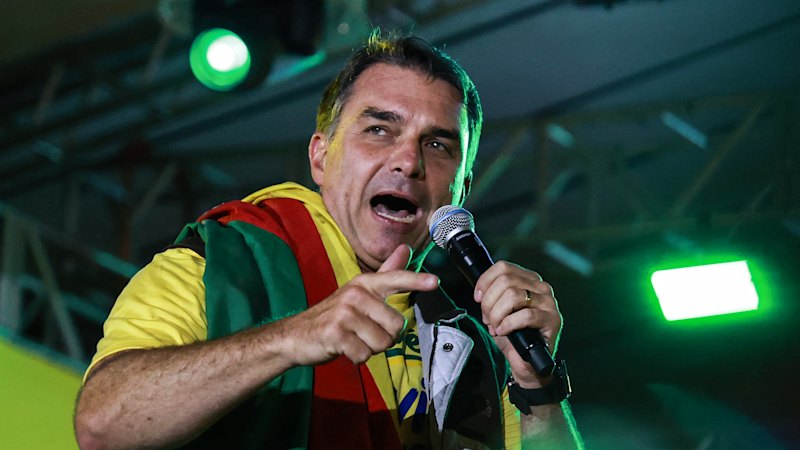
With former Brazilian President Jair Bolsonaro barred from holding public office until 2030 by the Superior Electoral Court, the question of who inherits Brazil’s most potent conservative movement has shifted squarely to his eldest son, Senator Flávio Bolsonaro. While international headlines often fixate on the firebrand rhetoric of his brother Eduardo or the evangelical appeal of former First Lady Michelle Bolsonaro, political insiders in Brasília know the real power play is happening quietly in the Senate. Flávio is positioning himself not as a carbon copy of his father, but as the pragmatic, institutional bridge capable of uniting hardline right-wing voters with Brazil’s traditional political establishment.
To understand why Flávio is emerging as a serious contender for the Planalto Palace, you have to look past the loud rallies in São Paulo and examine the mechanics of power in Brasília. Brazilian presidential politics rarely rewards pure ideological purity over the long haul. Winning the presidency requires a brutal mathematical calculation involving regional political bosses, agricultural lobbying groups, evangelical mega-churches, and the notorious Centrão—the ideological shape-shifters of Congress who trade legislative support for federal budget allocations and cabinet posts.
Jair Bolsonaro spent much of his presidency at war with these very institutions, often governing through crisis and confrontation. Flávio, by contrast, has spent years learning how to speak their language.
The Anatomy of a Dynasty Handover
Political dynasties are hardly a novelty in Latin America, yet the Bolsonaro family’s rapid transition from fringe anti-establishment disruptors to an entrenched political brand is unique. When Jair Bolsonaro rode a wave of anti-corruption fury to victory in 2018, he promised to destroy the "old politics." Within four years, his sons had become the ultimate insiders.
The succession crisis was triggered in June 2023, when Brazil’s Superior Electoral Court (TSE) voted 5-2 to declare Jair Bolsonaro ineligible for office over his baseless attacks on the country’s electronic voting system during a meeting with foreign ambassadors. That ruling created an immediate vacuum on the Brazilian right.
For months, conventional wisdom suggested two paths forward. The first was anointing a loyalist outside the bloodline, most notably São Paulo Governor Tarcísio de Freitas, a former infrastructure minister with strong ties to financial markets and the agribusiness sector. The second was turning to Michelle Bolsonaro, whose charismatic presence on the campaign trail and deep roots within the Pentecostal movement made her an electoral juggernaut among conservative women.
Both options carry massive risks for the Bolsonaro clan. Elevating Tarcísio means surrendering control of the movement to a technocrat who might eventually outgrow his creator. Pushing Michelle forward exposes the family to internal fractures and intense scrutiny over her political inexperience.
Enter Flávio.
Born in 1981, Flávio is the eldest of Jair’s three politically active sons and the first to follow his father into public office, winning a seat in the Rio de Janeiro state legislature in 2002 at just 21 years old. He served four terms there before leaping to the federal Senate in 2018. Unlike his younger brother Eduardo—who thrives on culture-war provocation, gun-rights absolutism, and international networking with conservative figures from Washington to Budapest—Flávio has systematically cultivated a reputation as the family’s dealmaker.
The Senate as an Incubator
In the halls of the National Congress, senators operate on eight-year terms, insulating them from the frantic two-year election cycles of the lower house. This long runway has allowed Flávio to build transactional relationships across party lines that would be unthinkable for his father.
During debates over tax reform, fiscal frameworks, and judicial appointments, Flávio has consistently adopted a softer, more conciliatory tone than the broader Bolsonarista base. When hardliners demanded scorched-earth opposition to President Luiz Inácio Lula da Silva’s administration, Flávio frequently opted for quiet negotiations behind closed doors. He understands a fundamental truth of Brazilian governance that his father learned too late—you cannot govern Brazil from the balcony of the presidential palace while throwing rocks at the Supreme Federal Court and Congress simultaneously.
Why Financial Markets and the Centrão Are Watching Flávio
If you talk to investment bankers on São Paulo’s Faria Lima Avenue, their first choice for a right-wing candidate remains Tarcísio de Freitas. They view him as predictable, market-friendly, and free of the Bolsonaro family’s legal baggage. However, political analysts in Brasília recognize that Tarcísio’s path to the nomination runs entirely through Jair Bolsonaro’s blessing. Without the former president’s active endorsement, no conservative candidate can capture the roughly 30 percent of the electorate that forms the unshakeable Bolsonarista floor.
If Jair insists on keeping the presidential ticket inside the family, Faria Lima and the Centrão must decide which Bolsonaro they can live with.
- Eduardo Bolsonaro represents too much volatility. His confrontational style toward the judiciary and international trading partners like China—Brazil’s largest buyer of soybeans and iron ore—makes corporate elites nervous.
- Carlos Bolsonaro, a Rio de Janeiro city councilor and the architect of the family’s aggressive social media strategy, has zero interest in legislative compromise or executive administration.
- Michelle Bolsonaro commands massive crowds, yet business leaders question her grasp of macroeconomic policy and fiscal discipline.
Flávio, however, presents a recognizable profile to Brazil’s power brokers. He favors orthodox economic policies, deregulation, and privatization, aligning closely with the agenda pushed by former Economy Minister Paulo Guedes. More importantly, leaders of the Centrão know they can sit down with Flávio over coffee, divide up ministry budgets, and strike a deal that holds.
This predictability is his greatest asset. In a country exhausted by years of institutional brinkmanship, Flávio is quietly selling himself as Bolsonarismo without the chaos—a candidate who can deliver the social conservatism and pro-market reforms the right wants without triggering daily constitutional crises.
The Shadow of the "Rachadinha" Scandal
Any serious assessment of Flávio Bolsonaro’s presidential viability must confront the massive legal and reputational vulnerability hanging over his head. You cannot analyze his rise without examining the rachadinha scandal—a traditional Brazilian political corruption scheme in which lawmakers hire phantom staffers and force them to kick back a portion of their taxpayer-funded salaries.
Following the 2018 election, investigators from the Rio de Janeiro Public Prosecutor's Office uncovered suspicious financial transactions involving Fabrício Queiroz, a former police officer, longtime friend of Jair Bolsonaro, and top aide in Flávio’s state legislative office. Bank records flagged by Brazil’s financial intelligence unit revealed millions of reais moving through Queiroz’s accounts in patterns consistent with salary kickbacks, alongside deposits flowing directly into the accounts of Michelle Bolsonaro and payments covering personal expenses for the family.
Prosecutors formally charged Flávio with running a criminal organization, embezzlement, and money laundering, alleging that the diverted funds were laundered through a high-end chocolate franchise Flávio co-owned in a Rio shopping mall and through profitable real estate transactions.
Flávio consistently denied all wrongdoing, framing the investigation as a politically motivated witch hunt designed to weaken his father’s presidency. Ultimately, the criminal case collapsed on procedural grounds rather than an exoneration on the merits. Higher courts threw out key evidence after ruling that investigators had obtained financial intelligence reports improperly without prior judicial authorization, effectively gutting the prosecution.
Why the Scandal Still Matters
Legally, Flávio walked away unscathed. Politically, the scars remain deeply embedded in the public consciousness.
For middle-class swing voters in Brazil’s populous southeast—the exact demographic that swung back to Lula in 2022 after backing Jair Bolsonaro in 2018—corruption was the defining issue that brought the Bolsonaro family to power. Jair’s entire brand rested on being an incorruptible outsider cleaning up a rotten system. The image of his eldest son buying luxury mansions in Brasília worth nearly six million reais while fielding questions about phantom employees shattered that narrative for millions of moderate voters.
In a hypothetical general election matchup, opposition campaigns would relentlessly hammer Flávio with the details of the Rio investigation. Unlike his father, who could deflect criticism by pointing to his own spartan personal lifestyle, Flávio’s wealth and real estate portfolio make him an easy target for populist attacks from the left.
The Internal Friction Inside the Right
Even if Flávio manages to neutralize his legal baggage, he faces a treacherous path before even reaching a general election ballot. The Brazilian right is no longer a monolith controlled solely by the Bolsonaro surname.
Over the past several years, powerful regional governors have built their own independent bases of support. Alongside Tarcísio de Freitas in São Paulo, figures like Ronaldo Caiado in Goiás, Romeu Zema in Minas Gerais, and Ratinho Júnior in Paraná all harbor national ambitions. These governors represent Brazil’s economic engine—the wealthy agricultural and industrial heartland—and many believe the conservative movement needs to move beyond the Bolsonaro family to win back the political center.
This creates a delicate standoff. If Jair Bolsonaro endorses Flávio, these governors face a difficult choice. Running against the Bolsonaro machine splits the conservative vote, virtually guaranteeing victory for the Workers' Party (PT) candidate. Yet falling in line behind Flávio means surrendering their own presidential aspirations to a candidate carrying heavy rejection rates among independent voters.
Furthermore, there is the question of Jair Bolsonaro himself. Veteran observers of Brazilian politics know that the former president is notoriously reluctant to share the spotlight, even with his own children. Anointing a successor—whether a governor or a son—requires Jair to accept that his own political career as a candidate is permanently finished. For a leader whose entire political identity is built around personal loyalty and messianic appeal, handing over the keys to the movement is an agonizing step.
How Flávio Is Playing the Long Game
Aware of these competing pressures, Flávio has avoided declaring an open candidacy too early, a move that would invite immediate sabotage from rival conservative camps and relentless scrutiny from the press. Instead, he is executing a patient, multi-track strategy designed to make himself the default option when the dust settles.
First, he has positioned himself as the primary guardian of his father’s political legacy and legal defense. Whenever Jair faces new inquiries from the Federal Police or the Supreme Court, Flávio acts as the family’s chief spokesperson, projecting calm defiance while quietly lobbying senators to push back against what the right views as judicial overreach.
Second, he is actively courting the evangelical leadership. While Michelle Bolsonaro enjoys natural affinity with Pentecostal pastors, Flávio has used his legislative leverage in the Senate to champion bills blocking abortion expansion, opposing drug decriminalization, and protecting religious tax exemptions. He knows that in Brazil, evangelical endorsements are not won merely through emotional speeches at megachurches; they are secured through concrete legislative delivery in Brasília.
Third, he is working to lower the temperature with the judiciary. Behind the scenes, Flávio has maintained open channels of communication with several justices on the Supreme Federal Court—the very institution his father’s supporters regularly threaten to shut down. By signaling that a Flávio presidency would respect institutional boundaries rather than wage endless war against the courts, he is attempting to remove the single biggest obstacle standing between his family and the establishment.
The Structural Reality of Brazilian Elections
To understand whether this strategy can actually work, you have to look at the structural math of a Brazilian presidential race. Elections in Brazil are decided in two rounds. In the first round, candidates fight to consolidate their ideological base and finish in the top two. In the second round, everything comes down to rejection rates.
In 2022, Jair Bolsonaro lost to Lula by less than two percentage points—roughly two million votes out of more than 124 million cast. He did not lose because his base abandoned him; he lost because his personal rejection rate among moderates, women, and low-income voters in the northeast was simply too high to overcome.
Flávio’s entire pitch to the political establishment rests on the calculation that he carries the Bolsonaro floor without the Jair ceiling. By keeping the family surname, he retains automatic access to the tens of millions of conservative voters who view the Bolsonaro movement as an article of faith. By adopting a more measured, institutional demeanor, he hopes to shave off just enough of his father’s rejection rate among centrist voters to flip those crucial two percentage points in a runoff.
Yet politics is rarely a clean arithmetic exercise. Carrying the Bolsonaro name brings automatic polarization. Voters who despise Jair Bolsonaro will not suddenly view Flávio as a harmless moderate simply because he wears a tailored suit and speaks softly in Senate committee hearings. At the same time, diluting the raw, anti-system anger that fueled his father’s rise risks dampening enthusiasm among the hardcore base that turns out on election day.
The Ultimate Test of the Bolsonaro Brand
Brazil’s conservative movement stands at a crossroads that every populist movement eventually faces—how to survive the removal of its charismatic founder. History across Latin America shows that personalist movements rarely transfer smoothly from one leader to another, even within the same bloodline.
Flávio Bolsonaro has spent twenty years preparing for this exact moment, methodically transforming himself from a young state assemblyman riding his father’s coattails into a seasoned senator fluent in the dark arts of Brasília power brokering. He has the surname, the institutional foothold, and the strategic patience to outmaneuver louder rivals on the right.
Whether that combination is enough to carry him to the Planalto Palace depends on a single unresolved question—whether Brazilian voters want a quieter, smoother version of the Bolsonaro era, or whether they are ready to turn the page on the family altogether.