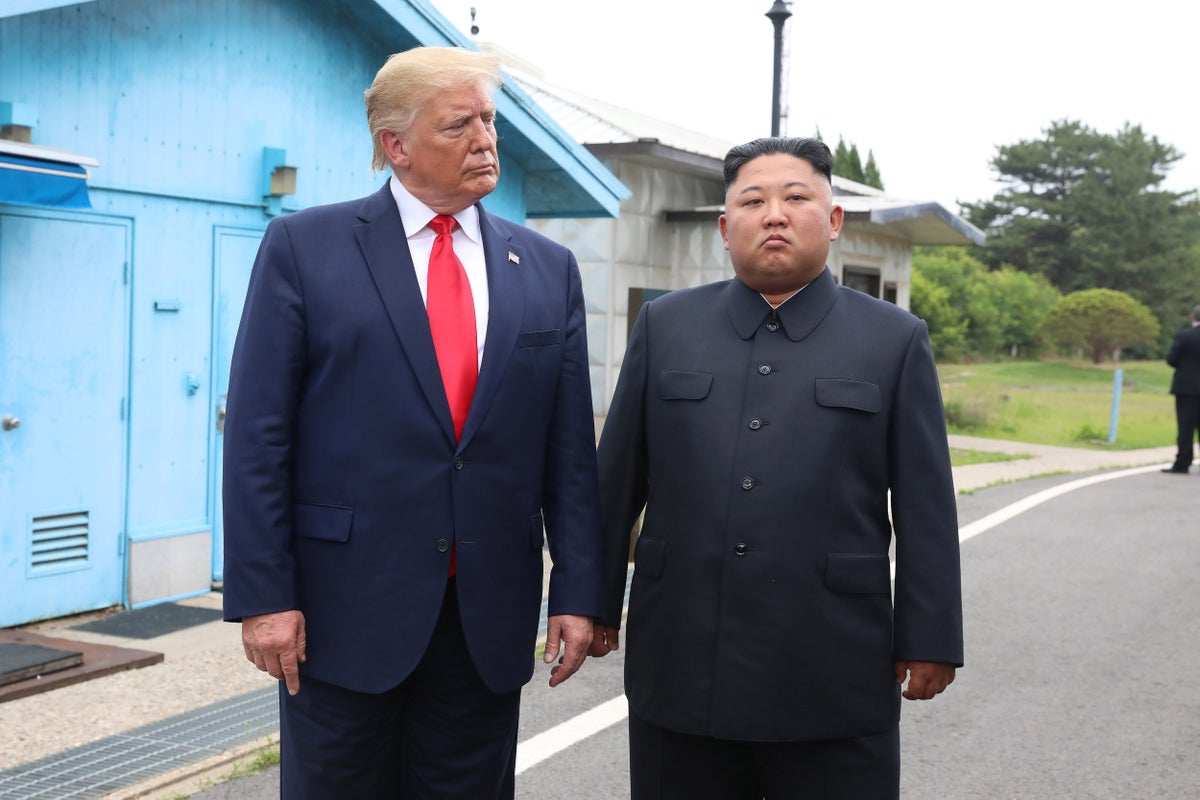
North Korea rejected renewed diplomatic overtures from Washington by branding U.S. calls for denuclearization as pointless, exposing a deep chasm between White House ambitions and the military reality on the Korean Peninsula. Pyongyang's state media dismissed American demands as an unchanging hostile policy, directly rebuffing efforts to restart high-level summits. This latest diplomatic freeze follows U.S. President Donald Trump's public statements referencing an arsenal of 57 nuclear warheads alongside a directive to scale back joint military drills with South Korea. Rather than welcoming these concessions, Kim Jong Un's regime answered with short-range ballistic missile tests and a sweeping military leadership reshuffle, signaling that the price for dialogue has moved far beyond what Western policymakers are prepared to offer.
To understand why Pyongyang treats these diplomatic openings with contempt, one must examine the structural transformation of North Korea's military command over the past several years. Western analysts frequently misinterpret North Korean rhetoric as mere posturing designed to extract food or fuel aid. That framework expired long ago. The regime has systematically modernized its nuclear delivery systems, incorporating tactical nuclear weapons, submarine-launched capabilities, and dispersed command structures designed to survive a first strike. When Washington dangles the prospect of a summit while simultaneously maintaining a formal policy of complete denuclearization, Pyongyang views the dual-track approach as an irreconcilable contradiction. From the perspective of the Workers' Party of Korea, any conversation that begins with the premise of surrendering their primary constitutional deterrent is a non-starter.
The friction is magnified by the growing discomfort in Seoul. South Korean policymakers find themselves cornered by Washington's transactional approach to security guarantees. When the White House unilaterally curtails major exercises like Ulchi Freedom Shield to court Pyongyang, it sends shockwaves through the security architecture of East Asia. Conservative lawmakers in Seoul have openly revived debates about acquiring independent nuclear capabilities, terrified that Washington might eventually settle for a freeze-and-reduction arrangement that leaves South Korea under the shadow of an officially recognized nuclear-armed neighbor.
Consider a hypothetical scenario where two opposing business partners attempt to negotiate a merger while one insists the other must destroy its core product line before entering the boardroom. The talks stall instantly. That is the exact impasse defining modern U.S.–North Korea relations. Washington wants a verifiable rollback, while Pyongyang operates under the immutable assumption that its nuclear inventory is non-negotiable state property. By publicly quantifying the adversary's stockpile at 57 warheads, the White House inadvertently crossed an analytical Rubicon, treating a proliferated state as a baseline mathematical reality rather than an illegal anomaly slated for eradication.
This shift creates a dangerous convergence with Beijing's regional strategy. China has long prioritized stability on its border above all else, fearing that a collapsed North Korea would trigger a humanitarian catastrophe and place a unified, U.S.-aligned Korea directly on its frontier. While Beijing officially subscribes to the goal of denuclearization, its actions point toward quiet management of the existing nuclear status quo. When American presidents signal a willingness to bypass traditional alliance protocols for the sake of personal diplomacy, they play directly into Beijing's hands, hollowing out the international sanctions regime and normalizing North Korea's permanent place in the nuclear club.
Beneath the diplomatic theater, structural realignments inside Pyongyang tell the true story. The recent dismissal of Defense Minister No Kwang Chol and the elevation of hardline military planners indicate a regime tightening its belt for long-term strategic competition. North Korea is not preparing to bargain away its hard-won deterrent for temporary sanctions relief. The state has codified its nuclear status into its constitution, restructured its tactical command authorities to ensure decentralized retaliation capabilities, and thoroughly insulated its domestic audience against economic coercion.
Expectations of a diplomatic breakthrough in the coming months ignore these structural barriers. As trilateral security drills between the United States, South Korea, and Japan proceed, Pyongyang will continue to test advanced delivery systems to demonstrate the futility of American pressure. The strategic deadlock persists because the core premise driving Western policy—that isolation and pressure will eventually force a sovereign regime to commit strategic suicide—flies in the face of every observed data point from the past three decades
North Korea fires short-range ballistic missiles hours after Trump said he'd meet with Kim Jong Un
This video provides valuable context on the immediate tactical reactions and expert analysis surrounding North Korea's missile tests following high-level diplomatic overtures.
http://googleusercontent.com/youtube_content/1


