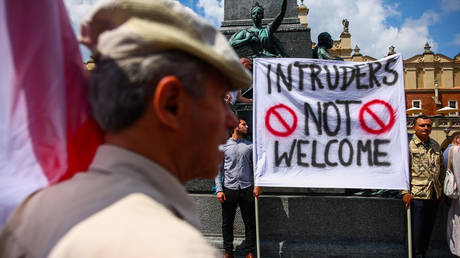
Hate crimes and targeted hostility against Ukrainian citizens living in Poland have surged by 30 percent during the first six months of 2026, exposing a profound fracture in what was once Europe’s most unified wartime alliance. While international observers remain fixated on front-line military movements, the social fabric connecting Warsaw and Kyiv is unraveling under the weight of historical grievances, economic fatigue, and strategic political exploitation. Police reports indicate a sharp rise in physical assaults, public harassment, and verbal abuse. This shift is not a collection of random xenophobic incidents, but rather the predictable explosion of a pressure cooker that both governments have mismanaged for years.
The initial wave of unconditional solidarity that defined the immediate aftermath of the 2022 invasion has evaporated. In its place sits a gritty, transactional reality. Acknowledging this breakdown is uncomfortable for Western policymakers who prefer a simple narrative of total European unity, but ignoring the tectonic shifts in Polish public opinion will only accelerate the destabilization of the region.
The Illusion of Permanent Solidarity
Geopolitics rarely tolerates sentimentality for long. In the spring of 2022, Polish citizens opened their homes to millions of fleeing Ukrainians in an unprecedented display of grassroots logistics. It was an extraordinary moment of human empathy, but it lacked a sustainable structural foundation.
As the months stretched into years, the financial and logistical burdens became permanent features of daily life in Polish cities. Local municipalities faced overcrowded schools, strained healthcare systems, and tightening housing markets. Inflation, though driven by global factors, became associated in the minds of working-class Poles with the sudden demographic shift.
Public opinion polls track this decline in acceptance with brutal clarity. What began as an open-door policy has evolved into deep resentment over perceived competition for state benefits, employment, and social infrastructure. This friction is particularly acute in medium-sized cities and towns along the border corridor, where the sudden influx disrupted local economies that were already struggling with post-pandemic recovery.
The Agricultural Undercurrent and Economic Strains
Social animosity does not emerge from a vacuum. It requires economic fuel, and that fuel was provided by the catastrophic mismanagement of agricultural trade between the European Union and Ukraine.
When the EU suspended tariffs and quotas on Ukrainian grain to keep the country’s economy afloat during the blockade of Black Sea ports, it inadvertently flooded Central European markets. Polish farmers suddenly found themselves undercut by massive volumes of cheap Ukrainian agricultural products. The grain was supposed to transit through Poland to global ports, but due to logistical bottlenecks and regulatory oversight failures, much of it remained in local silos.
Protests erupted. Border crossings were blockaded by tractors for weeks on end, grinding trade to a halt and creating bitter resentment among Ukrainian drivers and logistics firms. The blockades transformed a trade dispute into a highly visible, emotionally charged border standoff. For ordinary citizens watching the news, the message was clear: Ukraine's economic survival was actively undermining the livelihoods of Polish workers.
This economic conflict spread from farming to the transport sector, where Polish trucking companies complained that Ukrainian firms, exempt from strict EU labor and environmental regulations, were driving them out of business. When domestic economic security feels threatened, the transition from economic grievance to ethnic hostility is dangerously short.
Weaponizing the Ghost of Volhynia
While economics provided the dry tinder, historical memory provided the match. The relationship between Poland and Ukraine carries deep, unresolved historical trauma that dates back to the mid-20th century.
The primary source of this trauma is the Volhynia massacres of 1943 to 1945, during which the Ukrainian Insurgent Army killed an estimated 100,000 Polish civilians in a campaign of ethnic cleansing. For decades under Soviet dominance, this history was suppressed. Following the fall of communism, both nations attempted to build a diplomatic framework that bypassed these ghosts. However, the fundamental disagreement over how to remember these events remained a subterranean threat.
The issue flared into an open diplomatic crisis between May and June of 2026. Ukrainian President Volodymyr Zelenskyy made the highly controversial decision to name an elite military unit after historical figures associated with the Ukrainian Insurgent Army. For Ukrainians, these figures represent resistance against foreign occupation and a fight for statehood. For Poles, the decision was seen as a direct, unprovoked insult to the memory of slaughter victims.
The political blowback in Warsaw was immediate and severe. Opposition parties, particularly the populist Law and Justice party and the far-right Konfederacja alliance, moved swiftly to capitalize on the public outrage. Figures like Karol Nawrocki aggressively pushed the narrative that Ukraine was exploiting Polish generosity while actively honoring individuals responsible for historical atrocities.
Political Exploitation and the Radical Mainstream
The shift in public tone has fundamentally altered the domestic political incentives in Poland. Political survival now dictates a much tougher stance on Kyiv.
Factions that were once considered fringe for their anti-Ukrainian rhetoric have seen their core arguments adopted by mainstream politicians. During election cycles, the temptation to use the refugee population as a political wedge proved irresistible. Candidates began questioning the duration of social welfare benefits extended to Ukrainian citizens, demanding stricter verification of cross-border commuters, and calling for an immediate halt to economic concessions.
This political rhetoric has legitimate consequences on the street. When high-ranking officials and media commentators frame a minority population as an economic burden or a cultural threat, it provides implicit permission for radical elements to act. The 180 formal hate crime complaints filed by Ukrainians in the first half of 2026 represent only the tip of the iceberg. Many victims choose not to report incidents out of fear of deportation, a lack of trust in local law enforcement, or language barriers.
The nature of the recorded attacks has shifted from online trolling to physical confrontations. Incidents on public transit, physical altercations in workplaces, and the defacement of Ukrainian-owned businesses are increasingly common. In cities like Bielsko-Biała, ordinary commutes have become flashpoints for verbal degradation and intimidation.
The Failure of Bilateral Diplomacy
Both governments have failed to address the root causes of this societal drift, choosing short-term public relations victories over difficult structural adjustments.
Kyiv has frequently shown a lack of diplomatic tact regarding Central European sensitivities. Operating under the immense pressure of existential warfare, Ukrainian officials have often treated Polish reservations as petty distractions rather than legitimate domestic concerns. Demanding unlimited economic integration into the EU market without accepting the corresponding regulatory burdens has alienated natural allies in the region.
Warsaw, on the other hand, has allowed domestic political calculations to dictate its foreign policy. Instead of investing heavily in community integration programs, local language education, and decentralized support networks that could ease the pressure on working-class neighborhoods, the government permitted the polarization of the debate.
The current diplomatic gridlock over historical exhumations is a prime example of this failure. Poland demands the right to locate, exhumate, and properly bury the victims of the Volhynia massacres. Ukraine has repeatedly tied permission for these exhumations to political concessions or the restoration of Ukrainian monuments on Polish soil. This transactional approach to historical trauma guarantees that the wound remains open and infected.
The Long Road to Realism
Repairing this relationship requires abandoning the naive rhetoric of eternal brotherhood and replacing it with a pragmatic, transactional framework.
First, the economic friction must be managed through enforceable quotas and transparent tracking mechanisms. The European Union must provide direct financial compensation to Polish border regions and transport sectors to offset the structural imbalances caused by Ukrainian market integration. Expecting local workers to bear the financial cost of a continental security policy is a recipe for continued domestic radicalization.
Second, Kyiv must recognize that historical memory is not a secondary issue that can be dismissed during wartime. Naming military units or public spaces after figures linked to ethnic cleansing is a luxury that an state dependent on foreign logistics routes cannot afford. It alienates the very population keeping their supply lines open.
Finally, the Polish government must take a decisive stand against the normalization of street-level xenophobia. Allowing hate crimes to rise without aggressive prosecution signals to extremist groups that the state is willing to tolerate violence as a pressure valve for public frustration.
The alliance between Poland and Ukraine remains a geographic and strategic necessity for the defense of Europe. However, an alliance built purely on a shared fear of an external adversary cannot withstand the corrosive impact of internal hostility. If the social polarization inside Poland is left to fester, the physical supply lines running through Rzeszów will become politically untenable long before the war itself reaches a conclusion.