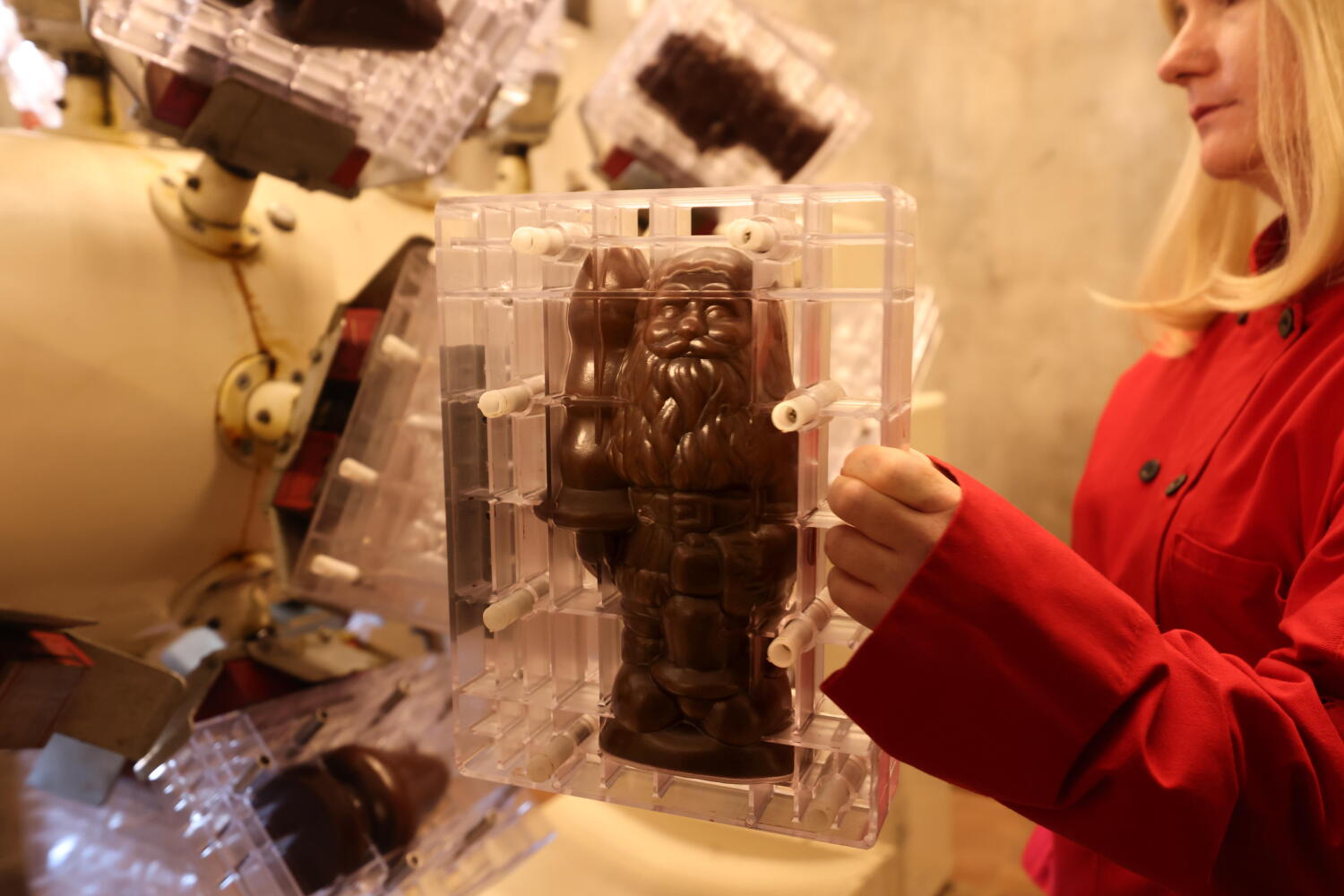
Walk into a traditional holiday pop-up in Los Angeles and you expect peppermint bark, manicured photo booths, and sanitized nostalgia. Walk into Paul McCarthy’s Chocolate Factory installation, and you are confronted with an industrial assembly line churning out chocolate sculptures of Santa Claus gripping butt plugs, accompanied by visceral video projections and live, grueling endurance performances. For decades, McCarthy has dismantled American corporate mythology from the inside out, and his L.A. iteration of the Chocolate Factory turns the most commercialized season of the year into a sticky, pungent critique of consumer desire, factory labor, and infantile regression.
The premise sounds like pure shock value until you look at the mechanics of the room. McCarthy is not merely trying to make gallery-goers blush; he is exposing the thin line between holiday consumption and bodily compulsion. By replacing high-art marble and bronze with industrial-grade dark chocolate—a material that melts under body heat, smells overwhelmingly sweet, and visually mimics excrement—the veteran California artist forces audiences to confront what they actually swallow when they buy into festive corporate spectacle.
The Architecture of Industrial Excess
To understand why the Paul McCarthy Chocolate Factory hits harder in Los Angeles than in its earlier European iterations, you have to look at the geography of the entertainment industry. Los Angeles is the global headquarters of manufactured fantasy. Just miles away from Hollywood soundstages and theme park backlots, McCarthy constructs a working, chaotic factory floor that mimics the assembly lines of Walt Disney and Willy Wonka while stripping away every ounce of wholesome magic.
The installation operates as a fully functioning, albeit deliberately dysfunctional, production facility. Industrial tempering machines hum continuously. Stainless steel tables groan under the weight of silicone molds. Performers dressed in stained aprons, grotesque prosthetic masks, and oversized Santa suits pour, demold, and stack hollow chocolate figurines in real time.
It is exhausting to watch. It is even more exhausting to perform.
Unlike a static museum exhibition where objects sit safely behind stanchions, the Chocolate Factory is an active endurance piece. The smell hits you before you even cross the threshold—a thick, cloying wave of cocoa butter and sugar that turns nauseating after twenty minutes. That sensory overload is entirely intentional. McCarthy has spent over forty years weaponizing visceral, bodily materials—ketchup, mayonnaise, raw meat, motor oil, and chocolate—to bypass the viewer’s intellectual defenses. You cannot stand back and analyze the brushwork when the room smells like a melting candy bar and performers are aggressively smearing chocolate across Plexiglas walls.
Why Chocolate Works as Subversion
In the art market, permanence equals value. Collectors pay millions for cast bronze, welded steel, and oil on linen because those materials survive intact. Chocolate is the exact opposite. It blooms, cracks, sweats, and degrades when exposed to studio lights and human warmth.
- Sensory Manipulation: Chocolate triggers immediate neurochemical responses tied to comfort, childhood reward, and indulgence. Pairing that biological pleasure trigger with transgressive imagery creates acute cognitive dissonance.
- Scatological Resonance: Visually, melted brown chocolate on white surfaces reads immediately as fecal matter, tapping into Freudian associations between infantile development, control, and filth.
- Planned Obsolescence: The sculptures produced on the L.A. factory floor are literally consumable commodities, mocking the scarcity models that drive contemporary art auctions.
Sexual Innuendo as a Blunt Instrument
Mainstream coverage often fixates on the sexual innuendo embedded in McCarthy’s holiday iconography, particularly his recurring "Tree" and "Santa" motifs—figures that blur the silhouette of a Christmas pine or a jolly gift-giver with that of a sex toy. When McCarthy erected a massive inflatable version of his Tree sculpture in Paris’s Place Vendôme in 2014, vandals deflated it within days and assaulted the artist in the street. That public outrage proved his point better than any critical essay ever could.
In the L.A. Chocolate Factory, those same forms are miniaturized, mass-produced, and placed directly on the assembly line. Yet calling McCarthy’s work "innuendo" is almost a misnomer. Innuendo relies on coyness, double entendre, and polite concealment. McCarthy deals in blunt, unapologetic collision. He takes the paternal figure of Santa Claus—an archetype invented and standardized largely by twentieth-century American advertising—and fuses him with overt emblems of adult fetish and taboo.
The friction comes from watching the mechanics of childhood innocence collide with adult repression. American holiday culture demands relentless, mandatory cheer. It asks adults to regress into wide-eyed consumers who believe in benevolent bearded patriarchs delivering rewards from the North Pole. McCarthy’s performers enact that regression literally, stumbling around the factory floor with exaggerated physical clumsiness, babbling, grunting, and treating the chocolate figurines with a mixture of manic devotion and violent frustration.
Inside the Performance Engine
The true backbone of the installation is not the sculpture; it is the performance art happening inside the space. McCarthy came out of the late-1960s and 1970s Los Angeles performance scene alongside peers like Chris Burden and Bruce Nauman, an era when artists used their own bodies as the primary medium to test physical and psychological limits.
In the Chocolate Factory, McCarthy acts less like a traditional painter and more like a film director running an unscripted, multi-camera shoot on a soundstage. Performers follow loose scores rather than rigid scripts. They repeat mundane factory tasks—pouring liquid chocolate, trimming seams, wrapping finished Santas in foil—until fatigue sets in and the movements break down into slapstick chaos.
The Mechanics of Repetition and Breakdown
Watch the floor long enough and a clear structural rhythm emerges:
- The Routine: Performers execute precise culinary and manufacturing steps, establishing the illusion of an efficient commercial enterprise.
- The Friction: Small mistakes accumulate. Molds overflow, chocolate splatters onto costumes, and props get knocked to the floor.
- The Rupture: Instead of cleaning up, performers lean into the mess, abandoning factory discipline for manic, physical improvisation that smears the boundary between worker, product, and waste.
Video monitors and large-scale projections line the perimeter of the gallery, broadcasting raw, unedited footage from earlier performance sessions alongside live feeds from cameras mounted inside the workspace. The viewer is caught in a feedback loop. You watch live performers making objects while simultaneously watching recorded versions of the same characters committing far darker, more chaotic acts on screen. The gallery becomes a hall of mirrors reflecting Hollywood’s obsession with production, surveillance, and behind-the-scenes spectacle.
The Economics of Selling Critique
Here is the uncomfortable gray area that every serious critic has to confront when covering Paul McCarthy: the art market loves anti-capitalist satire, provided it comes with a certificate of authenticity.
McCarthy’s Chocolate Factory is undeniably a blistering indictment of American consumerism, corporate branding, and the commodification of holiday joy. At the same time, it is staged within the upper echelons of the blue-chip gallery system, backed by institutional powerhouses like Hauser & Wirth and frequented by collectors, celebrities, and cultural insiders. During certain iterations of the project, visitors could even purchase the chocolate Santas straight off the line—turning gallery attendees into literal consumers of the critique itself.
Does participating in the luxury art economy neutralize the rebellion? Not entirely, though it complicates it. McCarthy has never pretended to operate outside the system. Unlike street artists or underground collectives who reject institutional validation, McCarthy uses the vast financial and spatial resources of mega-galleries to build environments on an industrial scale that independent spaces could never afford. He takes collector money and spends it on tons of Belgian couverture chocolate, custom silicone molds, multi-channel video rigs, and weeks of paid performance labor.
The tension is baked into the experience. When a wealthy collector buys a residual video piece or a preserved resin cast from a show that mocks mindless consumption, the joke cuts both ways. McCarthy holds up a mirror to the room, and nobody—not the artist, not the gallery, and certainly not the audience—walks out completely clean.
Why Los Angeles Makes It Essential
New York’s art world often prizes cool intellectual distance, irony, and clean conceptual minimalism. Los Angeles has always favored the grotesque, the theatrical, and the physically visceral. From Ed Kienholz’s claustrophobic tableaux to Mike Kelley’s stuffed-animal assemblages, Southern California art history is deeply rooted in excavating the dark subconscious of suburban American fantasy.
McCarthy’s L.A. Chocolate Factory sits squarely at the center of that lineage. Situated in a city built on illusion, plastic surgery, theme parks, and studio backlots, the installation strips away the polished veneer of the dream factory and forces you to stare at the messy, sugary, sweat-soaked machinery underneath. You leave the building with the smell of cocoa clinging to your clothes, unsure whether you just witnessed a profound critique of late-stage capitalism or an elaborate, high-budget prank—and knowing that for Paul McCarthy, there has never been any difference between the two.



