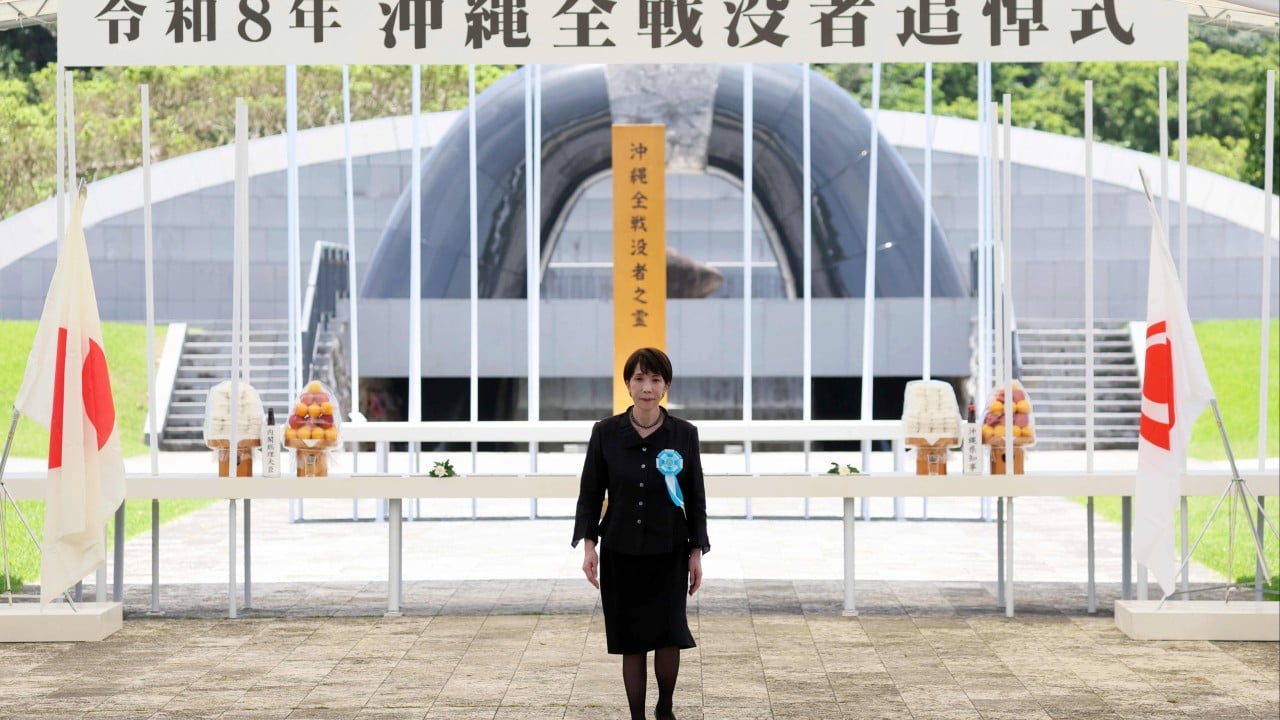
The jeering started before Prime Minister Sanae Takaichi even reached the podium. On Tuesday, amidst the heavy, humid air of the Okinawa Peace Memorial Park, a solemn ceremony marking 81 years since the Battle of Okinawa transformed into a political lightning rod. As Takaichi prepared to speak, a chorus of anti-war protesters cut through the silence, chanting "No to war" and "Protect Article 9." The immediate disruption made headlines, but the real story is not that a hawkish leader faced a hostile crowd. The real story is that this confrontation reveals a deeper, structural splintering of Japan's post-war identity, driven by a administration that is systematically dismantling decades of pacifist precedent.
The immediate catalyst for the outrage is a rapid-fire series of legislative victories engineered by the Takaichi cabinet. Just days ago, a landmark bill designed to ease referendum procedures cleared the Lower House of the Diet, moving the administration within striking distance of its ultimate holy grail: a direct revision of Article 9, the constitutional clause that explicitly renounces war and prohibits Japan from maintaining land, sea, and air forces. For the local population in Okinawa, this is not an abstract debate about constitutional law. It is a matter of physical survival.
Okinawa represents less than one percent of Japan's total landmass, yet it hosts more than 70 percent of the United States military facilities in the country. To understand the fury directed at Takaichi, one must understand how Okinawans view their geography. They do not see themselves as a secure fortress; they see themselves as a target. The Takaichi administration’s aggressive military expansion across Japan’s southwestern islands, aimed squarely at countering Chinese naval ambitions and preparing for a potential Taiwan contingency, looks to locals like history preparing to repeat itself. The 1945 battle claimed over 200,000 lives, including one-third of the civilian population. The local memory is long, and the fear that Tokyo will once again sacrifice the islands in a great-power conflict is palpable.
Takaichi tried to defuse the tension with standard political rhetoric. "Under our unwavering pledge never again to repeat the devastation of war, Japan has steadfastly moved forward on this path as a nation that places the highest value on peace," she declared before the crowd. Yet, her actions tell a entirely different story.
Since taking office, Takaichi has acted with a ideological clarity that her predecessors lacked. She is the political heir to the late Shinzo Abe, but where Abe nudged the boundaries of pacifism through clever legal reinterpretations, Takaichi is smashing them open. In April, her cabinet quietly enacted a monumental policy overhaul, completely lifting the decades-old ban on exporting lethal weaponry. For generations, Japan restricted defense exports to non-combative categories like rescue and surveillance. Under Takaichi, Japan can now sell fighter jets, warships, and missiles to seventeen approved partner nations.
The Mirage of Independent Defense
The administration frames this shift as a pragmatic necessity. Takaichi regularly asserts that "no single country can protect its own peace and security alone," pointing to the volatile combination of a nuclear-armed North Korea and an expansionist China. The goal, according to Tokyo insiders, is to build a self-reliant domestic defense industry that can sustain the country without total dependence on Washington.
It is a strategy fraught with economic and geopolitical contradictions. Consider the math of modern defense production. Japan’s domestic defense sector has spent decades operating as a boutique industry, producing low volumes of highly expensive equipment exclusively for the Self-Defense Forces. Opening up exports to countries like India or the United Kingdom is meant to achieve economies of scale. However, global arms markets are hyper-competitive. Japan is entering a crowded arena where established players already control the supply chains.
Furthermore, the domestic blowback is severe. The Japanese public remains deeply attached to the concept of state pacifism, which served as the bedrock of the country's post-war economic miracle. By forcing a constitutional rewrite through a divided parliament, Takaichi is expending immense political capital.
The Economic Security Pivot
To shield her defense agenda from domestic criticism, Takaichi is shifting the conversation toward economic security. At the recent Group of Seven summit in France, she focused heavily on supply chain resilience and critical mineral stockpiling rather than raw military power.
- The 90-Day Standard: Japan is pushing G7 nations to establish national stockpiles covering at least three months of critical mineral demand to counter economic coercion.
- Procurement Diversification: Utilizing state-backed entities like the Japan Organization for Metals and Energy Security to finance alternative supply chains outside of Beijing's sphere of influence.
- The Counter-Coercion Clause: Restricting access to these stockpiles to companies that explicitly commit to moving away from monopolistic suppliers during a trade dispute.
This focus on supply chains allows Takaichi to build international alliances while presenting a less threatening face to the domestic electorate. It is a sophisticated strategy. By framing the struggle as one of economic survival, she can justify a stronger state apparatus without triggering the immediate, visceral anti-war sentiment that erupted in Okinawa.
The Taiwan Threshold
The core vulnerability of this strategy remains the administration's explicit positioning on Taiwan. Takaichi has stated that a Chinese naval blockade of Taiwan could constitute a "survival-threatening situation" for Japan. This is a highly specific statutory trigger. Under the 2015 security legislation, crossing this threshold legally permits Japanese forces to exercise collective self-defense and enter a shooting war.
No previous Japanese prime minister has been quite so direct. While Washington maintains a policy of strategic ambiguity regarding Taiwan, Takaichi is leaning into strategic clarity. This approach has earned accolades from defense hawks in Washington and Delhi, but it has locked Tokyo into a dangerous escalatory spiral with Beijing.
The protesters in Okinawa understand the implications of this rhetoric perfectly. If a conflict breaks out in the Taiwan Strait, the missile batteries and radar stations currently being installed across Japan's southwestern islands will be the first targets. The administration promises security through deterrence. The people on the ground see only provocation.
The jeering at the Okinawa memorial was not an isolated incident of political theater. It was a warning sign. As the Takaichi government pushes forward with its plans to dismantle Article 9 and position Japan as a major regional military power, the chasm between Tokyo’s strategic ambitions and the deeply ingrained pacifism of its people will only widen. Takaichi may possess the legislative numbers to alter the constitution, but changing the soul of a post-war nation is a far more difficult task.