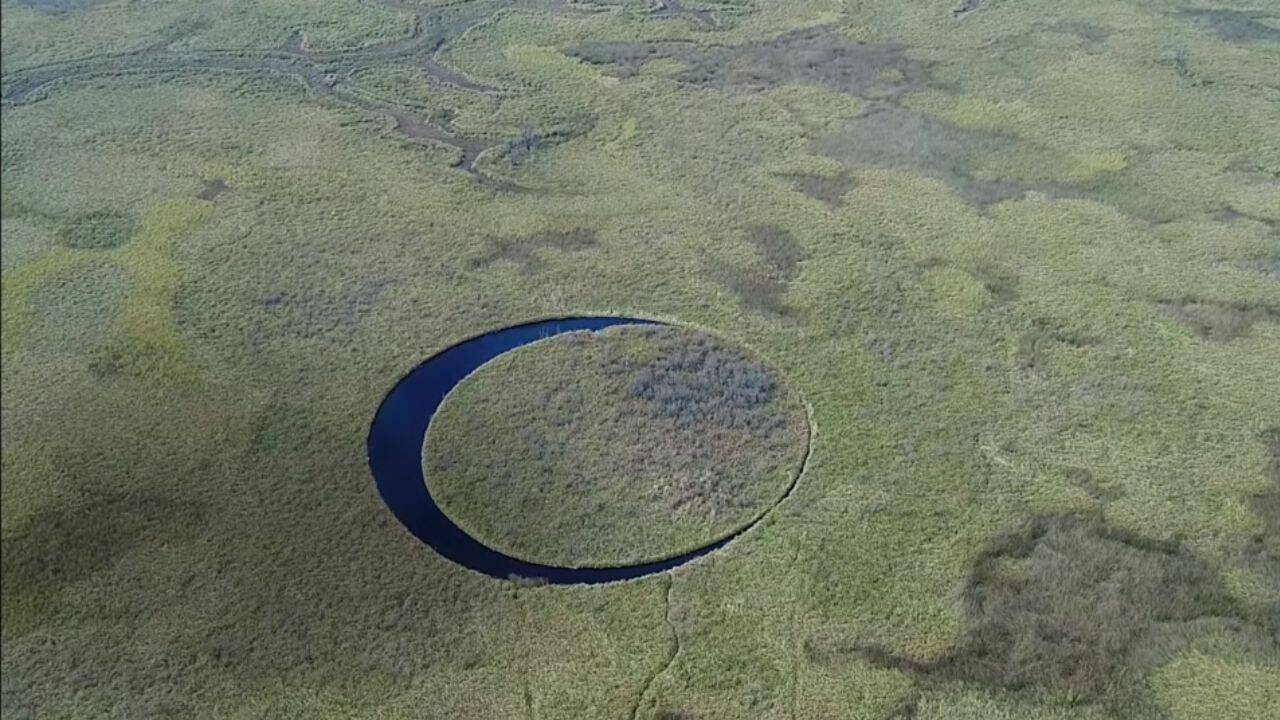
Nestled deep within the treacherous, labyrinthine wetlands of the Paraná Delta in Argentina lies El Ojo, an uninhabited circular landmass measuring roughly 118 meters in diameter. Known locally as The Eye, this floating anomaly sits inside a perfectly circular pool of crystal-clear, ice-cold water that sharply contrasts with the turbid, warm swamps surrounding it. The landmass rotates continuously on its own axis, creating a hypnotic visual that has baffled casual observers and fueled wild internet lore since its digital discovery.
The phenomenon was first brought to public attention in 2016 by Argentine filmmaker Sergio Neuspiller, who stumbled upon the coordinates while scouting locations for a supernatural documentary. Historical satellite records reveal that the structure has maintained its uncanny shape and continuous movement since at least 2003. Yet, despite decades of satellite visibility and viral internet fascination, the ground truth remains largely unverified. The initial momentum to fund a full-scale scientific expedition fizzled out on crowdfunding platforms, leaving the site shrouded in a mix of genuine hydrogeological curiosity and unchecked internet mythmaking. For a closer look into this area, we recommend: this related article.
The Mechanics Behind the Spin
Nature rarely draws a straight line, let alone a flawless circle. When satellite data exposed El Ojo for the first time, skeptics immediately cried foul, assuming digital manipulation or human engineering. Field evaluations and hydrological assessments tell a different, more grounded story.
The mechanism driving the rotation is a rare interplay of water currents and spatial geometry. As water flows past a floating mass anchored or bounded within a confined space, friction and continuous pressure create a slow, perpetual turning motion. This mechanical action mirrors the formation of rotating ice disks observed in cold-climate rivers. For further details on this topic, detailed analysis can also be found at The New York Times.
[ Incoming Water Current ]
         │
         ▼
┌─────────────────┐
│                 │  <-- Friction shears the edge
│     EL OJO      │      into a circle while
│   (Rotating)    │      the island spins on axis
│                 │
└─────────────────┘
As the landmass rotates against the outer perimeter of the water channel, continuous edge-on erosion shears away irregular corners. Over years of steady friction, this process sculpts a jagged chunk of swamp mat into a nearly perfect geometric circle.
Separating Physics from Internet Folklore
The internet hates a vacuum. When science offers complex probabilities, social media substitutes extraterrestrial bases, secret military bunkers, and ancient civilizations.
The allure of El Ojo stems from its anomalous properties that defy standard regional expectations. Swamp floors in the Paraná Delta are typically soft, yielding muck. Divers and researchers who have analyzed similar floating peat mats note that the surface of El Ojo feels uncommonly dense and compact. Furthermore, methane gas bubbling up from decaying organic matter trapped beneath the dense root systems provides natural buoyancy, helping the heavy mat stay afloat without sinking into the basin.
The surrounding water temperature also raises valid questions. While swamp water in the region tends to be stagnant and warm, the water encircling El Ojo registers as distinctively cold. Hydrogeologists point toward pressurized underground artesian springs as the likely culprit. Cold subterranean water feeding upward into the pool would explain both the thermal anomaly and the striking clarity of the basin, effectively keeping organic silt suppressed.
Why the Scientific Community Stalled
Public interest does not always translate to academic funding. When Neuspiller and hydraulic engineer Ricardo Petroni attempted to launch a comprehensive expedition involving drone surveys, core soil sampling, and underwater telemetry, their public fundraising campaign fell drastically short of its financial targets.
Access logistics present an extreme hurdle. The Paraná Delta is a sprawling maze of dense vegetation, deep marshes, and shifting channels that resist standard watercraft navigation. Moving heavy equipment into the heart of the wetland requires specialized amphibious transport or expensive aerial logistics. Without institutional backing or government grants, thorough, boots-on-the-ground exploration remains out of reach for independent researchers.
The mystery persists because investigating a patch of floating weeds in a remote swamp offers little immediate commercial return. Governments prioritize ecological management of the broader delta ecosystem rather than funding deep-dive diagnostics into a single rotating peat formation. Consequently, El Ojo remains a geographic curiosity protected by its own impenetrable geography.
The spinning island continues its slow, silent rotation beneath the satellite gaze. It serves as a stark reminder that Earth still harbors autonomous micro-phenomena capable of humbling our digital omniscience, operating entirely outside human intervention or understanding.


