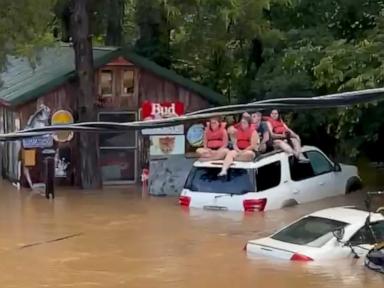
Widespread flash flooding tore through southeastern Missouri on Friday, turning the popular recreation corridors around the Black River into immediate survival zones. At the Bearcat Getaway campground in Reynolds County, roughly 85 miles south of St. Louis, 20 campers were forced to scramble onto the roof of a campground building to escape the rapidly rising current. The structure, buckling under the dual stress of intense water pressure and sudden weight, collapsed completely beneath them, plunging the group into the torrent. While emergency crews successfully pulled all 20 individuals from the water, the near-catastrophe exposes a systemic vulnerability in how rural recreation zones are built, regulated, and policed against escalating climate volatility.
The incident was part of a larger, state-wide emergency that triggered over 90 water rescues in Reynolds County alone, prompted Governor Mike Kehoe to declare a state of emergency, and forced the National Guard to deploy Black Hawk helicopters to evacuate another 160 stranded individuals from nearby Camp Taum Sauk. The National Weather Service reported that parts of the region were hammered with six to 12 inches of rain in a 24-hour window, pushing the Black River at Annapolis to a record-breaking 28.73 feet. This crest shattered the historic benchmark set during the notorious Great Flood of 1993.
Local officials quickly labeled the downpour a once-in-a-thousand-years weather event. That phrase is comfortable. It implies an unavoidable act of God, a statistical anomaly that no amount of human foresight could have prevented.
The label is dangerously obsolete.
The Myth of the Statistical Anomaly
Hydrologists use terms like "1,000-year flood" to describe a disaster that has a 0.1% chance of occurring in any given year. When these anomalies occur multiple times within a single generation, the math is no longer working. Missouri has watched these supposedly rare atmospheric events transform into regular seasonal disruptions, yet the state infrastructure and local zoning codes remain stubbornly anchored to mid-twentieth-century assumptions.
The Black River basin is a premier destination for float trips, summer camps, and wilderness tourism. It draws thousands of vulnerable, out-of-town visitors every weekend who possess little to no knowledge of local topography or how fast a small tributary can turn into a killer. The state meteorologist team in St. Louis noted that the very features making the area attractive for recreation also make it an active trap during stationary convective thunderstorms.
The physical mechanics of the Ozark plateau compound this danger. Steep valleys and thin, rocky soils offer minimal absorption capability. When a train of thunderstorms stalls over the basin, rainwater does not soak into the ground. It shears off the hillsides and drops immediately into the river channels. Within hours, a gentle stream becomes a vertical wall of water.
The emergency response on Friday illustrated just how overwhelmed local resources can become when these predictable anomalies hit. The Reynolds County Sheriff’s Office reported that two rescue boats capsized during the operations. When the rescuers themselves require rescuing, the line between an organized evacuation and total operational failure wears thin.
The Regulatory Vacuum in Rural Recreation Zones
The collapse of the structure at Bearcat Getaway points directly to a glaring lack of structural oversight in unincorporated rural areas. In many rural Missouri counties, building codes for commercial structures inside recreational campgrounds are either non-existent, poorly enforced, or grandfathered into permanent non-compliance.
Campgrounds frequently operate as seasonal businesses with minimal permanent infrastructure. Structures are often built using basic framing methods meant to withstand wind or snow loads, but completely incapable of resisting hydrodynamic forces. When floodwaters hit a standard timber-frame building, the water exerts immense lateral pressure. If the building is not anchored to a engineered foundation designed for hydrostatic buoyancy, it will lift, shift, and disintegrate.
- Hydrodynamic Pressure: Moving water carries immense kinetic energy, easily shifting unreinforced structures.
- Debris Impact: Flooding rivers carry logs, vehicles, and loose debris that act as battering rams against stationary walls.
- Foundation Scouring: Fast-moving currents rapidly erode the soil from underneath concrete pads and footings, causing sudden structural failure.
Private property rights dominate the political and cultural ethos of rural Missouri. Efforts to implement stricter building guidelines or mandatory setbacks from riverbanks are routinely met with fierce resistance from local landowners and business operators who view zoning laws as government overreach. The result is a patchwork of safety standards where the safety of a campsite relies entirely on the personal risk tolerance of the business owner.
This hands-off approach creates an unfair burden on local volunteer fire departments and underfunded sheriff's offices. They are the ones forced to risk their lives swimming into capsized structures to pull tourists out of the debris.
The Liability Gap and Public Awareness
Tourists booking a weekend float trip rarely consider the structural integrity of the main lodge or the evacuation plan of the campground. They assume that if a business is open, it has been vetted by state inspectors.
That assumption is false.
Missouri law offers significant protections to landowners under recreational use statutes, which are designed to encourage property owners to open their lands for public enjoyment without fearing ruinous lawsuits. While these laws generally exclude instances of gross negligence, they create a high legal hurdle for victims trying to hold operators accountable for structural failures during natural disasters. A business owner can easily argue that 12 inches of rain constitutes an unforeseeable act of nature, shielding them from financial liability even if the building that collapsed was structurally deficient.
This lack of accountability means there is little economic incentive for campground operators to invest in expensive flood-proofing measures or early-warning siren networks. Instead, the financial burden of these disasters is shifted directly onto the taxpayers who fund the National Guard helicopter deployments, state highway patrol deployments, and emergency medical services.
The economic reality of these rural counties makes the situation even more difficult. Tourism is the lifeblood of the local economy. Acknowledging that certain areas are fundamentally unsafe for overnight camping during the summer months would devastate the seasonal revenue that sustains these communities through the winter. This creates a quiet consensus among local stakeholders to downplay the systemic risks and treat every major flood as an isolated, historic freak occurrence.
Rebuilding for a Volatile Century
The state cannot afford to continue treating these disasters as unpredictable surprises. Relying on Black Hawk helicopters to hoist hundreds of children from stranded summer camps is a strategy of desperate luck, not a sustainable emergency management plan.
True resilience requires a fundamental shift in how the state regulates its riparian recreation corridors. First, Missouri must establish mandatory, statewide minimum building standards specifically tailored for structures located within designated floodways, regardless of county-level zoning exemptions. Any building intended for public occupancy or emergency shelter within 500 feet of a major river basin must be engineered to withstand hydrodynamic forces and frequent inundation.
Second, the state should tie commercial tourism permits to mandatory early-warning infrastructure. Campground operators must be required to maintain direct communication links with the National Weather Service and possess automated, loud-siren alert systems capable of waking campers in the middle of the night before the access roads wash out.
Finally, the state needs to implement a transparent, publicly accessible risk-rating system for recreational properties. If a campground chooses to operate in a high-risk flash zone with no elevated emergency shelter, that information should be prominently displayed on every booking confirmation and entry gate. Consumers deserve to know exactly what kind of gamble they are taking when they pitch a tent next to a river that is increasingly proving it will no longer stay within its banks.

.webp)