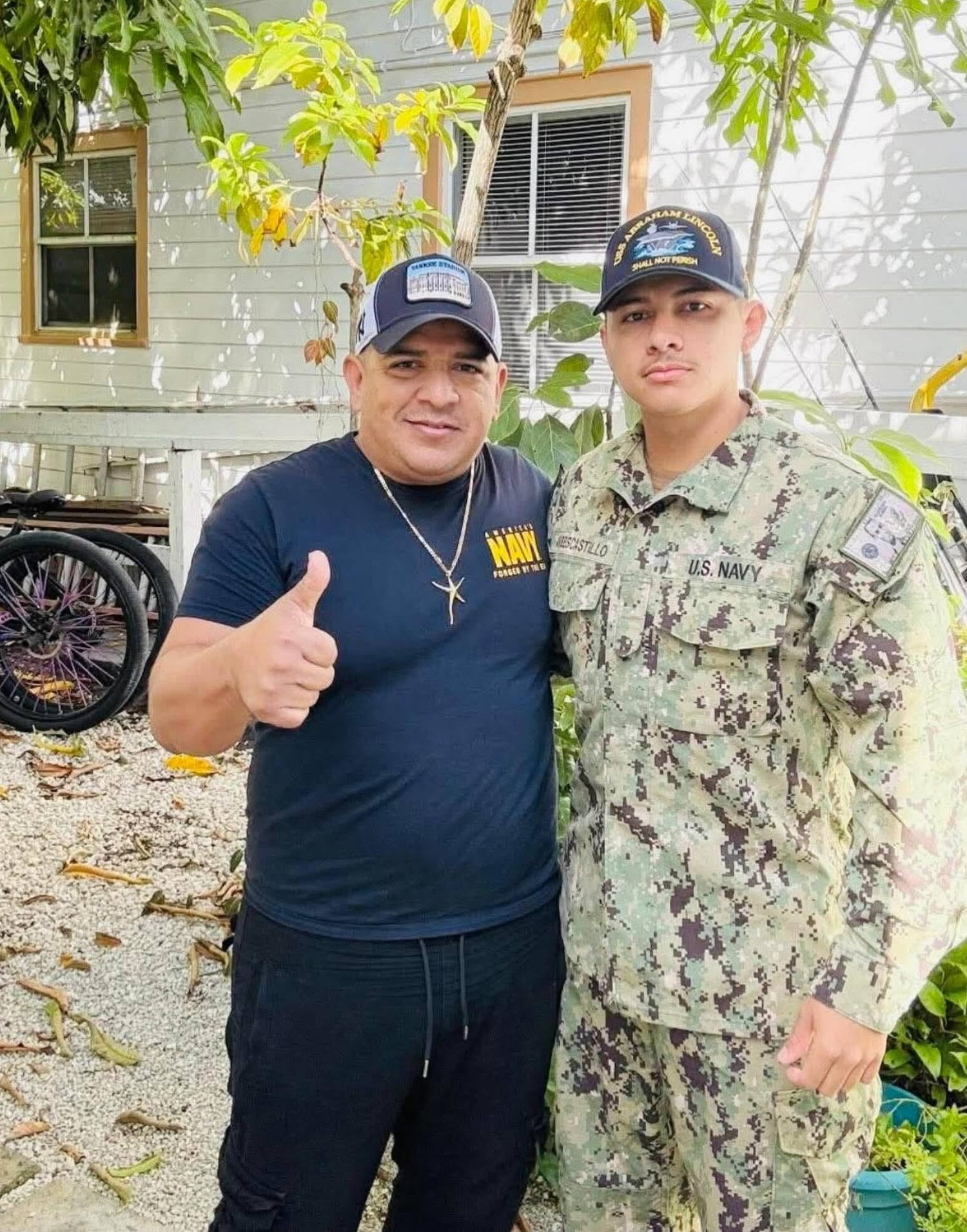
The rapid detention and subsequent release of Luis Manuel Aviles, father of an active-duty U.S. Navy sailor serving aboard the USS Abraham Lincoln, exposes a profound structural friction point between aggressive domestic immigration enforcement and national security readiness. When 48-year-old Aviles was booked into a Miami immigration detention center after stepping out to service his car in Key West, it triggered immediate public outcry and a swift judicial dismissal of his case within twenty-four hours. Yet, this administrative whiplash is far from an isolated clerical error. It represents a recurring flashpoint where aggressive federal sweep operations collide with the immediate families of troops deployed on grueling, record-breaking operational timelines.
For Joshua Aviles, an enlisted sailor handling aircraft maintenance on the flight deck of the USS Abraham Lincoln, the news arrived across erratic internet connections during his ninth consecutive month at sea. The aircraft carrier had just shattered modern records for uninterrupted deployment duration in the Middle East, pushing crew exhaustion to dangerous thresholds. Receiving word that an immediate relative with a pending green card application and a valid work permit had been seized by Immigration and Customs Enforcement introduces a toxic variable into military readiness. When service members spend twelve-hour shifts operating heavy machinery under extreme psychological distress, operational safety degrades rapidly.
The Bureaucratic Anatomy of a Crisis
The Department of Homeland Service defended the initial apprehension by emphasizing that immediate family status does not confer absolute immunity from statutory enforcement.
"Having a family member in the military is not a free pass to violate our nation's laws," a DHS spokesperson asserted.
From a purely literal standpoint, statutory code supports this rigid boundary. Immigration law draws no explicit, blanket carve-out exempting the parents of active-duty service members from administrative removal proceedings.
However, this hardline stance ignores the unwritten social compact military families rely upon. For decades, discretionary policy guidelines historically shielded the immediate relatives of men and women in uniform from targeted enforcement actions, recognizing the unique psychological burdens placed upon those wearing the cloth of the nation. When the current administration reversed these internal protective boundaries, it opened a Pandora's box of operational blowback.
Consider the logistical absurdity of the enforcement sequence. Luis Manuel Aviles had lived inside the United States for nearly two decades, working as a local handyman, paying taxes, maintaining a valid driver's license, and advancing through administrative channels to secure permanent legal residency. Arresting a cooperative resident during a routine local errand while his son launches jets off a carrier deck thousands of miles away generates zero strategic value for national security. It actively undermines it.
The Collateral Damage on Morale
Military retention and recruitment are currently facing historic deficits. Young Americans look at the lifestyle sacrifices, extended deployments, and pay structures, and they weigh those against civilian opportunities. When the state signals that an enlisted sailor's family is fair game for sudden detention sweeps, the psychological contract shatters.
Margaret Stock, an immigration attorney specializing in military families, noted that the sudden filing and equally rapid dismissal of the Aviles case is extraordinarily abnormal within standard jurisprudence. This erratic legal cycling points to a system straining under the weight of uncoordinated directives. Field enforcement teams execute broad mandates without cross-referencing military database registries, while civilian leadership scrambles to contain the public relations disasters after congressional investigators open formal inquiries.
The ripple effects extend far beyond a single detention center in Miami. Across various branches, other families of active-duty personnel have found themselves abruptly targeted, including the recent deportation of the wife of an active-duty Army sergeant. Each incident reverberates through mess decks, barracks, and family readiness groups. Sailors and soldiers begin calculating whether their service protects their loved ones or inadvertently places a target on their backs.
Reforming the Fault Lines
Resolving this structural friction demands more than ad-hoc judicial dismissals executed twenty-four hours after a public relations firestorm erupts. Relying on last-minute legal interventions to fix arbitrary enforcement actions creates a chaotic system where only those families who manage to go viral on social media secure relief.
A functional national security apparatus cannot operate on algorithmic luck. Protecting the domestic security of the nation requires acknowledging that the domestic stability of its defenders forms the bedrock of combat readiness. If the state expects eighteen-year-olds to endure nine-month combat deployments without a break, it cannot simultaneously criminalize the households keeping their families afloat back home.
The swift release of Luis Manuel Aviles avoided an immediate tragedy of distraction for the crew of the USS Abraham Lincoln. Yet the underlying policy mechanisms that sent federal agents to his Key West driveway remain fully intact. Until administrative discretion is codified to protect the immediate families of deployed service members, every carrier launch and combat patrol carries an invisible, entirely avoidable domestic threat


