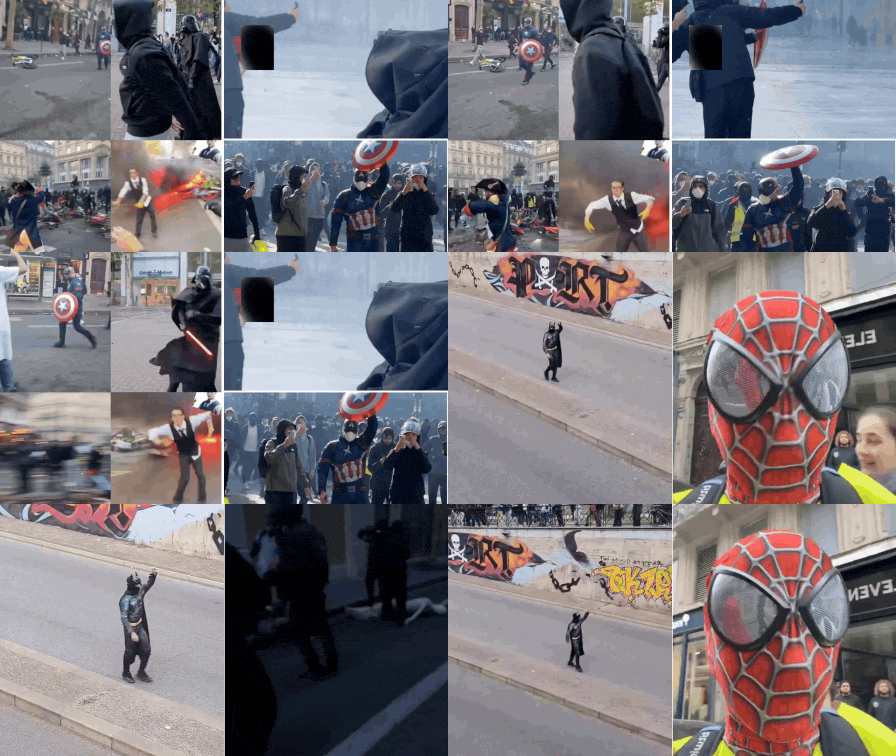
Demonstrators dressed as Batman, Spider-Man, and Captain America have repeatedly surfaced during French street protests to turn tense confrontations into viral visual spectacles that cut through news fatigue. In a media ecosystem that rewards shock value and instant recognition, a recognizable mask does something a cardboard placard cannot. It forces a camera lens to pause. It turns a routine march or a volatile blockade into a clip that travels well beyond France’s borders.
I have covered street politics, labor strikes, and public disorder long enough to recognize a prop when I see one. Most coverage treats a costumed protester as a quirky footnote, a lighthearted contrast to tear gas and police lines. That framing misses the real mechanics of modern protest. When recognizable comic-book figures step into French demonstrations, they operate inside a calculated collision of visual media, street theater, and political optics. They are not merely joking around. They are competing for attention in an attention economy where ordinary grievances struggle to stay visible for more than a few hours.
Why Comic Book Masks Work on French Streets
French protest culture already has deep roots in satire, parody, and visual provocation. From carnival traditions to student movements and labor marches, mocking authority with costumes and irony is part of the national street repertoire. Adding American pop-culture icons adds another layer entirely. Batman, Spider-Man, and Captain America carry instant global shorthand that requires zero translation. A viewer in Chicago, Seoul, or London does not need to know the fine print of a pension reform bill, a fuel tax dispute, or a municipal budget fight to grasp the visual tension of a masked vigilante standing beside a chant-filled crowd.
That instant readability is why visual framing matters so much in contemporary demonstrations. Traditional news coverage often relies on familiar imagery: flags, banners, smoke, sirens, and rows of riot police. Once audiences see that combination enough times, saturation sets in. A costume disrupts the pattern. It creates a jarring contrast between manufactured fantasy and gritty reality.
Consider a hypothetical example from a mid-sized demonstration over transit costs. Suppose three marchers show up in recognizable superhero gear near the front of a crowd. Television crews and smartphone users naturally gravitate toward them because the image pops against gray pavement and dark jackets. Within minutes, clips circulate online with captions debating whether the stunt makes the protest look clever, absurd, or out of touch. In that hypothetical scenario, the costume does not change the underlying policy dispute, yet it completely alters which moments get clipped, shared, and remembered.
There is also a practical layer that seasoned observers notice right away. A mask offers a degree of visual anonymity in an era of constant filming, facial recognition, and social media identification. While a full costume is hardly inconspicuous once someone spots it, a mask obscures immediate facial identity in passing footage. At the same time, wearing a bright suit or cape makes a person a magnet for cameras, which cuts both ways depending on whether a protester wants to blend in or stand out.
The Attention Economy Behind the Spectacle
Every modern street movement faces a brutal bottleneck. Getting people into the street is only half the battle; getting the rest of the country—and international audiences—to pay attention is the harder part. Broadcasters juggle dozens of stories a day, and social feeds move at blinding speed. Protesters who want leverage know that quiet, orderly marches rarely dominate evening bulletins unless they reach massive scale or collide with a major flashpoint.
Enter the spectacle economy. Costumed appearances work like visual hooks engineered for short-form video and wire photography. A photo of a masked figure standing near a plume of smoke or a line of officers is far more likely to be picked up by an international outlet than a wide shot of five hundred people holding hand-painted signs. Editors know what drives clicks and engagement, even when they frame the story around novelty rather than substance.
Yet attention is a fickle asset. Visibility is not the same thing as persuasion. When a demonstration features Batman or Spider-Man, opponents of the movement have an immediate gift wrapped in spandex. Critics can dismiss the grievance as theater, accuse demonstrators of trivializing serious issues, or argue that serious policy debates deserve serious presentation rather than comic-book cosplay.
I have watched plenty of movements win headlines while losing public sympathy. The line between clever satire and self-sabotage is razor-thin. If the mask sharpens a point about power, absurdity, or everyday strain, it can land with real punch. If it reduces a complex dispute to a punchline, the message gets swallowed by the costume.
What Captain America Means in a French Crowd
Different characters carry different freight, especially when imported into French political space. Captain America is particularly loaded. As a symbol rooted in American wartime propaganda and postwar pop culture, placing him inside a French street protest inevitably invites layers of irony. Depending on who is watching, that image can read as playful mockery of global power, a nod to Americanized protest tropes, or a deliberate clash of cultural symbols.
Batman brings a darker, grittier register. A vigilante operating outside official institutions speaks to themes of frustration with systems perceived as slow, distant, or unresponsive. Spider-Man leans younger, nimbler, and more street-level—a figure tied to ordinary neighborhoods and everyday pressures rather than boardrooms or palaces.
None of these figures belong organically to the French labor hall or civic square. Their presence reflects how global pop culture bleeds into local politics. Young demonstrators in particular grow up fluent in memes, franchises, and visual remixing. Expressing dissent through familiar screen icons feels natural to people who process culture through shared digital references.
Still, there is an awkward tension baked into the trend. Relying on commercial entertainment icons to dramatize civic conflict can feel strangely dependent on the very media conglomerates that dominate global culture. A protester wearing a corporate-owned mask to challenge state authority or economic inequality is working with borrowed symbols. That contradiction does not invalidate the protest, nor does it mean the person in the suit lacks genuine convictions, but it is a nuance worth seeing clearly rather than brushing past.
Street Risk and Operational Realities
Behind the viral clips lies a physical reality that screen viewers rarely consider. Street demonstrations in France can shift quickly from peaceful marching to tense standoffs, chaotic dispersal, or heavy use of crowd-control tactics. Moving through a dense, unpredictable crowd in a costume comes with obvious drawbacks.
Visibility is one issue. A bright suit or distinctive silhouette makes a person easy to spot from a distance, which can be a liability if tensions flare or police move to clear an area. Restricted peripheral vision, heat buildup, or awkward footwear can slow movement when a crowd suddenly surges or scatters. What looks effortless in a ten-second vertical video can be exhausting and impractical over a four-hour march.
Law enforcement and authorities also view masked appearances through a security lens. Over the years, French legal frameworks and policing practices around face coverings and protest conduct have drawn intense scrutiny and debate over civil liberties, public order, and proportionality. Wearing a mask during a demonstration is never just a fashion choice; it sits right at the intersection of expression, anonymity, and public order enforcement.
Even among fellow protesters, reactions are rarely uniform. Seasoned union organizers or long-time activists sometimes view novelty costumes with skepticism, worrying they distract from core demands or give critics easy ammunition. Younger or more fluid participants may welcome the humor and energy, seeing it as a way to keep spirits up and draw eyes to the street. Neither side has a monopoly on strategy, and that internal friction is part of why street movements constantly evolve.
Why Viral Moments Distort the Bigger Picture
One of the biggest traps in watching protest footage online is mistaking the highlight reel for the whole event. Algorithms reward the unusual, the dramatic, and the absurd. A clip of a superhero walking past a line of officers or chanting in a crowd can rack up millions of views while thousands of ordinary workers, students, or residents marching quietly a block away receive almost none.
That distortion shapes how people outside the scene judge what is happening. Someone watching a curated feed might conclude that a movement is mostly stunts and memes, or conversely that an entire city is in constant, theatrical upheaval. In reality, most demonstrations consist of long stretches of walking, waiting, chanting, listening to speeches, and dispersing without major incident.
Recognizing that gap is essential for anyone trying to make sense of modern unrest. Viral visibility amplifies the edges of an event while flattening the center. The costumed protester is real, the crowd is real, and the underlying grievance is real—but the camera angle decides which piece of that reality dominates public memory.
The Strategy Beneath the Mask
To understand why these appearances keep recurring, stop looking at the spandex and start looking at the incentive structure around modern dissent. Protesters are adapting to a media environment where traditional persuasion is slow and noisy feeds reward instant visual hooks. Using recognizable characters is a low-cost way to manufacture a memorable frame in a crowded street.
It is an imperfect tactic with clear limits. A costume can get a movement into the frame, spark a conversation, or inject dark humor into a grueling day on the pavement. It cannot substitute for coherent demands, durable organization, or sustained political pressure. Watch the next masked figure who steps onto a French boulevard not as a comic relief act, but as a signal of how fiercely movements have to fight just to be seen.


