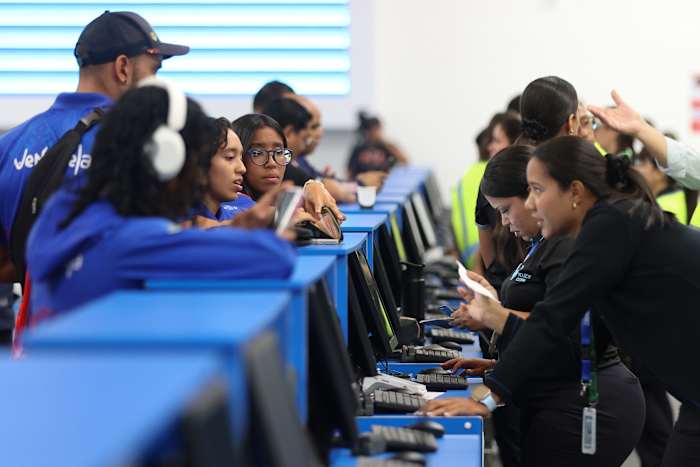
Simón Bolívar International Airport at Maiquetía has officially resumed partial commercial operations, marking a fragile milestone for Venezuela nearly ten weeks after twin earthquakes shattered the nation's primary aviation gateway. The disaster, which struck on June 24 with magnitudes of 7.2 and 7.5, claimed more than 6,500 lives and crippled critical infrastructure along the northern coast. Today, passengers checking in for flights do not enter the iconic main terminal building. Instead, they pass through a sprawling temporary structure erected directly in the airport parking lot.
The reopening of the country's main international portal exposes the severe engineering and economic hurdles facing a nation trying to stitch its connectivity back together. For months, international carriers had been tentatively returning to Caracas following the political shifts earlier in the year. American Airlines had restored Miami service, and regional operators were re-establishing primary links. That hard-won momentum evaporated in seconds when the ground buckled. In related developments, take a look at: The Ghost Island of the Atlantic That Refuses to Stay Put.
The timeline of the recovery reveals an intense scramble behind closed doors. Initial estimates suggested a faster turnaround, but structural assessments of the primary runways, taxiways, and the air traffic control tower uncovered deep systemic vulnerabilities. While cargo operations crawled back online earlier, commercial passenger traffic remained diverted to regional secondary facilities such as Barcelona and Valencia. These regional airports, hundreds of kilometers away from the capital, turned routine travel into an exhausting logistical gauntlet for business travelers and returning diaspora members alike.
Transportation Minister Francisco Garcés acknowledged the heavy limitations of the current phase. The newly constructed temporary terminal space covers roughly 10,000 square meters and features modular check-in counters, air-conditioned waiting zones, and remote bus boarding. Authorities project that this makeshift setup will handle barely 25 percent of the airport's pre-earthquake traffic volume. Scaling that capacity up to 40 percent is targeted for later in the autumn, with a hopeful ceiling of 60 percent by the close of the year. The Points Guy has provided coverage on this critical subject in extensive detail.
The physical scars on the ground match the economic turbulence in the boardroom. Major international carriers are moving cautiously. While regional heavyweights like Copa Airlines and European operators such as Air Europa have begun executing limited round-trip rotations out of the temporary facility, others are waiting for certified structural clearance on the permanent concourses. Insurance underwriters are demanding exhaustive safety audits before expanding liability coverage for aircraft parking at Maiquetía. Every cracked apron and compromised utility line requires meticulous remediation, slowing down the return of long-haul widebody aircraft.
The neighborhood surrounding the aviation hub shares the burden of the crisis. La Guaira state absorbed the brunt of the seismic devastation, suffering extensive residential collapses alongside the damage to the airport and the adjacent maritime port. The local economy depends heavily on transit-related commerce, hospitality, and logistics. When the airport went dark, small businesses lost their core customer base overnight. The partial reopening offers a lifeline, yet local vendors know that a 25 percent capacity cap translates to a fraction of their former livelihoods.
Travelers navigating Maiquetía this week must adapt to an entirely different workflow. Security protocols involve multi-stage verifications outside the main perimeter before passengers board transport buses that navigate past ongoing heavy construction zones. Airlines have issued strict advisories urging travelers to arrive hours ahead of standard schedules to clear the bottlenecked temporary processing gates.
The road ahead for Venezuelan aviation remains steep. Fixing a terminal building is straightforward compared to restoring absolute confidence in a nation's logistical infrastructure after a catastrophe of this scale. The tents in the parking lot keep the planes moving, but true recovery will not arrive until the heavy steel and glass of the main terminal safely opens its doors once again.