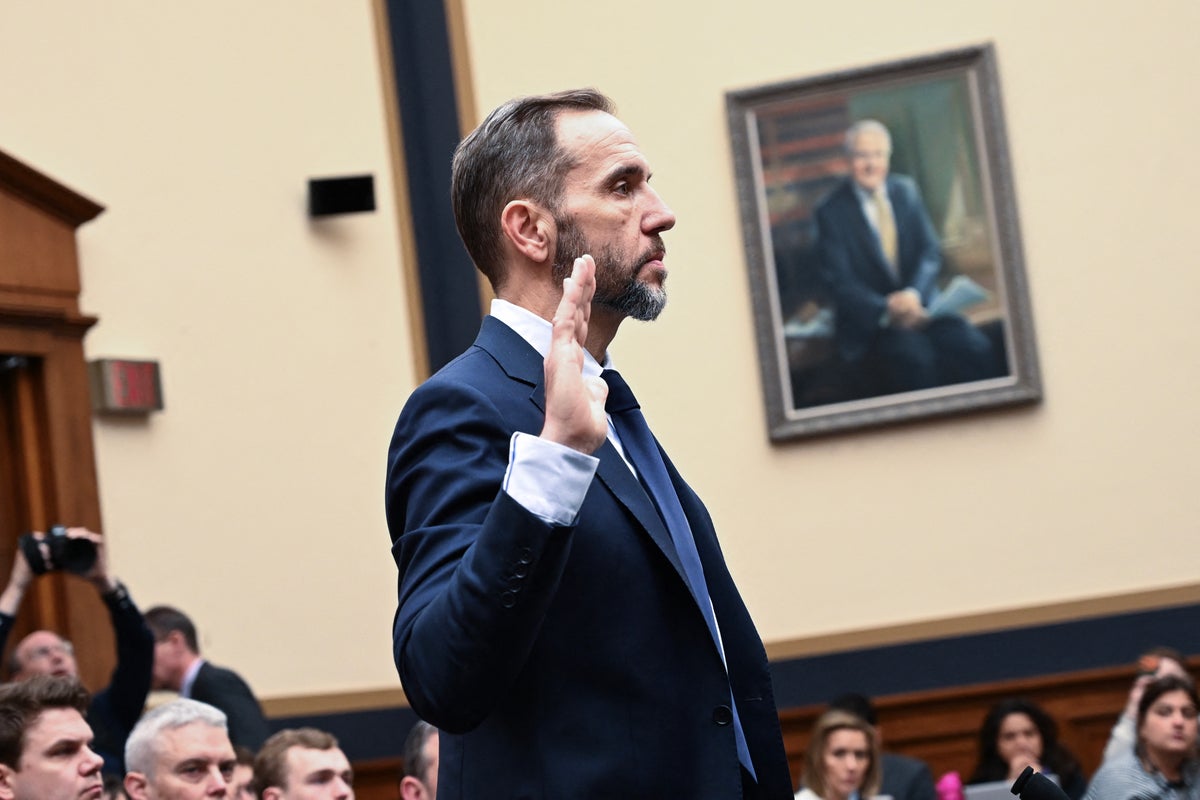
House Republicans have formally requested that the Justice Department launch a criminal investigation into former Special Counsel Jack Smith for allegedly lying to Congress under oath. The criminal referral, authored by House Judiciary Committee Chairman Jim Jordan, claims Smith made false statements during a December deposition regarding his team’s acquisition of lawmakers’ communications. Yet the legal foundation of this referral is unraveling under scrutiny. By conflating two entirely distinct legal processes—subpoenas for telephone tolling records versus archival requests for White House communications—the charges collapse under basic legal standards governing perjury and false statements.
Political grandstanding often wears the armor of legal accountability. When congressional committees issue criminal referrals against former prosecutors, the public is expected to see a serious breach of federal law. Beneath the headline-grabbing allegations lies a technical reality that reveals this maneuver as an evidentiary dead end. If you liked this post, you should look at: this related article.
The Flawed Premise of the False Statement Charge
At the center of Chairman Jordan’s referral is a single assertion: Jack Smith misled Congress when asked whether his investigative team collected the text messages and phone records of sitting members of Congress. During sworn testimony, Smith explained that his prosecutors had obtained telephone "tolling records". These metadata logs track call times and durations without recording actual spoken words or text content.
The friction arose when subsequent disclosures showed that the special counsel's office had received text messages exchanged between lawmakers and White House officials. Jordan quickly labeled this a contradiction, framing it as an intentional effort to deceive federal investigators. For another perspective on this development, see the recent update from Reuters.
The mechanics of federal record collection tell a very different story.
Smith’s testimony specifically addressed direct grand jury subpoenas served on telecommunications carriers. Those carrier subpoenas yielded metadata, exactly as Smith testified. The actual text message transcripts came through an entirely separate channel: a lawful subpoena served on the National Archives and Records Administration for official executive branch phone records maintained under federal recordkeeping laws.
Prosecutors routinely distinguish between telecommunication carrier metadata and archived executive communications. Failing to volunteer details about an unasked question regarding the National Archives does not constitute a crime. Perjury requires proof beyond a reasonable doubt that a witness knowingly made a materially false statement under oath. Silences or unprompted omissions do not meet that threshold.
+--------------------------+----------------------------------+------------------------------------+
| Feature                  | Carrier Subpoenas (Tolling)      | National Archives Subpoenas        |
+--------------------------+----------------------------------+------------------------------------+
| Target Entity            | Telecommunications Providers     | Executive Branch Archives (NARA)   |
| Data Collected           | Call logs, timestamps, metadata  | Official White House records, texts|
| Privacy Scope            | Non-content routing information  | Documented executive communications|
| Testimony Context        | Specifically addressed by Smith  | Separate administrative collection |
+--------------------------+----------------------------------+------------------------------------+
The High Evidentiary Bar of Title 18 Section 1001
To secure a conviction under Section 1001 of Title 18—the federal statute prohibiting false statements to Congress—prosecutors must establish five specific elements.
- The defendant made a statement.
- The statement was false, fictitious, or fraudulent.
- The statement was material to the matter under review.
- The statement was made knowingly and willfully.
- The matter fell within the jurisdiction of the legislative branch.
The hurdle that dooms this referral is intent.
A prosecutor cannot simply prove an answer was incomplete or open to interpretation. They must prove the witness set out to lie.
Consider a hypothetical example. Suppose a corporate executive is asked under oath if their company purchased steel from a specific vendor in 2022. The executive answers no, because the company only purchased raw iron ore from that vendor. If investigators later discover the company acquired steel finished products through a third-party subsidiary, the executive's initial statement remains technically accurate. Unless the questioner specifically asked about indirect subsidiary purchases, establishing deliberate deceit becomes impossible.
The deposition transcript shows Republican members never explicitly asked Smith if his team acquired lawmaker texts from the National Archives. They asked about direct phone record grabs from telecommunications providers. Smith answered the precise question asked.
Courts have repeatedly struck down prosecutions based on ambiguous questioning. Under standard legal doctrine established by the Supreme Court in Bronston v. United States, a witness cannot be convicted of perjury for giving an answer that is literally true, even if it leaves a misleading impression, if the examining attorney failed to ask precise follow-up questions.
Retaliation and the Changing Norms of the Justice Department
Criminal referrals from Capitol Hill carry no independent legal authority. They are formal letters requesting that career prosecutors take action. Historically, the Department of Justice evaluates these referrals through a neutral, factual lens, routinely discarding those that lack prosecutorial merit.
The broader institutional climate complicates this baseline.
Recent years have seen an unprecedented push to turn investigative mechanisms inward against former civil servants, special counsels, and political opponents. When congressional leadership uses criminal referrals as political communication tools, it shifts the burden onto career prosecutors who must balance institutional integrity against intense partisan pressure.
Career attorneys inside the Public Integrity Section—the very unit Smith once led—know the legal standards for false statement cases intimately. They know that taking a weak Section 1001 case to trial against a veteran federal prosecutor would result in a swift dismissal or acquittal.
The defense would present the transcript. They would show the precise phrasing of the question. They would demonstrate that the subpoena to the National Archives was fully documented in official case files.
No experienced prosecutor wants to bring an indictment built on selective excerpts of a deposition transcript when the full record provides immediate reasonable doubt.
The Structural Reality of Special Counsel Oversight
The conflict highlights a fundamental tension in modern American governance: the line between legitimate congressional oversight and the constitutional independence of executive branch law enforcement.
Special counsels operate under specific federal regulations designed to isolate them from day-to-day political pressure while maintaining accountability to the Attorney General. When a prosecution closes, the special counsel submits a comprehensive final report detailing their findings, decisions, and investigative steps.
Congress possesses broad oversight authority to review how funds were spent and how power was exercised. That authority does not grant lawmakers the ability to retroactively criminalize standard investigative tactics.
Obtaining non-content tolling records and reviewing executive branch records at NARA are standard steps in complex public corruption inquiries. Investigators tracking efforts to interfere with the peaceful transfer of power were bound by duty to look at communications between the White House and external actors on relevant dates.
By attempting to recast standard evidence gathering as an illegal dragnet, critics hope to discredit the underlying findings of the January 6 and classified documents investigations. The legal system, however, operates on rules of evidence rather than political narratives.
When the Justice Department reviews the referral alongside the actual deposition transcripts and court filings, the legal arguments evaporate. What remains is a documented effort to punish a career prosecutor for doing his job, using an indictment theory that cannot survive its first day in court.