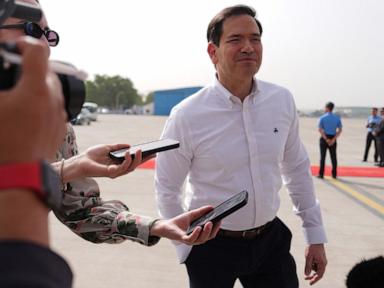
The United States and Iran are on the precipice of a sweeping diplomatic agreement to end their three-month-old war, but the framework currently being rushed through final negotiations contains structural flaws that could trigger a far larger conflict. While Secretary of State Marco Rubio expressed optimism from New Delhi that a "pretty solid" deal could materialize immediately, the underlying terms reveal a high-stakes gamble. The proposal buys temporary maritime peace at the expense of long-term nuclear stability, trading a 60-day window of economic relief for an enforcement mechanism that is virtually nonexistent. By focusing heavily on reopening global shipping lanes, negotiators are leaving the core drivers of regional instability completely unaddressed.
The superficial breakthrough hinges on a simple trade. Iran agrees to reopen the blockaded Strait of Hormuz, clear its newly laid naval mines, and waive shipping tolls. In exchange, the United States will lift its April 13 maritime blockade on Iranian ports, unfreeze select overseas bank assets, and allow Tehran to resume unrestricted oil exports.
On paper, the immediate economic dividends look spectacular. Global oil markets reacted instantly, with Brent crude tumbling more than 4% to under $99 a barrel as the panic premium evaporated.
Yet, looking past the market rally reveals a deeply troubling asymmetric reality. The proposed agreement does not require Iran to surrender or dilute its highly enriched uranium stockpile. Iranian negotiators have successfully walled off their nuclear program from the immediate ceasefire terms, turning a temporary pause in hostilities into a massive financial injection for Tehran without securing a single permanent nuclear concession.
The Strategic Illusion of the Sixty Day Window
The core of the Rubio-negotiated text is a 60-day ceasefire extension. This period is intended to serve as a runway for complex, time-limited negotiations over Iran's nuclear capabilities. It is an approach built on a foundational misunderstanding of how Tehran utilizes diplomatic pauses.
Historically, regional powers use ceasefires not to reform, but to rearm, regroup, and reinforce their logistics. By allowing Iran to immediately resume oil sales and access billions in frozen assets before a permanent nuclear framework is signed, the U.S. removes its primary leverage. Once the oil cash flows back into Tehran, the incentive for the Iranian regime to sign away its enriched uranium disappears.
The Western calculus assumes that the threat of a snapped-back blockade will keep Iran compliant. This ignores the fact that clearing mines from the Strait of Hormuz is an arduous, weeks-long process, while relaying them takes mere hours. Iran can plug the global energy chokepoint far faster than an international coalition can re-establish a functional embargo. The deal grants Iran immediate, tangible economic liquidity in exchange for a reversible, easily broken maritime promise.
The Domestic Backlash and the Republican Schism
The haste of the current negotiations has created an ideological civil war within Washington. President Donald Trump has actively defended the emerging memorandum of understanding, publicly telling critics to disregard opposition and giving his negotiators room to execute an "America First" exit from the conflict. However, the domestic political alignment behind this deal is crumbling from within.
Prominent congressional defense hawks have broken ranks with the administration. Critics argue that the current framework amounts to a de facto recognition of Iran as the dominant, unchecked power in the Persian Gulf. By returning to what is essentially the pre-war status quo but with an advanced Iranian nuclear program, the U.S. signals that aggressive regional disruption yields financial rewards.
Conversely, libertarian-leaning factions have urged patience, viewing the deal as a necessary, pragmatic extraction of American military power from an unsustainable theater. This fracturing shows that even if Rubio secures a signature in the coming days, the domestic political foundation required to enforce the deal over the long haul is dangerously weak.
The Hidden Nuclear Trigger
The most explosive element of the proposed agreement is what it leaves out. Senior Iranian officials have explicitly stated that Tehran’s highly enriched uranium stockpile remains entirely off the table for this preliminary phase.
Proposed US-Iran Intermediary Framework (May 2026)
┌────────────────────────────────────────┐
│        60-DAY CEASEFIRE WINDOW         │
└───────────────────┬────────────────────┘
                    │
         ┌──────────┴──────────┐
         ▼                     ▼
┌─────────────────┐   ┌──────────────────┐
│   U.S. GIVES    │   │    IRAN GIVES    │
│  · Lift Blockade│   │  · Open Hormuz   │
│  · Free Assets  │   │  · Clear Mines   │
│  · Oil Sales    │   │  · No Tolls      │
└────────┬────────┘   └────────┬─────────┘
         │                     │
         └──────────┬──────────┘
                    ▼
┌────────────────────────────────────────┐
│          UNRESOLVED FLASHPOINT         │
│  Iran retains highly enriched uranium  │
└────────────────────────────────────────┘
This structural omission makes the 60-day window a countdown clock rather than a peace process. Israel, which continues to launch strikes in the Levant despite the nominal ceasefire, views an unchecked Iranian nuclear stockpile as an existential threat. By separating maritime commerce from nuclear disarmament, the U.S. is creating a split-screen reality. While commercial tankers begin moving through the Strait of Hormuz again, regional intelligence agencies will be watching Iran’s centrifuges spin without international oversight.
If the 60 days expire without a comprehensive nuclear breakthrough—a near certainty given the historical timeline of non-proliferation treaties—the conflict will resume at a much higher level of intensity. Iran will be wealthier, its ports will be operational, and its proxies will be resupplied.
The Regional Toll and Weak Links
While diplomats talk in the clean air of New Delhi or Geneva, the realities on the ground demonstrate how brittle this pause truly is. The proxy networks that ignited the war remain fully operational and fundamentally opposed to a permanent Western footprint.
- Lebanon: Despite the diplomatic optimism, localized strikes continue to claim civilian and paramilitary lives in the south and east. The political fabric in Beirut is fracturing as local factions clash over the economic destruction caused by the conflict.
- The Maritime Corridor: Insurance syndicates in London remain deeply skeptical. Even if Iran stops laying mines, the presence of unexploded ordnance and rogue paramilitary cells means commercial shipping rates will not return to pre-war baselines overnight.
- The Gulf Monarchies: While regional capitals have lent vocal support to Trump's diplomatic push, their backing is born of economic exhaustion, not structural trust. They are acutely aware that a wealthier, unfettered Iran poses a direct challenge to their security.
The administration’s strategy relies on the hope that economic integration will incentivize good behavior. This is an outdated theory that has failed repeatedly across the globe. For the Iranian regime, ideological survival and regional hegemony override long-term macroeconomic stability.
Moving Toward a Realistic Enforcement Strategy
If the United States intends to prevent this "work in progress" from devolving into a broader geopolitical catastrophe, the current framework must be fundamentally altered before formal ratification. A policy built solely on optimism and temporary maritime access is an invitation to future aggression.
First, the unfreezing of Iranian foreign assets must be executed in tranches, strictly indexed to verifiable reductions in Iran’s enriched uranium stockpile. Immediate, unconditional liquidity removes any reason for Tehran to cooperate during the subsequent 60 days.
Second, the maritime monitoring mechanism cannot rely on Iranian self-policing. The reopening of the Strait of Hormuz must be overseen by a neutral, multinational naval task force with the explicit mandate to inspect vessels and ensure no further mining occurs.
Ultimately, Secretary Rubio’s assertion that the U.S. will either secure a good agreement or deal with Iran "another way" sets up a dangerous binary. By rushing an incomplete, economically front-loaded deal to capture a quick diplomatic win, the administration risks stumbling into the very alternative it is trying to avoid. True stability is not measured by a sudden drop in the price of oil, but by the permanent dismantling of the infrastructure that caused the war in the first place.