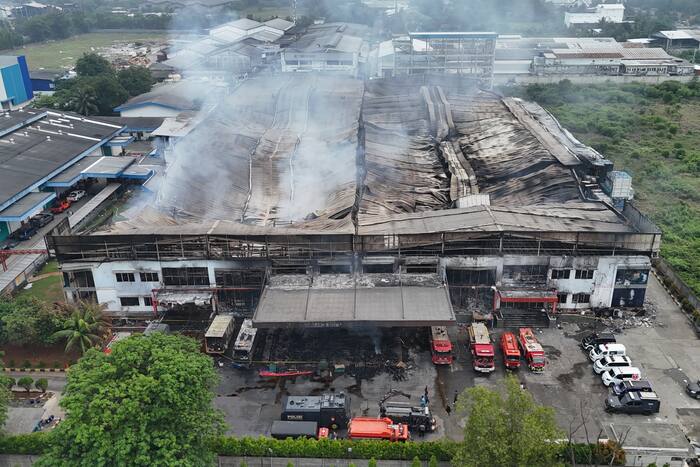
Three workers are dead and 37 remain unaccounted for following a devastating fire at a candy factory in Indonesia, exposing a deadly pattern of lax industrial safety enforcement across Southeast Asia's booming manufacturing sector. While initial news dispatches treat the blaze as an isolated tragedy, the reality on the factory floor tells a far grimmer story. Rapid production quotas, volatile confectionery ingredients, and systemic regulatory failures combined to turn a routine shift into a mass-casualty trap.
When smoke begins pouring out of a food processing plant, most observers assume the hazard is minor. Sugar doesn't look like jet fuel. Yet anyone who has spent time auditing industrial facilities knows that confectionery manufacturing harbors some of the most aggressive fire and explosion risks in light industry. If you enjoyed this article, you might want to read: this related article.
The Hidden Volatility of Sugar and Packaging
To understand how an Indonesia candy factory fire escalates so quickly that dozens of workers cannot escape, you have to look at the chemistry of the assembly line. Candy production relies heavily on fine particulate matter—pulverized sugar, cornstarch, and milk powders.
In an open bowl, powdered sugar is harmless. Suspended in the air inside an unventilated mixing room, it becomes a high-grade explosive. Combustible dust explosions occur when fine organic particles reach a critical concentration in an enclosed space and meet a single ignition source, such as an overheated motor bearing, a static spark, or faulty wiring. The primary blast often shakes loose accumulated dust from rafters and ductwork, triggering a massive secondary explosion that collapses walls and blocks exits within seconds. For another look on this story, check out the latest coverage from The Guardian.
Then comes the fuel load. Modern confectionery plants do not just boil sugar; they operate high-speed automated packaging lines stacked floor-to-ceiling with polypropylene films, cardboard cartons, and paraffin-coated wrappers. Once ignited, these petroleum-based plastics burn at extreme temperatures, releasing thick, hydrogen-cyanide-laced smoke that incapacitates human lungs in two or three breaths.
If a facility lacks automated deluge sprinklers or compartmentalized fire walls, a localized flash fire at a wrapping station can engulf an entire production hall before a manual alarm is even pulled.
Why Thirty-Seven Workers Could Not Get Out
A death toll of three with 37 missing points directly to a breakdown in means of egress—the unobstructed pathways required for workers to flee a burning building. In my decades covering industrial disasters from Dhaka to Jakarta, a high ratio of missing personnel almost always stems from three recurring failures on the factory floor.
- Locked or obstructed fire exits: Factory managers frequently padlock exterior emergency doors from the outside to prevent inventory theft or unauthorized breaks. In other cases, pallets of raw materials and finished goods are stacked directly in front of exit corridors to maximize floor space during peak production runs.
- Window bars and single-stairwell bottlenecks: Older or retrofitted industrial buildings often feature heavy iron security grilles welded over ground- and second-floor windows. When smoke fills the main hallway, workers trapped on upper mezzanines have no way to break out, turning standard workspaces into cages.
- Absent or inaccurate shift manifests: The stark number of 37 unaccounted-for workers highlights a chronic administrative blind spot in regional manufacturing. Many facilities rely heavily on daily-wage contractors and third-party labor agencies. When a disaster strikes, management often lacks a real-time headcount of who actually clocked in for the shift, leaving rescue crews guessing how many people remain inside the rubble.
"In industrial fire safety, the first three minutes determine survival. If exit doors are chained or corridors are choked with inventory, no municipal fire brigade in the world can arrive fast enough to prevent a mass-casualty event."
The Regulatory Gap in Indonesia's Manufacturing Boom
Indonesia has positioned itself as a premier alternative to Chinese manufacturing, aggressively courting foreign direct investment and expanding domestic food and beverage production. The macroeconomic numbers look impressive on paper. On the ground, however, safety oversight has failed to keep pace with industrial expansion.
Under Indonesian law, specifically Law No. 1 of 1970 on Occupational Safety and Ministry of Manpower regulations, factories are strictly required to maintain fire suppression systems, clear evacuation routes, and certified safety officers. The problem is not the absence of legislation; it is the mechanics of enforcement.
Local labor inspectorates across Indonesia's sprawling archipelago are chronically understaffed. A handful of inspectors are routinely tasked with monitoring thousands of registered factories, workshops, and warehouses within a single regency. When inspections do occur, they are often announced weeks in advance, giving facility operators ample time to unlock doors, clear aisles, and stage compliance.
Even when violations are documented, the financial penalties are rarely severe enough to compel immediate capital investment. Retrofitting a mid-sized factory with industrial dust-collection systems, fire-rated doors, and pressurized sprinkler networks requires substantial upfront capital. For thin-margin manufacturers competing on price in global and domestic snack markets, paying an administrative fine—or greasing the wheels of local bureaucracy—frequently costs less than fixing the hazards.
Supply Chain Accountability and the Cost of Cheap Goods
This disaster cannot be viewed purely through the lens of local municipal failure. Confectionery and packaged food brands operate within deeply interconnected supply chains. Larger conglomerates routinely outsource production, co-manufacturing, and packaging to smaller third-party facilities to keep overhead low and absorb seasonal demand spikes.
When major buyers audit these tier-two and tier-three suppliers, their checklists heavily prioritize food hygiene—things like hairnets, stainless steel prep tables, and pest control—because a contaminated batch of candy triggers an immediate, expensive product recall. Structural fire safety, electrical load testing, and dust mitigation rarely receive the same scrutiny. A factory can pass a food-safety audit with flying colors while operating with bare copper wires hanging over piles of cardboard.
Consider a hypothetical example of how this plays out in practice. Suppose a regional distributor needs 500,000 units of hard candy packaged ahead of a major holiday. They contract a mid-tier plant running at 110 percent capacity. To hit the deadline, the plant brings in unvetted temporary workers, runs machinery past scheduled maintenance intervals, and stores excess packaging film in the rear stairwell. Everyone in the chain gets their product on time and at a competitive price, right up until a bearing seizes on a conveyor belt.
What Meaningful Prevention Actually Requires
Fixing this crisis does not require inventing new safety technology. The engineering solutions to prevent an Indonesia candy factory fire from turning lethal have existed for a century. What is missing is the economic and legal pressure to mandate their use before bodies are pulled from the ash.
- Mandatory third-party unannounced audits: Buyers and insurers must stop accepting scheduled self-assessments. Fire safety certifications should require unannounced physical inspections by independent engineers with the authority to suspend operating licenses on the spot if exits are blocked.
- Dust hazard analysis enforcement: Any facility handling bulk sugars, starches, or flours must be legally required to install explosion venting and spark-detection systems inside pneumatic conveyors and mixing hoppers.
- Digital biometric tracking at turnstiles: Factories must be forced to maintain automated, off-site cloud logs of every worker entering the premises. Rescue teams cannot be left relying on paper clipboards that burn up in the first five minutes of a fire.
- Executive criminal liability: Administrative fines will never deter negligence if they are treated as a routine cost of doing business. Holding factory owners and corporate directors personally and criminally liable for locked exits or disabled alarms changes the financial math overnight.
Until local authorities and global supply chain buyers treat fire safety with the same urgency as profit margins and export quotas, the next deadly factory blaze is not a matter of if, only where and when.


