India managed to lift its outbound merchandise shipments by nearly 14% year-on-year in April 2026, hitting a total of $43.56 billion. The headline numbers suggest a triumph of domestic manufacturing over geopolitical chaos. Yet, standard economic reporting has overlooked the precarious structural shifts underneath this expansion, notably a widening merchandise trade deficit that hit $28.38 billion and a severe 28% contraction in exports to West Asia. India is not merely outrunning global conflict; it is actively rewriting its trade geography at a massive financial cost.
By examining the mechanisms behind these latest trade figures from the Ministry of Commerce and Industry, a clearer, far more complex picture emerges. The growth was not uniform, nor was it a simple case of global demand picking up. It was an aggressive, expensive pivot.
The Illusion of Resilient Western Demand
Much has been made of India’s ability to protect its supply lines while a localized war involving Iran and the regional blockades of the Strait of Hormuz disrupt the Persian Gulf. Commentators point to the headline growth as proof that traditional buyers in the West are stepping up. The data says otherwise.
Outbound shipments to the United States grew by a microscopic 1.1% in April 2026, reaching $8.48 billion. This indicates that traditional Western consumer markets are flattening out, weighed down by high interest rates and sticky global inflation. The real fuel behind the 14% bump came from an unexpected, aggressive diversification campaign into non-traditional markets.
Indian trade bureaucrats and private export houses spent the early months of 2026 establishing what they call product-country combinations. The strategy has been to flood smaller, historically secondary economies with goods that can no longer easily safely transit the Persian Gulf or find high-margin buyers in Europe.
The New Trade Corridors
The growth rates seen in alternative destinations during April 2026 are astronomical. They indicate panic-selling and market-shifting rather than organic, long-term expansion.
- Sri Lanka: Outbound shipments skyrocketed by 214.65%.
- Singapore: Shipments surged by 179.18%, reaching $3.20 billion.
- Tanzania: Exports jumped 157.63% to hit $1.2 billion.
- Hong Kong: Value grew by 90.61%.
- Bangladesh: Trade volume increased by 64.16%.
This sudden re-routing of goods was essential because the West Asian market collapsed. Shipments to the United Arab Emirates, historically one of India’s top three trade partners, plumetted by 36.4% during the month, dropping to $2.19 billion. Total exports to West Asia fell to $4.16 billion from $5.78 billion a year ago.
The Hidden Cost of the Cargo Shift
Moving millions of tons of freight away from the Persian Gulf to East Africa and Southeast Asia is not a cost-neutral exercise. Private logistics data reveals that micro, small, and medium enterprises (MSMEs), which make up over 40% of India's total exports, are absorbing brutal freight premiums.
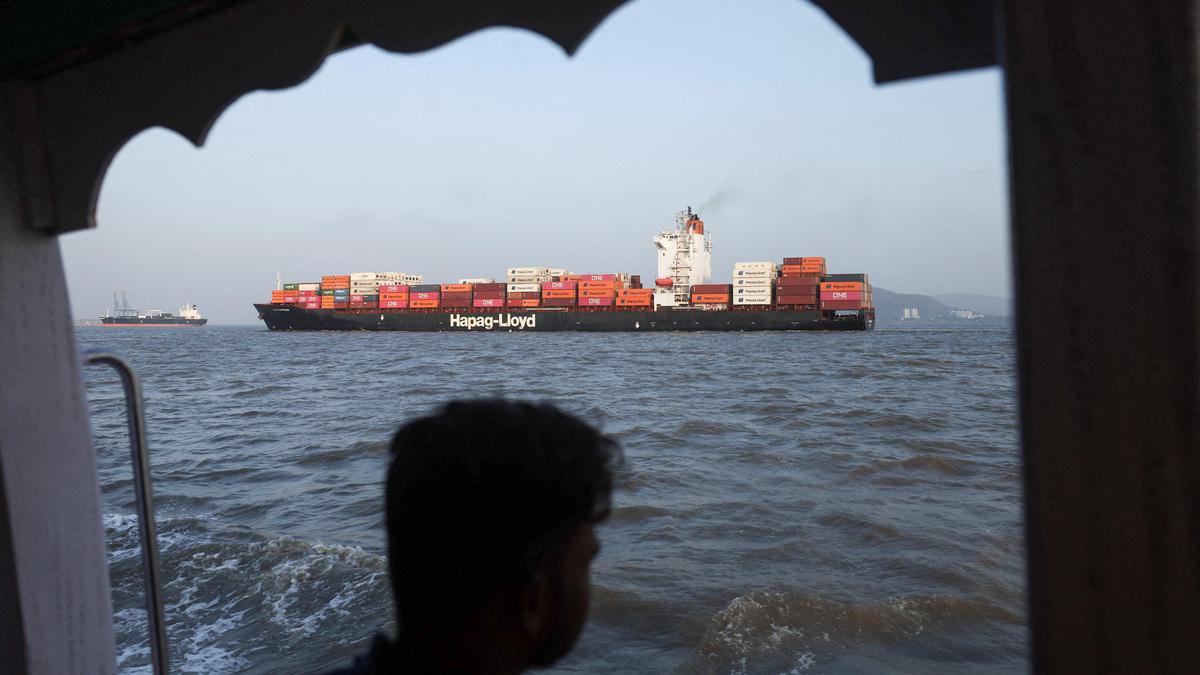
With the Strait of Hormuz effectively unnavigable for standard cargo insurance, shipping lines are charging war-risk premiums. Alternative maritime routes around Africa or overland bypasses through Central Asia add weeks to delivery schedules. For a textile exporter in Surat or an engineering firm in Jalandhar, a 14% growth in top-line export value looks a lot less impressive when corporate margins are being systematically hollowed out by a 300% increase in spot freight rates.
Furthermore, the types of goods driving the growth tell us that price inflation, rather than raw volume, is doing the heavy lifting.
The Petroleum and Commodity Paradox
Petroleum product exports rose 34.66% year-on-year to hit $9.59 billion in April 2026. This is a 24-month high. On paper, it looks spectacular. In reality, global crude oil prices have been trading near $120 a barrel due to the ongoing blockades and the conflict in the Middle East.
India imports roughly 80% of its crude oil requirements. When global oil prices surge, the nominal value of India’s refined petroleum exports goes up automatically, even if the actual volume of refined fuel leaving Indian ports remains flat or declines. This is a price effect, not a structural manufacturing boom.
Electronic goods did show genuine structural progress, climbing 40.31% to hit $5.18 billion. Engineering goods grew at a modest 8.76% to $10.35 billion. However, the reliance on high global commodity prices to push the aggregate export figure higher means that any sudden cooling of geopolitical tensions could cause India's export revenues to contract just as quickly as they expanded.
The Widening Merchandise Deficit
The single biggest warning sign in the April 2026 trade data is the merchandise trade deficit, which expanded to $28.38 billion from $27.1 billion in the same month last year. While India managed to export $43.56 billion worth of physical goods, it imported a massive $71.94 billion.
A widening goods deficit while exports are growing at double digits means one thing: the import bill is growing faster, and it is being driven by inelastic domestic dependencies.
+-----------------------------------------------------------+
|               APRIL 2026 MERCHANDISE TRADE               |
+-----------------------------------+-----------------------+
| Merchandise Exports               | $43.56 Billion        |
+-----------------------------------+-----------------------+
| Merchandise Imports               | $71.94 Billion        |
+-----------------------------------+-----------------------+
| Merchandise Trade Deficit         | $28.38 Billion        |
+-----------------------------------+-----------------------+
Electronic goods imports jumped to $12.78 billion during the month. More concerningly, gold imports surged to $5.63 billion, nearly doubling from the $3.10 billion recorded in April 2025. This occurred despite banks scaling back physical purchases and domestic gold prices hitting record highs, forcing the government to consider emergency tariff adjustments. When citizens plow capital into gold during a geopolitical crisis, it is a classic flight to safety, but it severely drains the nation’s foreign exchange reserves.
The Services Safety Net
Were it not for India's software and services sector, the external trade balance would be in a critical state. Services exports grew 13.36% in April 2026 to reach $37.24 billion. Meanwhile, services imports actually contracted slightly, dipping to $16.66 billion.
This resulted in a massive services surplus that acted as a buffer, narrowing the country’s overall trade deficit (combining both merchandise and services) to $7.81 billion, down from $11.16 billion in April 2025.
Relying on invisible service earnings to cover a gaping physical trade deficit is a high-wire act. Service exports are highly sensitive to corporate IT spending budgets in the US and Europe. If the Western slowdown deepens from flat retail demand into widespread corporate austerity, that services surplus will shrink, leaving the physical merchandise deficit fully exposed.
Wholesale Inflation and the Domestic Squeeze
The strategy of aggressive export diversification has also triggered an acute domestic side effect that the Ministry of Commerce chose not to highlight in its main briefing. Wholesale inflation in India jumped to a three-and-a-half-year high of 8.3% in April 2026.
The link is direct. Because Indian producers are frantic to find new international buyers in places like Tanzania and Singapore to compensate for lost Middle Eastern revenue, they are redirecting supplies outward. This has created artificial shortages at home. Agricultural exports under the "other cereals" category grew by 210.19% in April, while meat, dairy, and poultry shipments rose by 48.03%.
Exporters are chasing higher global food prices, leaving domestic consumers to deal with soaring grocery bills. The government has already dropped hints about an austerity plan that includes forcing administrative staff to work from home twice a week to cut down on national fuel consumption.
The central bank now faces a brutal trilemma. It must keep interest rates high to defend the rupee against a widening merchandise deficit, manage an 8.3% wholesale inflation spike, and somehow avoid choking off the credit needed by the very MSMEs keeping the export engine running.
The 14% growth in goods exports is a testament to the agility of Indian trade networks. It is a brilliant short-term tactical scramble. But celebrating it as a sign of absolute economic health ignores the underlying strain on corporate margins, the heavy reliance on inflated oil prices, and the domestic inflationary tax being paid by ordinary citizens to subsidize this global pivot.