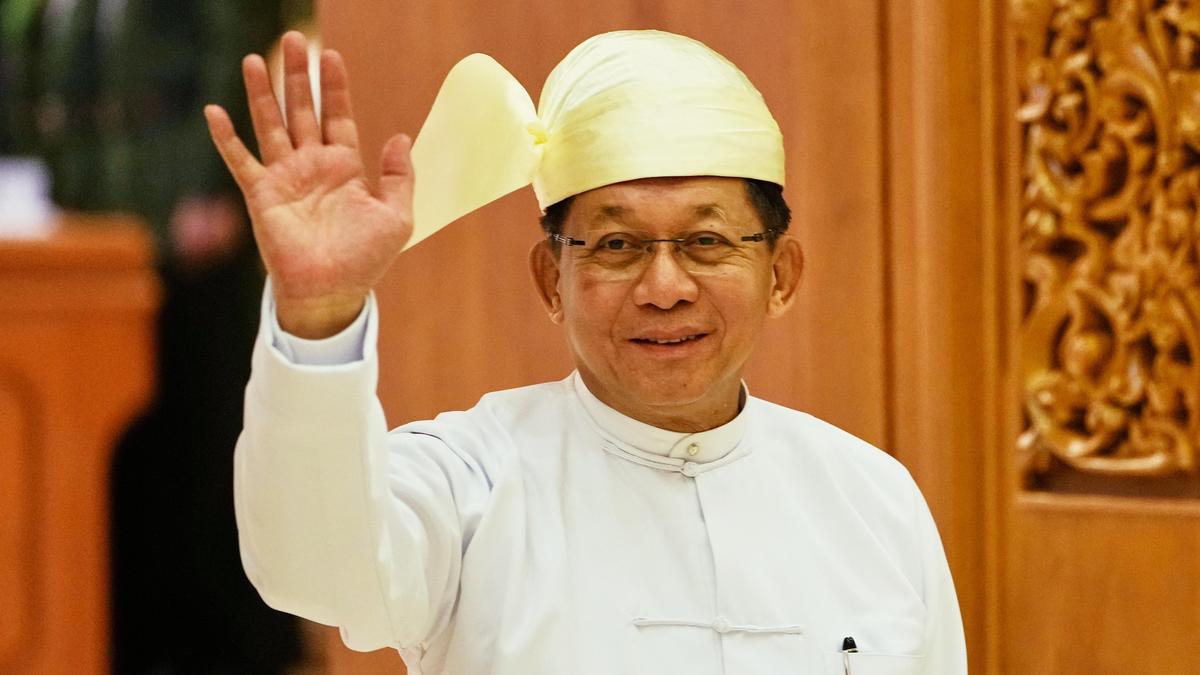
India will follow a pragmatic policy on Myanmar to protect its own borders and prevent rival powers from expanding their footprint in the region. The approach prioritizes national security, economic infrastructure, and border stability over democratic idealism. While western nations isolate the military regime in Naypyitaw, New Delhi is opening its doors. This strategy crystallizes with the arrival of Myanmar President U Min Aung Hlaing in India for an official five-day visit, signaling that the Indian government values stability on its eastern frontier far more than international approval.
Delhi refuses to let regional rivals fill the geopolitical vacuum.
A senior Indian official confirmed that domestic and international criticism over engaging the military-backed administration will not deter India. The official noted that policymakers must remain realistic about the immediate neighborhood, warning that failing to engage would allow extra-regional actors to exploit the situation. This realistic stance defines India's foreign policy framework toward a fractured neighbor.
The Illusion of Choice on the Eastern Border
Geographical reality dictates foreign policy. India shares a 1,643-kilometer land border with Myanmar, running alongside four sensitive northeastern states: Mizoram, Manipur, Nagaland, and Arunachal Pradesh.
When the military seized power in February 2021, western capitals immediately issued sanctions. They demanded a return to democracy. For a nation sitting thousands of miles away, cutting ties is an easy moral victory. For India, it is an impossible luxury.
The border region remains volatile. Decades of ethnic insurgencies in India’s northeast have relied on the dense jungles of western Myanmar for safe havens. Armed groups like the People's Liberation Army of Manipur have historically used Burmese territory to launch attacks and evade Indian security forces.
Total alienation of the central authority in Myanmar would instantly freeze security cooperation. Without a working relationship with the forces controlling Naypyitaw, India cannot secure its own perimeter.
This engagement does not imply a blanket endorsement of military rule. Indian diplomats have consistently urged a return to inclusive, constitutional governance. However, the political reality changed after the tightly controlled elections held between late December 2025 and January 2026. While opposition groups and international observers dismissed the polls as fraudulent, the exercise solidified a new institutional reality in Myanmar.
Delhi views the situation through a lens of survival, not political perfection. The alternative to engagement is state collapse, a scenario that would transform the border into an unmanageable corridor of chaos.
Infrastructure and the Shadow of Beijing
Strategic competition drives India’s patience. China has spent decades embedding itself into the economic fabric of Myanmar, building deep-water ports, oil pipelines, and transport corridors that offer direct access to the Indian Ocean. The Kyaukpyu port project gives Beijing a strategic maritime foothold right in India’s backyard.
India countered with its own investments, most notably the Kaladan Multi-Modal Transit Transport Project. This network connects the eastern Indian port of Kolkata to the Sittwe seaport in Myanmar’s Rakhine State. From Sittwe, cargo moves up the Kaladan River via inland waterways to Paletwa, and then by road into Mizoram.
The project has faced massive delays. Civil conflict, particularly the rise of the Arakan Army in Rakhine State, turned construction zones into active combat areas. Yet, walking away would mean abandoning hundreds of millions of dollars in capital and surrendering the entire Bay of Bengal coastline to Chinese influence.
By maintaining open channels with President U Min Aung Hlaing, India seeks to protect these investments. Securing commitments for the physical safety of Indian workers and the long-term operational viability of the Sittwe port tops the bilateral agenda.
Economic interdependence extends beyond concrete and steel to basic food security. India relies heavily on Myanmar for agricultural imports, particularly pulses like black gram (urad) and pigeon peas (tur). Disruptions in global supply chains have forced India to seek a five-year extension of its pulse import agreements with Myanmar. A stable trade relationship keeps food prices predictable in Indian markets.
The Fracture at Home
The crisis in Myanmar has already crossed into domestic Indian politics. Since 2021, tens of thousands of displaced persons and refugees have crossed the border into India.
The domestic reception reveals deep demographic anxieties. In Mizoram, local communities share close ethnic and cultural ties with the incoming Chin refugees from Myanmar. The state government and local civil society groups provided shelter and aid, often clashing with central directives from New Delhi.
In contrast, the situation in Manipur is tense. The arrival of undocumented migrants fueled existing ethnic anxieties among local populations, who feared that demographic shifts would strain land resources and alter political dynamics. The unrestricted movement across a porous boundary is seen as an active threat to internal peace.
In response, the Indian government took definitive steps:
- Scrapping the Free Movement Regime: The decades-old arrangement allowed border residents to travel up to 16 kilometers into each other’s territory without a visa. This privilege was suspended to curb unauthorized crossings.
- Border Fencing: New Delhi initiated plans to construct a physical fence along the entire 1,643-kilometer border, mirroring its western frontier infrastructure.
- Strict Border Passes: Casual crossings now require formal clearance from the Assam Rifles, limiting stays to a maximum of seven days.
A physical fence cannot replace intelligence sharing. A wall in a mountainous jungle is only as effective as the soldiers guarding it and the information shared by the authorities on the other side.
A Diversified Diplomatic Playbook
Relying solely on a weakened central junta is a risky gamble. While India hosts the head of the military regime, its intelligence and diplomatic channels have quietly diversified.
The military regime does not hold absolute control over the country. Vast swaths of the borderlands are governed by Ethnic Armed Organizations and anti-junta resistance forces. India has subtly engaged with these non-state actors near its borders to protect infrastructure projects and ensure that local commanders do not target Indian interests.
This dual-track diplomacy requires constant adjustment. It is a messy, high-wire act where a single misstep can alienate either the ruling generals or the rebel forces holding the ground.
By welcoming the Myanmar leader to New Delhi, Bodh Gaya, and Mumbai, India offers the regime a rare commodity: international visibility. For President U Min Aung Hlaing, a visit to the world's largest democracy provides a domestic counter-narrative to western isolation. He can signal to his domestic audience that his administration retains powerful regional partners.
India extracts concrete security guarantees in exchange for this diplomatic platform. It expects cooperation against insurgent camps, protection for transit corridors, and a coordinated approach to cross-border drug and arms trafficking.
The upcoming meetings at Hyderabad House will focus on these transactions. There will be public statements celebrating shared history and Buddhist heritage. Behind closed doors, the focus will remain entirely on territorial defense, geopolitical balance, and infrastructural survival.
India recognizes that a perfect neighbor is a luxury of geography. A pragmatic partner is the only realistic option.