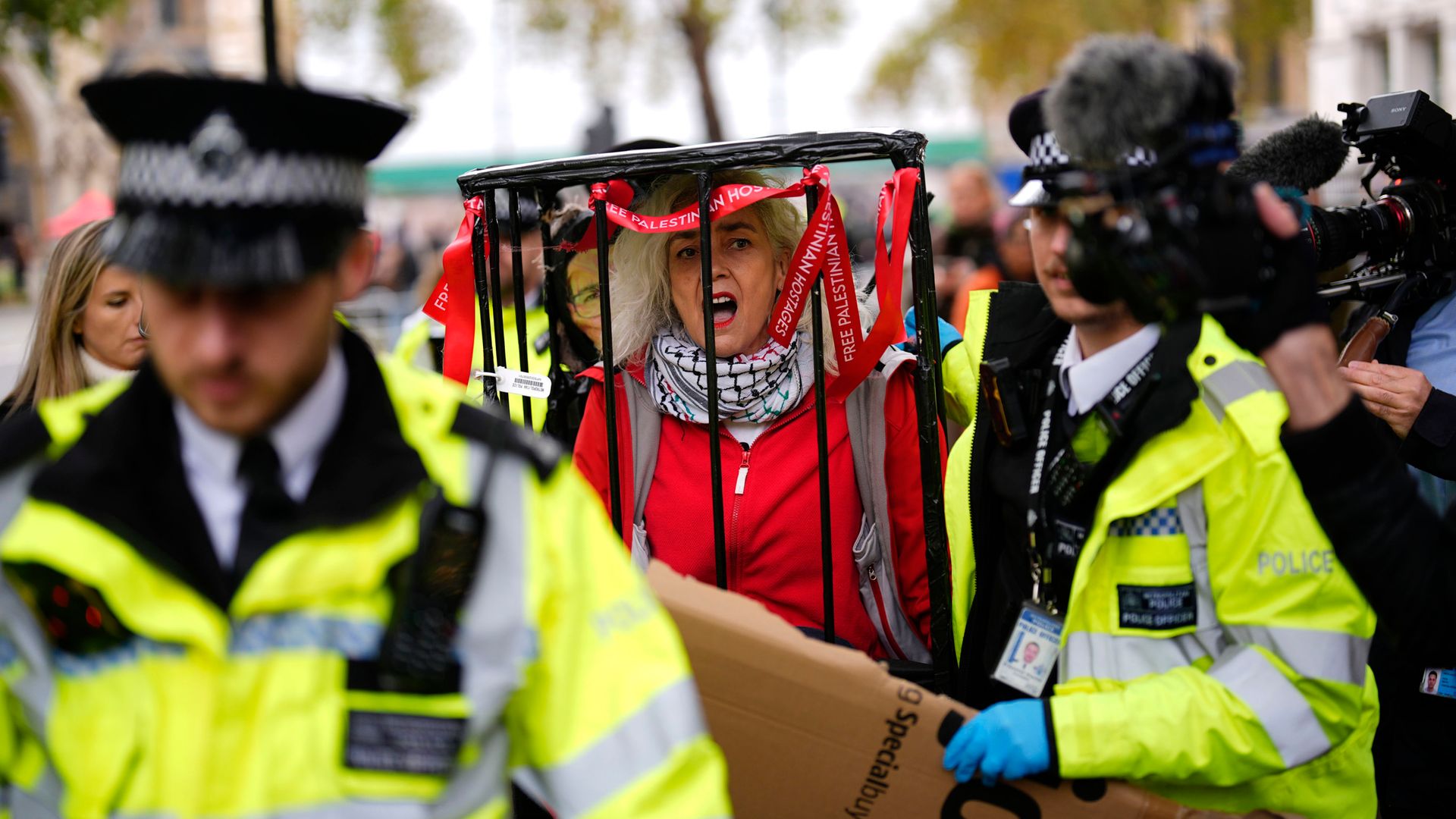
Dozens of demonstrators were arrested outside the Royal Courts of Justice in London during a pivotal judicial review challenging the British government's move to proscribe Palestine Action under the Terrorism Act 2000. While standard news wires focused strictly on the number of handcuffs clicked shut on the Strand, the real story lies inside the courtroom. A direct-action protest network known for targeting defense contractors is fighting a legal classification that turns non-violent property damage and civil disobedience into serious terrorism offenses, carrying penalties of up to fourteen years in prison.
This confrontation marks a sharp escalation in how the United Kingdom defines domestic extremism. For decades, anti-terrorism legislation was primarily reserved for armed militant groups and violent ideological cells. Now, the state is testing whether sustained, coordinated disruption of private arms manufacturers crosses the legal threshold into terrorism.
The Mechanics of Proscription Under UK Law
To understand why the arrests outside the court carried such immediate weight, you have to look at how proscription actually functions under British law. When the Home Secretary adds an organization to the list of proscribed groups under the Terrorism Act 2000, the legal ground beneath its supporters vanishes overnight.
Membership alone becomes a crime. Raising funds, organizing meetings, or even wearing clothing that arouses reasonable suspicion of support can trigger immediate arrest. That is precisely what unfolded on the pavement outside the court. Police officers did not need to prove that protesters were planning an attack or inciting violence. Under Section 13 of the Act, simply displaying an item or chanting a slogan linked to a banned group is sufficient probable cause for detention.
The legal threshold for banning a group relies on Section 1 of the Terrorism Act 2000. That definition is remarkably broad. It encompasses not just serious violence against a person, but also serious damage to property designed to influence the government or intimidate the public for a political, religious, racial, or ideological cause.
- Standard Criminal Prosecution: Historically, protesters who broke into factories, sprayed red paint on buildings, or chained themselves to gates faced charges of criminal damage, aggravated trespass, or burglary. These cases went before magistrates or crown court juries, where defendants frequently argued their actions were justified to prevent greater harm.
- Terrorism Classification: Proscription bypasses the jury defense mechanism entirely. Once banned, the group's very existence is illegal, stripping activists of the ability to organize openly and exposing peripheral supporters to counter-terrorism policing powers, including extended pre-charge detention and stop-and-search without suspicion.
Why Direct Action Provoked an Unprecedented Response
Palestine Action did not emerge from the traditional mold of street-marching activist coalitions. Founded in 2020, the network adopted a decentralized, cell-based model aimed explicitly at shutting down the UK operations of Israeli defense firm Elbit Systems and other weapons manufacturers supplying military hardware abroad.
Their tactics were relentless and expensive. Activists occupied factory rooftops for days, smashed windows, dismantled machinery, and sprayed blood-red paint across corporate facades. For the targeted companies, the financial toll mounted into the millions of pounds through lost production, heightened security budgets, and rising insurance premiums. Some facilities eventually closed or changed hands, which the group claimed as strategic victories.
Inside Whitehall, patience ran thin. Defense industry executives lobbied ministers, arguing that standard policing was failing to deter repeat offenders. Furthermore, prosecutors faced a recurring headache in the courts. On multiple occasions, juries acquitted activists charged with criminal damage after defense lawyers successfully argued that the defendants genuinely believed their actions were necessary to save lives overseas.
The state needed a sharper instrument. By moving toward proscription, the Home Office sought to dismantle the network's logistical backbone—its bank accounts, public fundraising channels, and open recruitment—without having to win individual criminal damage trials one by one.
The Clash on the Strand
Outside the Royal Courts of Justice, the tension between the right to protest and state security played out in real time. Supporter networks mobilized to demonstrate solidarity during the judicial review, knowing full well that public displays of allegiance carried the risk of arrest.
Uniformed officers, backed by specialized public order units, monitored the crowd closely. When demonstrators unfurled banners bearing the group's name and insignia, police moved in swiftly. The arrests were methodical. Officers cited violations of the Terrorism Act, removing individuals from the crowd and processing them into waiting vans.
Critics of the police operation pointed out the stark optics of the day. Dozens of peaceful demonstrators—many of them older activists, students, and local community members—were detained under laws originally drafted to combat paramilitary organizations and international terror networks. Civil liberties monitors watching from the sidelines warned that the street-level enforcement demonstrated the exact chilling effect the legal challenge was trying to prevent.
Inside the Judicial Review
While police cleared the pavement outside, barristers inside the courtroom dissected the legality of the ban. A judicial review does not ask whether the government made a good policy choice; it asks whether the government acted lawfully, rationally, and proportionally within the bounds of its statutory powers.
The legal team challenging the ban centered their arguments on two primary pillars:
Overreach of Statutory Definitions
Lawyers for the challengers argued that Parliament never intended the Terrorism Act 2000 to be weaponized against domestic direct-action groups that adhere to a strict policy of non-violence toward human beings. While acknowledging that Palestine Action engaged in deliberate property damage, counsel contended that equating broken windows and paint with terrorism destroys the legal distinction between civil disobedience and political terror.
Disproportionate Interference with Free Expression
Under the European Convention on Human Rights, incorporated into UK law via the Human Rights Act 1998, citizens have protected rights to freedom of expression (Article 10) and freedom of assembly (Article 11). While the state can restrict these rights in the interest of national security, those restrictions must be strictly proportionate. The challengers maintained that existing criminal laws—which already carry stiff prison sentences for aggravated burglary and criminal damage—were more than adequate to punish unlawful behavior without criminalizing political speech and association.
Government lawyers pushed back hard. Representing the Home Office, state counsel argued that systematic, coordinated sabotage against defense infrastructure directly threatens national security and public safety. They contended that when a group deliberately inflicts massive economic damage to coerce government foreign policy, it fits squarely within the statutory wording Parliament approved more than two decades ago.
Historical Precedents and the Slippery Slope
Veteran court watchers recognize this friction. Britain has a long, complicated history of balancing public order against radical protest movements.
Consider a hypothetical example to see how easily the legal boundary shifts. Imagine an environmental group decides to halt fossil fuel extraction by systematically sabotaging pipelines and gluing themselves to refinery valves, causing millions in losses to force a change in government energy policy. Under the exact same reading of Section 1 of the Terrorism Act—serious property damage intended to influence the government for an ideological cause—that environmental group could also be proscribed as a terrorist organization.
This is not merely theoretical speculation. Civil liberties organizations, including Liberty and Amnesty International, have repeatedly raised alarms over the expansion of public order and counter-terrorism laws in Britain. Over the past decade, successive governments have introduced measures such as Serious Disruption Prevention Orders and lowered the threshold for what constitutes a public nuisance.
Each legislative step was justified as a targeted response to specific, disruptive tactics—whether from climate activists blocking motorways or anti-war demonstrators occupying factories. Yet taken together, these measures steadily narrow the space for dissenting political action.
The Counter-Argument From National Security Officials
To dismiss the government's position entirely as authoritarian overreach ignores the very real dilemmas facing security planners and defense officials. From the perspective of the Home Office and intelligence agencies, the distinction between property sabotage and personal harm is thinner than activists claim.
Security officials point out several uncomfortable realities:
- Escalation Risks: When activists breach secure defense facilities, they do not always know what is inside. Breaking into sites that manufacture sensitive military electronics or aerospace components creates immediate security vulnerabilities that foreign intelligence services can exploit.
- Operational Disruption: Britain's defense industrial base is intertwined with NATO supply chains and domestic military readiness. Sustained disruption at key manufacturing hubs does not just hurt corporate shareholders; it delays equipment deliveries to armed forces.
- Worker Intimidation: While direct-action groups insist they target property rather than people, factory employees report feeling terrified when masked individuals breach perimeters, smash through roofs, and confront staff on the factory floor. From the state's viewpoint, terrorizing workers to force a business to close crosses a bright moral and legal line.
For ministers, relying on standard criminal trials proved untenable when juries repeatedly refused to convict despite clear video evidence of property destruction. Proscription offered a decisive administrative hammer to stop a campaign that the courts seemed unable or unwilling to halt through conventional prosecutions.
What the Ruling Means for Protest Movements in Britain
The outcome of this legal battle extends far beyond a single activist network or a specific defense contractor. It establishes a critical precedent for how the British state polices ideological dissent in the years ahead.
If the court upholds the Home Secretary's decision, the operational playbook for radical protest in the UK changes permanently. Any group that adopts economic sabotage or sustained property damage as a political tactic will face the existential threat of proscription. Fundraising via mainstream platforms will become impossible, public solidarity rallies will result in mass arrests, and peripheral supporters will risk lifelong terrorism convictions that bar them from international travel and standard employment.
Conversely, if the challengers succeed and the court quashes the ban, the Home Office suffers a major constitutional rebuke. It would signal that the judiciary remains willing to police the boundaries of counter-terrorism legislation, forcing the government back to relying on traditional criminal law and jury trials to handle disruptive protesters.
Even a victory for the challengers, however, carries caveats. Judicial review rulings often hinge on narrow procedural grounds—such as whether a minister failed to consider a specific piece of evidence or neglected a consultation step—rather than sweeping declarations on human rights. A government that loses on a technicality can simply rewrite the justification, conduct a fresh review, and re-impose the ban months later.
Meanwhile, the individuals arrested outside the Royal Courts of Justice face the immediate, grinding reality of the criminal justice system. Released on bail with strict conditions, they must wait months to learn whether holding a placard on a London street will saddle them with a terrorism record, leaving the fundamental boundary between fierce political dissent and state-defined extremism sharper, darker, and more contested than ever before.


