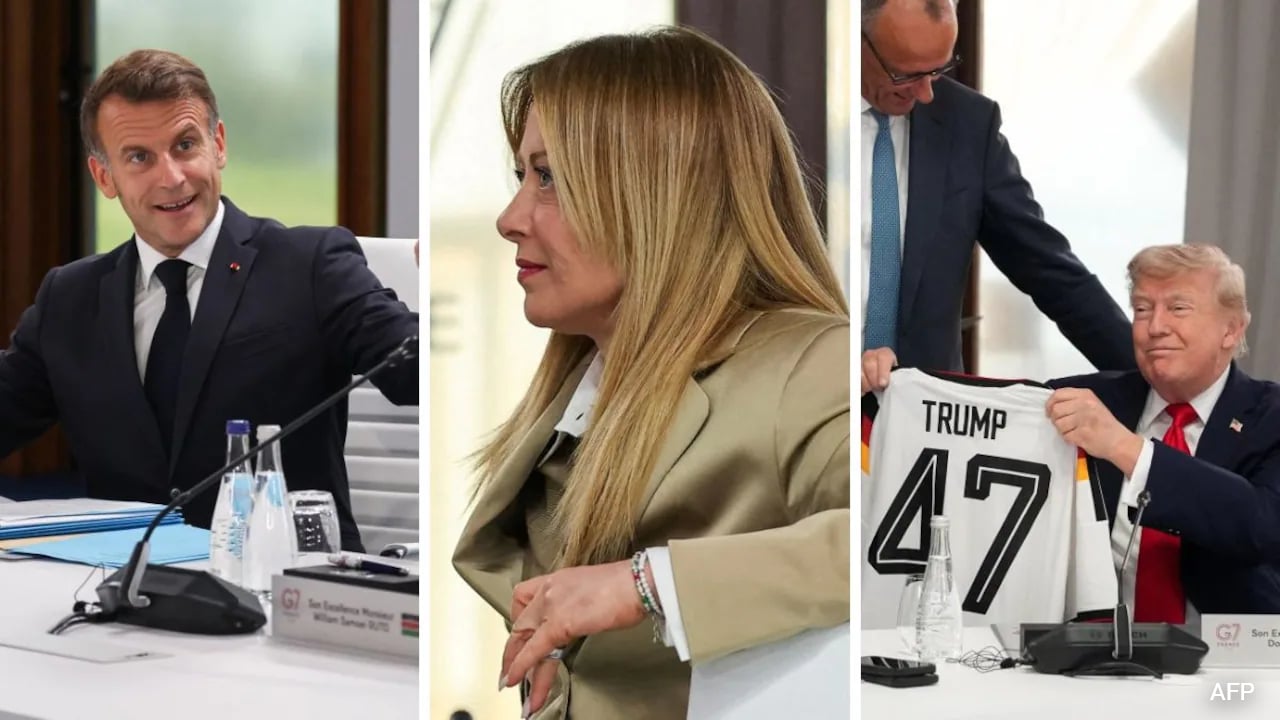
The real business of global governance never happens during the televised plenary sessions. It happens in the five-minute buffer periods when staff clear the plates and leaders think the audio feeds are dead. At the G7 summit in Evian-les-Bains, France, a series of hot-mic recordings exposed the vast gulf between the sanitized communiqués fed to the press and the ruthless, transactional reality of international diplomacy. While official reports focused on formal economic declarations, the live microphones captured something far more revealing. They exposed how leaders execute backchannel trade maneuvers, test geopolitical redlines, and size up their peers through engineered casualness.
The broadcast networks treated these recordings as lighthearted human-interest gossip. Tabloids ran pieces detailing Italian Prime Minister Giorgia Meloni’s tobacco cravings and French President Emmanuel Macron’s misplaced timepiece. That reading completely misinterprets how power operates at this level. In high-stakes diplomacy, a casual question is rarely casual, a forgotten object is a vulnerability, and a single whispered noun can freeze an entire room.
The Tariff Backchannel in Plain Hearing
The most consequential interaction of the summit occurred over a discarded luxury accessory. French President Emmanuel Macron departed a working lunch and left his watch sitting on the roundtable next to U.S. President Donald Trump. Canadian Prime Minister Mark Carney spotted the item, initiating a brief, humorous exchange with Trump about pocketing it.
"Give me it if he left, gimme," Trump said, prompting laughter from the surrounding delegates.
That brief moment of levity served a specific tactical purpose. It broke the ice for Carney to immediately transition into a high-stakes, unsolicited pitch regarding international trade boundaries. Within thirty seconds of the watch joke, Carney leaned in toward a seated Trump to defend Canada’s highly controversial trade agreement with Beijing. The deal allows Canada to import up to 49,000 Chinese electric vehicles at a reduced tariff rate.
"Less than three percent of our market, 49,000 cars," Carney was heard saying, his hand slicing through the air to mimic a ceiling. "It's a cap, we capped, a hard line. I thought you'd actually like that."
Trump’s recorded response was brief. "That's good, I like it."
This exchange bypasses months of formal, deadlocked state department communications. The Trump administration had spent weeks publicly threatening severe retaliatory tariffs against Ottawa, warning that Canada must not become a transit hub for subsidized Chinese manufacturing to slip into the American market. By utilizing a moment of shared humor over a colleague's forgotten watch, the Canadian Prime Minister managed to present a defensive trade concession directly to the American president, securing a tentative verbal approval before formal bilateral negotiations even began.
The One Word Threat to European Sovereignty
While trade caps are negotiated with numbers, structural geopolitical threats are often delivered with minimal vocabulary. Later in the afternoon, microphones captured an exceptionally brief, chilling exchange between Trump and European Council President António Costa.
The recording picked up the tail end of an unmonitored conversation. Trump leaned toward Costa, paused, looked directly at him, and uttered a single word.
"Greenland."
The audio feed cut out immediately after, leaving the context obscured. For European diplomats, however, the context requires no elaboration. The American president’s long-standing interest in acquiring the resource-rich, semiautonomous Danish territory has shifted from a historical oddity into a recurring structural anxiety for the European Union.
By dropping the name of a sovereign European territory into a casual hallway transition, the American administration signals that its transactional view of global real estate remains active. It functions as a psychological wedge, reminding European leadership that foundational continental borders remain up for discussion in the current Washington architecture. Costa’s silent, unrecorded reaction speaks to the broader European dilemma at this summit. They are forced to balance traditional alliances against an American leadership style that treats global geography as a real estate portfolio.
Tobacco Alliances and Domestic Posturing
Even the seemingly trivial personal updates at the summit table carried distinct political weight. German Chancellor Friedrich Merz opened a session by casually asking Giorgia Meloni if she had smoked her morning cigarette. Meloni responded that she had avoided tobacco entirely since the first of May, prompting applause from the leaders of the United Kingdom, Japan, and Canada. Mark Carney joked about whether she was wearing a nicotine patch.
On the surface, this is standard human camaraderie. In the context of Meloni’s current domestic reality, it is a calculated display of discipline. The Italian Prime Minister has built her political brand on an image of uncompromising willpower and nationalist strength. Publicly demonstrating the sheer physical discipline required to abruptly quit a long-term smoking habit reinforces that exact narrative to both her domestic electorate and her international peers.
Meloni used the moment to signal her status as an unyielding negotiator. If a leader possesses the absolute self-control required to terminate a lifelong physical addiction overnight, she implies she possesses the identical resolve when defending Italy's sovereign budget or border policies against European Union bureaucrats.
The Sports Fallback and the Illusion of Unity
When geopolitical friction threatens to stall proceedings entirely, sports talk serves as the ultimate diplomatic lubricant. As tensions simmered over trade disputes, leaders repeatedly retreated into discussions regarding the ongoing FIFA World Cup in North America.
British Prime Minister Keir Starmer deflected from intense regional security debates by effusing over Cape Verde’s unexpected scoreless draw against Spain. Simultaneously, French officials led chants of "Allez les bleus" to celebrate their national football squad. Trump countered by shifting the room toward American combat sports, praising UFC executive Dana White following an event hosted at the White House for his eightieth birthday.
This is not idle chatter. It is a deliberate containment strategy. When world leaders run out of script on matters of war, currency manipulation, and climate targets, they weaponize sports trivia to maintain a veneer of international collegiality. It allows them to project an illusion of shared global culture to the cameras while their respective policy teams trade irreconcilable demands in the adjoining rooms.
The hot mics of Evian-les-Bains did not expose a lighter side of global governance. They exposed a highly calculated ecosystem where every misplaced watch, every personal milestone, and every cryptic geographical reference is cataloged, weaponized, and deployed for national advantage.