Clashes between demonstrators and security forces across France are not random bursts of street chaos; they are the predictable collision of stagnant wages, strained schools, and a policing doctrine built to defend state institutions rather than de-escalate crowds. When headlines reduce these events to "clashes," readers miss the structural mechanics driving citizens into the streets.
Anyone who has covered French social movements over the past two decades recognizes the rhythm. A localized grievance sparks a walkout or blockade. Union leaders, student collectives, and frustrated households converge on overlapping grievances—rising living costs, underfunded public services, and political distrust—while small, hardened fringe groups exploit the congestion.
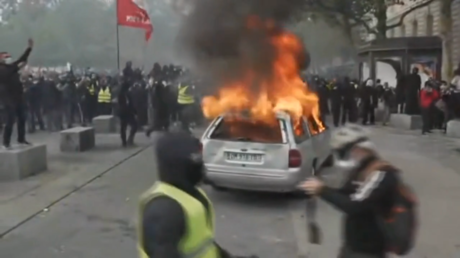
By autumn 2026, that combustible mix had turned into sustained nationwide friction. High school blockades that began in September over unfilled teaching posts, overcrowded classrooms, and shortages of support staff quickly collided with public-sector wage disputes and broad cost-of-living anger. Days of mobilization in October and November brought hundreds of thousands into the streets across Paris, Marseille, Lyon, Toulouse, and Nantes, leaving hundreds of demonstrators and educators injured alongside roughly a thousand police officers hurt during the peak October 17 clashes.
Why Grievances Stack Up Faster Than Policy Can Answer
Street anger rarely starts over a single line item in a budget. It builds when families feel squeezed from every direction at once while political institutions appear slow or distant.
In France, public-sector workers, students, and everyday consumers have been living through a prolonged squeeze on purchasing power. Talks between Prime Minister Sébastien Lecornu and labor unions in November failed to bridge demands for across-the-board public-sector pay increases, even after private-sector minimum wage adjustments. For workers watching grocery bills, housing costs, and energy expenses climb, incremental compromises feel like managed decline rather than relief.
Students and teachers brought a parallel set of pressures into the same streets. Starting in late summer and September—first in overseas territories like Mayotte and French Guiana, then spreading rapidly across lycées in the Paris suburbs and beyond—young people walked out over crumbling facilities, missing staff, and anxiety around university admissions through Parcoursup. When the government later floated reforms to replace Parcoursup over several years, student organizers welcomed the movement on paper while refusing to stand down entirely.
When schools lack tables and nurses in September and pay talks stall in November, a single march becomes a catch-all referendum on economic survival and institutional trust.
There is a crucial distinction between peaceful mass protest and fringe opportunism. Most marchers show up to be counted, chant slogans, and pressure lawmakers. Yet every large demonstration in France now attracts two disruptive poles: militant street fighters who throw projectiles, set fires, or loot storefronts, and counter-protesters or far-right agitators who turn flashpoints into ideological brawls.
How French Crowd Control Turns Friction Into Flashpoints
To understand why French demonstrations so frequently escalate into pitched battles, look at the hardware and doctrine on the ground. Security forces in France operate inside a centralized state tradition where maintaining public order and protecting government symbols carry heavy institutional weight.
Police deploy intermediate-force weapons designed to disperse and disorient crowds without using lethal firearms. Those tools include:
- LBD 40 and GL06 launchers, firing single-shot 40 mm blunt-impact rounds or 56 mm riot-control munitions.
- Tear gas and sting grenades, such as CM2L devices that pair chemical irritants with loud concussive blasts.
- Strobe shields and rigid side-handle batons, used to hold perimeters, dazzle advancing groups, and enforce physical separation.
- Water cannons and armored vehicles, brought out in cities like Lyon and Nice when barricades go up or gatherings are banned.
Interior Minister Laurent Nuñez and National Police officials argue these tools are defensive, graduated, and proportionate when officers face fireworks, projectiles, or petrol bombs. From the state's perspective, deploying tens of thousands of officers—including specialized units—is essential to stop property destruction and protect bystanders.
Critics, human rights monitors, and injured protesters see a harsher reality. Critics point out that blunt-impact rounds and concussive grenades do not distinguish cleanly between a violent instigator and a teenager standing nearby. Because foam projectiles leave no rifling or cartridge trail tied to a specific barrel, accountability after severe injuries remains fiercely contested.
There is also a tactical trap built into broad dispersal and protest bans. When authorities restrict march routes or ban gatherings altogether, peaceful demonstrators and violent fringe actors get compressed into the same side streets. Once tear gas flies into a mixed crowd, people who came to march peacefully can get swept into confrontations they never intended to join.
The Electoral Calculus Behind Every Street Battle
Street clashes in France never stay confined to the asphalt. They feed straight into national politics, especially with the next presidential election drawing closer.
Consider a hypothetical example to see how the political math works. Suppose a neighborhood shopkeeper in Lyon watches windows smashed during an evening clash, while a high school senior in Seine-Saint-Denis is hit by tear gas outside a blocked school earlier that afternoon. Both citizens may despise the status quo, yet they draw opposite conclusions about who failed them—one blaming lax order and street disorder, the other blaming heavy-handed state repression and indifferent ministries.
President Emmanuel Macron and his allies have tried to split the difference by condemning "ultra-left" rioters and threats to the Republic while separating them from legitimate student grievances or negotiating targeted concessions. Whether voters buy that distinction is another matter. Polling around the mid-October unrest showed a vast majority of respondents placing primary blame on the government for the spiral of confrontation.
Meanwhile, political extremes on both sides read the same street footage as an opportunity. Hard-right figures point to looting, burned vehicles, and attacks on officers to argue for tougher policing, stricter laws, and authoritarian order. Hard-left movements and militant factions frame the same clashes as proof that economic inequality and state coercion require radical confrontation.
| Factor | State & Security View | Protest & Civil Society View | Practical Trade-Off |
|---|---|---|---|
| Crowd Tactics | Graduated, defensive response to riots and projectiles | Aggressive dispersal that harms peaceful marchers and youths | Heavy force can halt immediate looting while fueling long-term resentment |
| Protest Bans & Limits | Prevents unlawful disorder in sensitive zones | Restricts democratic assembly and mixes peaceful and violent crowds | Clearer routes reduce chaos only if enforcement avoids mass kettling |
| Economic & School Demands | Constrained by budgets, inflation, and phased reforms | Urgent fixes needed for wages, living costs, and classrooms | Slow rollouts keep tensions simmering between major strike days |
What Real De-Escalation Would Actually Require
Fixing a cycle this entrenched takes more than a press conference or a fresh wave of riot gear. Neither pure repression nor endless street protest solves a structural mismatch between public expectations and state delivery.
First, targeted de-escalation has to separate peaceful marchers from violent offenders before clashes ignite. That means clearer communication with union and student stewards, avoiding blanket bans that trap bystanders in flashpoint zones, and tightening rules and traceability around high-impact munitions.
Second, credible material concessions matter far more than symbolic gestures. Announcing a multi-year overhaul of admissions or holding talks without concrete relief on wages and classroom staffing rarely calms people who feel the pinch every week.
Third, honest political leadership requires admitting when a policy or security posture is backfiring instead of treating every protest as an existential assault on the state. France has a long, proud history of public protest; treating citizens in the street as enemies guarantees the next clash is already waiting around the corner.
Watch how union leaders coordinate upcoming strikes with student groups over the coming weeks. If peaceful organizers can isolate street violence and force concrete policy answers on wages and schools, the pressure shifts back onto lawmakers—where democratic disputes belong.