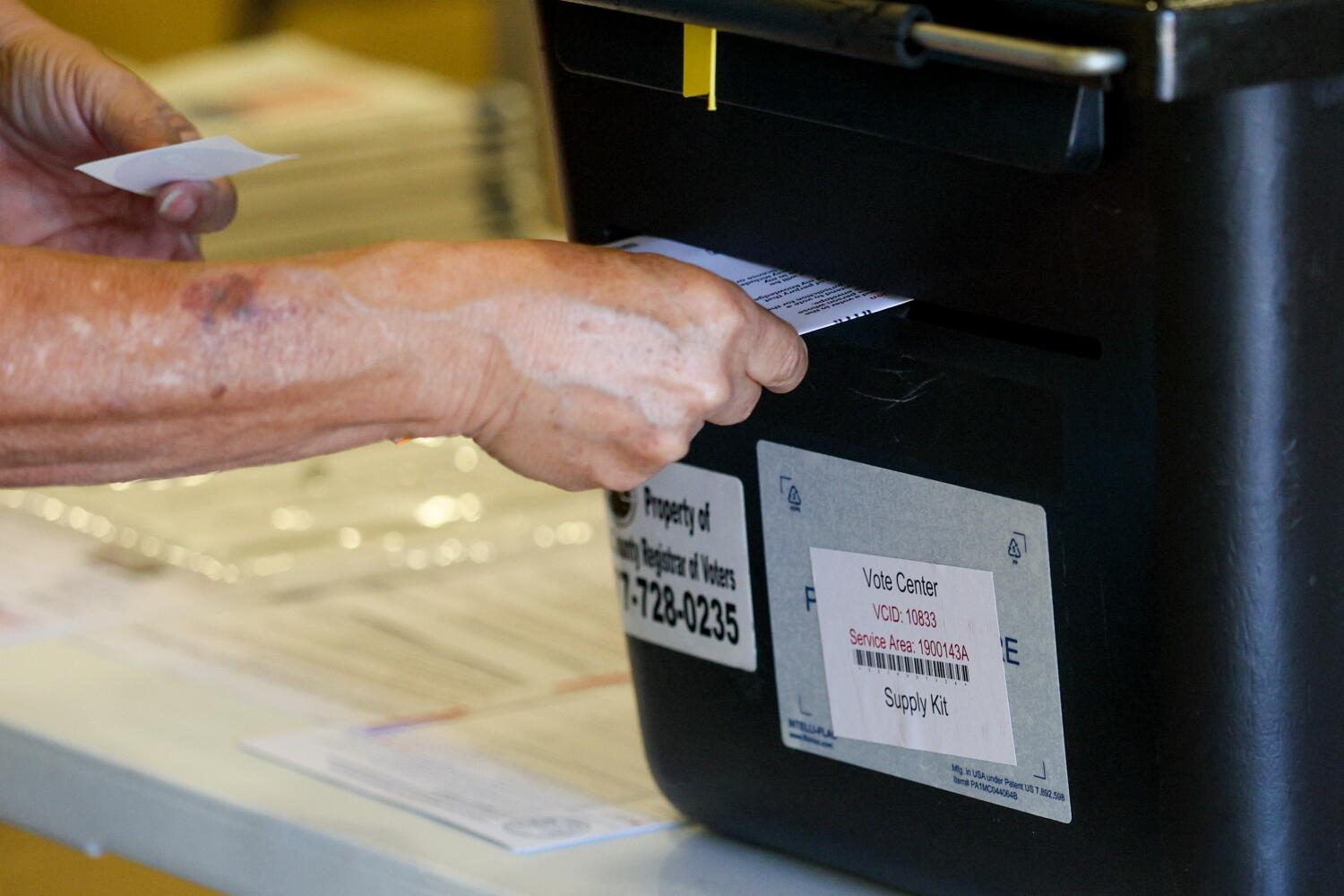
Federal courts have repeatedly turned back legal efforts to throw out roughly 20,000 disputed ballots in California, yet the underlying war between Sacramento and Washington over who controls American election rules is far from over. Despite judicial rebukes pointing out a lack of concrete evidence and procedural missteps, federal officials and allied litigants continue to press aggressive challenges targeting California’s mail-in voting architecture, signature verification protocols, and voter roll maintenance. At stake is not merely the fate of a localized batch of envelopes, but the constitutional boundary between state election autonomy under the Elections Clause and federal oversight.
The courtroom defeats did not end the campaign. They simply shifted its venue.
For decades, election litigation followed a predictable script: campaigns fought over hanging chads, broken machines, or late-arriving absentee envelopes in the weeks immediately following Election Day, and once a judge ruled, the losing side packed up its briefcases. That era is dead. Today, post-election lawsuits function as opening salvos in a multi-year war of attrition over statutory interpretation, administrative power, and public trust. When judges reject a challenge to 20,000 ballots, the plaintiffs do not view the ruling as a final verdict on the facts; they view it as an intermediate step toward appellate review, congressional hearings, or Department of Justice enforcement actions.
Why 20,000 Ballots Became a Constitutional Flashpoint
To understand why a dispute over 20,000 ballots refuses to die, you have to look at the mechanics of California’s modern voting system. Over the past decade, the California Legislature dismantled traditional precinct-based voting in favor of universal mail-in ballots, automatic voter registration through the Department of Motor Vehicles, same-day conditional registration, and a generous post-Election Day receipt window for postmarked mail. State officials argue these policies maximize turnout and eliminate artificial barriers to the franchise. Critics, including federal lawmakers and conservative legal groups, argue the exact opposite: that expanding the window and loosening chain-of-custody rules invites administrative error and erodes confidence in the count.
The specific batch of 20,000 ballots sits right on the fault line of those two philosophies.
In high-volume vote-by-mail states, tens of thousands of ballots routinely land in administrative gray zones during initial processing. Some arrive without a legible postmark. Others carry signatures that fail automated optical character recognition checks because a voter signed hastily on a kitchen counter or aged since their last DMV renewal. Still others belong to voters who moved across county lines without updating their registration in time, triggering provisional review. Under California law, county registrars do not simply toss these ballots into a shredder. Instead, election workers isolate them, notify the voters through a statutory cure process, and allow days or even weeks for the voter to verify their identity or prove timely mailing.
That window is where the legal warfare happens.
Opponents of California’s framework contend that counting ballots cured or received after Election Day violates federal statutes setting a uniform national "Election Day" for federal offices. In court filings, challengers argued that allowing state deadlines to stretch days past the first Tuesday after the first Monday in November effectively extends the election indefinitely and dilutes timely cast votes. Federal judges, however, have consistently pushed back against requests to invalidate those 20,000 ballots retroactively. Judges noted that election officials followed state statutes that had been on the books long before voters cast their ballots, and they emphasized that challengers failed to produce evidence showing any of the 20,000 ballots were cast by ineligible individuals.
In election law, that distinction is fatal to a plaintiff’s case. Courts are deeply reluctant to disenfranchise voters who followed the rules laid out by their state government at the time they voted, even if a challenger raises serious statutory questions about whether those rules should exist in the first place.
The Anatomy of a Judicial Rebuke
When federal judges rebuked the attempt to toss the 20,000 ballots, their opinions rested on three well-established pillars of federal jurisprudence: standing, laches, and evidentiary burden.
First comes Article III standing. To sue in federal court, a plaintiff cannot simply allege that a state government is mismanaging its elections or violating a federal statute in the abstract. The plaintiff must demonstrate a concrete, particularized injury that differs from the generalized grievance shared by every other citizen. Judges reviewing challenges to California’s ballot processing repeatedly found that plaintiffs relied on speculative theories of "vote dilution"—the claim that counting a potentially improper ballot mathematically weakens the value of a valid ballot. Federal appellate courts have largely rejected generalized vote dilution as a ticket into court unless a candidate or party can prove the disputed ballots directly threaten a specific electoral outcome.
Second is the equitable doctrine of laches, which bars litigants from sitting on their hands before an election and only suing after they see the results. California’s mail-in receipt deadlines, signature cure rules, and motor-voter procedures were enacted through public legislation years ago. Judges pointed out that challengers had ample opportunity to file pre-election facial challenges to those statutes before a single ballot was mailed out. Waiting until after ballots were cast and counted—and then asking a judge to throw out 20,000 votes—triggers intense judicial skepticism.
Third, and most damaging to the challengers' narrative, was the evidentiary gap. In court, statistical anomalies and administrative delays are not proof of fraud. Showing that 20,000 ballots required manual review or arrived during a post-election grace period proves only that California’s system operates at massive scale with built-in verification buffers. Without sworn affidavits, audit trails, or forensic records showing ineligible people actually voted, judges refused to issue the extraordinary remedy of mass ballot invalidation.
Yet a judicial rebuke on procedural or evidentiary grounds does not resolve the underlying constitutional friction. It leaves the core legal questions simmering just beneath the surface.
How Federal Leverage Works Without Winning in Court
If the courts won't throw out the ballots, why does the fight continue? Because courtroom victories are no longer the sole objective. Federal actors possess multiple levers to pressure California’s election apparatus outside the confines of a single ballot challenge.
Consider how National Voter Registration Act (NVRA) litigation operates. Under Section 8 of the NVRA, states are required to conduct reasonable list maintenance to remove voters who have died or moved away. Federal officials and outside watchdog groups routinely demand raw voter registration rolls, inactive-voter logs, and DMV motor-voter transfer records from the California Secretary of State. Even if a court refuses to invalidate 20,000 ballots from a past election, federal plaintiffs can use the discovery process in NVRA lawsuits to force county registrars to turn over millions of lines of administrative data. If those records reveal bloated rolls or sluggish removal of outdated addresses, federal authorities can seek consent decrees or court-ordered list cleanups ahead of future cycles.
Then there is the power of the federal purse and administrative rulemaking. Congress controls hundreds of millions of dollars in Help America Vote Act (HAVA) grants distributed to states for election security, voting machine upgrades, and poll worker training. Federal lawmakers and executive agencies can attach strict compliance conditions to future funding streams—requiring, for instance, hard cutoffs for ballot receipt on Election Night, mandatory documentary proof of citizenship during registration, or standardized federal signature-matching thresholds.
California officials view these efforts as an unconstitutional intrusion into state sovereignty. Under Article I, Section 4 of the U.S. Constitution—the Elections Clause—the times, places, and manner of holding elections for senators and representatives are prescribed in each state by its legislature, though Congress may at any time make or alter such regulations. California’s legal team argues that absent an explicit act of Congress overriding state law, Washington cannot use executive pressure, selective audits, or post-hoc litigation to dismantle state voting rules that have already survived judicial scrutiny.
Washington’s counterargument is equally rooted in constitutional text. Proponents of federal intervention argue that the Elections Clause explicitly grants Congress supremacy over federal election rules, and that federal statutes like the Electoral Count Reform Act and the uniform Election Day laws already preempt state rules that allow ballots to dribble in days after the polls close.
What Both Sides Miss About Administrative Reality
Strip away the partisan rhetoric from both Sacramento and Washington, and you are left with a gritty operational reality that neither side likes to advertise: running an election for more than 22 million registered voters in a state spanning 58 counties is an administrative high-wire act where perfection is impossible.
In any hypothetical county processing half a million mail ballots, a 1 percent exception rate produces 5,000 ballots requiring human intervention. Multiply that across California’s massive electorate, and 20,000 disputed or delayed ballots is not an anomaly—it is a mathematical certainty.
California defenders often downplay the friction caused by their sprawling post-election timeline. When it takes weeks to cure signatures, adjudicate provisional envelopes, and certify results in close congressional districts, public suspicion fills the vacuum. Even when every single ballot is ultimately verified and legitimate, a month-long count erodes confidence among voters accustomed to seeing winners declared on television before midnight. Transparency suffers when ballots sit in county warehouses undergoing multi-stage verification out of public view, no matter how many observers are technically permitted inside the tabulation room.
Conversely, federal critics frequently mischaracterize normal verification friction as evidence of systemic corruption. In reality, the very fact that 20,000 ballots were flagged, segregated, and subjected to secondary review proves that the guardrails were functioning. A rigged or lawless system does not quarantine 20,000 envelopes for signature mismatches or missing postmarks; it counts them silently without logging the exceptions. By demanding the wholesale rejection of ballots caught in routine administrative review, challengers risk punishing election administrators for catching the exact discrepancies those rules were designed to surface.
The Appellate Horizon and the Next Battleground
The judicial rebukes over the 20,000 ballots have only hardened the resolve of legal strategists looking toward the federal appellate courts and the Supreme Court. Legal teams challenging state mail-in regimes have studied why earlier lawsuits failed and are adjusting their tactics accordingly.
Instead of filing sprawling, last-minute complaints demanding the invalidation of thousands of ballots after an election, plaintiffs are now filing targeted, pre-election facial challenges on narrow statutory grounds. One major legal front involves whether federal Election Day statutes prohibit states from counting mail ballots received after Election Day, even if they were postmarked on time. Recent appellate rulings in other circuits have shown that at least some federal judges are receptive to the argument that "voting" is not complete until a ballot is received by election officials, not merely dropped into a mailbox.
If a circuit split widens on post-Election Day ballot receipt, the U.S. Supreme Court will almost certainly step in to settle the question nationwide. A ruling barring post-Election Day receipt would force California to rewrite its election code overnight, wiping out its multi-day mail grace period and potentially invalidating tens of thousands of late-arriving ballots in future cycles—not through post-election lawsuits, but by statutory mandate before Election Day even arrives.
At the same time, federal investigators and civil rights divisions remain locked in parallel disputes with California over data access, voter roll accuracy, and ballot-harvesting regulations. Sacramento has shown zero willingness to retreat from its universal mail-in model, viewing it as a national blueprint for democratic access. Federal challengers show equally little interest in backing down, viewing California’s system as a direct threat to uniform national standards.
The 20,000 ballots at the center of the recent court rulings may remain safely in the certified totals, protected by judicial precedent and the lack of evidence against them, but the machinery that produced them is now permanently on trial.


