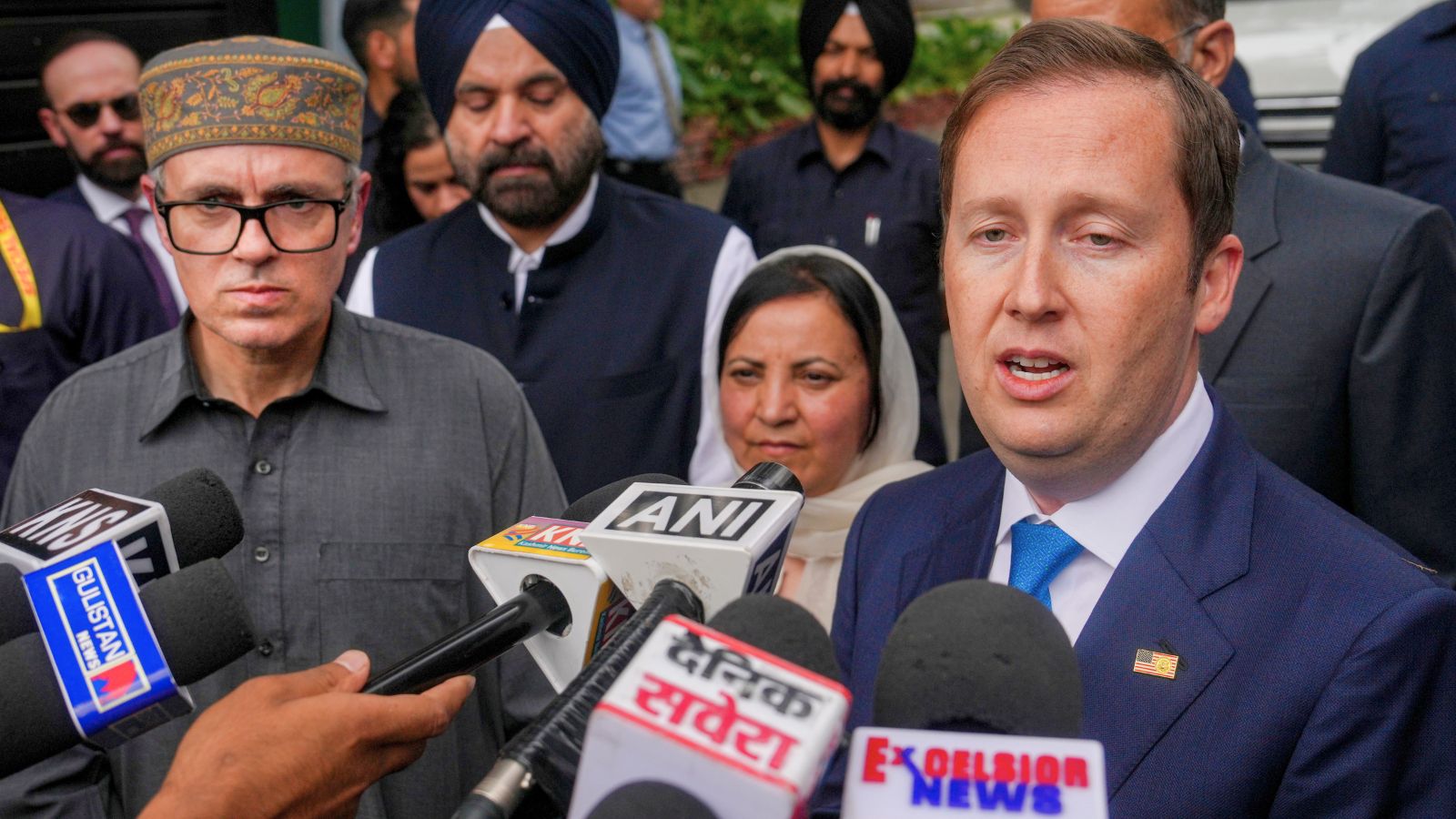
When United States Ambassador to India Sergio Gor touched down in Srinagar, strolled past Pari Mahal, and took a quiet shikara ride on Dal Lake, standard diplomatic protocol was quietly rewritten. Standing alongside Jammu and Kashmir Chief Minister Omar Abdullah, Gor delivered a sentence that instantly detonated decades of carefully hedged American foreign policy rhetoric. He called the region an important part of India.
The fallout was immediate. Within hours, Pakistan summoned the top American diplomat in Islamabad, handing over a stinging formal protest that accused Washington of abandoning international law and its own historical stance. But beneath the predictable diplomatic theater of summoned ambassadors and fiery press releases lies a much deeper geopolitical shift. Washington is no longer pretending to walk the tightrope in South Asia. For an alternative view, read: this related article.
The End of Strategic Ambiguity
For generations, the official position of the United States Department of State on Kashmir resembled a masterclass in linguistic gymnastics. Washington traditionally described the territory as a disputed status issue that needed to be resolved bilaterally between New Delhi and Islamabad, while occasionally paying lip service to the wishes of the local population. It was a deliberate ambiguity designed to keep both capitals pacified.
Gor’s phrasing in Srinagar tore up that diplomatic playbook. As both the U.S. Ambassador to India and a prominent appointee holding the weight of South and Central Asian affairs, Gor did not misspeak. His words were calculated to signal that Washington's calculus in the Indo-Pacific has crossed a permanent threshold. When an American envoy publicly validates India's sovereignty over a contested frontier while standing on its soil, the era of diplomatic balancing acts is effectively dead. Related analysis on this matter has been provided by Reuters.
Pakistan's Foreign Office understood the gravity of the moment instantly. By lodging a fierce demarche with the U.S. Chargé d'Affaires Natalie Baker, Islamabad stressed that the remarks directly contradicted United Nations Security Council resolutions and ignored decades of documented American neutrality. Yet, the protest exposes a bitter reality for Pakistani foreign policy. Islamabad’s traditional levers of influence in Washington have worn thin, overshadowed by India's sheer economic weight and its critical role in America's broader containment strategy in Asia.
Travel Warnings and Economic Realities
The second half of Gor’s Srinagar agenda carried financial weight that matched its political impact. The American envoy explicitly signaled that Washington is actively reviewing its Level 4 Do Not Travel advisory for Jammu and Kashmir. For years, that strict warning served as an invisible economic wall, keeping international tourism, foreign direct investment, and multinational corporate interest entirely out of the valley.
Local leaders, including Chief Minister Omar Abdullah, have long argued that blanket travel warnings punish the civilian population while failing to reflect ground realities. By acknowledging the security improvements implemented by the central government and local administration, Gor opened the door for a potential downgrade of the advisory. If Washington eventually scales back those warnings, the psychological barrier to Western tourism and commercial partnerships in the region will shatter.
This is where the real strategy becomes visible. The United States is not merely offering diplomatic compliments to please New Delhi; it is actively integrating Jammu and Kashmir into the broader economic pipeline of the U.S.-India partnership. Discussions during Gor's visit focused heavily on horticulture, tech infrastructure, and regional economic collaboration. Washington wants a stake in the region's commercial evolution, pushing past obsolete security paradigms.
The Regional Ripple Effect
Islamabad's fury is amplified by timing. Relations between Washington and Islamabad have experienced strange oscillations, featuring attempts at diplomatic mediation alongside friction over regional security. Pakistan expected a degree of diplomatic deference, especially given past White House offers to mediate the Kashmir dispute. Instead, they received a stark demonstration of realpolitik.
When a superpower recalibrates its alliances, it does so with ruthless disregard for legacy sentiments. Pakistan can summon diplomats and issue stern communiques, but words in Islamabad cannot alter the ground coordinates established in Srinagar. The geopolitical center of gravity in South Asia has tilted decisively toward New Delhi, and American diplomats are no longer whispering about it behind closed doors. They are announcing it from the shores of Dal Lake