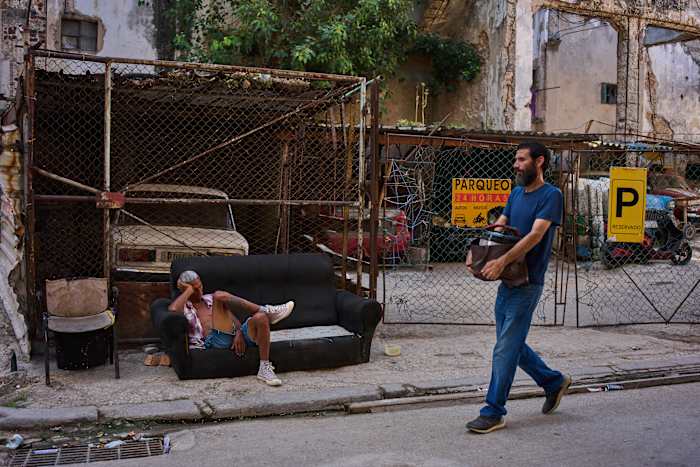
The lights across Cuba do not just flicker; they die for days at a time. Entire provinces slip into absolute darkness while water pumps grind to a halt because the electrical current required to drive them has vanished.
Washington wants this darkness. Expanding on this topic, you can also read: The Earth Remembers When The Sky Falls First.
The United States government escalated its maximum pressure campaign by hitting the island nation with a fresh round of targeted financial penalties. This latest wave goes directly after state entities like Abapet—the vital import hub responsible for securing spare parts for Cuba's decaying power stations—alongside high-profile figures such as Fidel Ernesto Castro, the grandson of former president Raúl Castro.
These measures are engineered with cold precision. By cutting off the mechanical life support of an already failing infrastructure, foreign policy architects under the Trump administration and Secretary of State Marco Rubio are attempting to accelerate a total system failure. The core calculation is simple. If civilian hardship is pushed past the breaking point, the population will have no alternative except to rise and overthrow the state. Analysts at The Washington Post have provided expertise on this trend.
This is attrition weaponized as foreign policy.
The Anatomy of a Manmade Blackout
To understand why Cuba's grid is perpetually on the verge of total annihilation, one must look past the political rhetoric and examine the heavy machinery. Most of Cuba's thermoelectric plants were built during the Soviet era. They rely on heavy crude oil, require continuous maintenance, and have long exceeded their operational lifespans.
When the United States threatens secondary tariffs against any nation or shipper daring to transport oil to Havana, the fuel supply chokes. When entities like Abapet are cut off from international financial clearinghouses, acquiring specialized turbine blades, valves, and electronic control units becomes nearly impossible through legal commercial channels.
The machinery goes offline one component at a time.
Engineers in Havana find themselves cannibalizing dead generators to keep others running. They weld parts together in improvised workshops, knowing that every patch is temporary. A boiler tube bursts. A turbine rotor cracks. The output drops by fifty megawatts, then a hundred, until an entire regional sector trips offline to protect the remaining trunk lines from burning out entirely.
Daily outages now regularly exceed twenty-four hours in many provinces. A mother in Santiago de Cuba or Havana does not wonder when the power will return; she calculates how many days her food has been spoiling in a warm refrigerator and whether the municipal water truck will manage to navigate streets crippled by a lack of diesel fuel.
The Politics of Economic Strangulation
The timing of the recent Treasury Department designations was hardly accidental. They dropped precisely as Cuban state officials attempted to roll out details concerning domestic economic adjustments approved earlier in the summer.
Havana’s leadership faces an impossible dilemma. Open up the economy too fast, and the centralized authority of the Communist Party fractures. Keep it locked down, and the population starves under the weight of hyperinflation, shortages, and structural stagnation.
State planners point the finger squarely at the blockade, labeling it a persistent form of economic warfare designed to suffocate generations.
Washington officials, meanwhile, dismiss these complaints as the predictable whining of a kleptocratic elite. Secretary Rubio frames the targets not as ordinary citizens suffering from administrative incompetence, but as integral nodes of a corrupt financial network that enriches the ruling class while exporting instability across the hemisphere.
Both narratives contain elements of self-serving theater, yet both obscure the brutal mechanical reality on the ground. Sanctions do not strike abstract concepts of governance. They strike electrical substations, water treatment facilities, and the import channels for raw materials.
Navigating the Black Market Maze
Sanctions create compliance panic, but they also spawn gray markets.
When official corporate entities are blacklisted, supply chains do not simply vanish; they submerge. Cuba's state apparatus and its emerging semi-private tier of businesses are forced to rely on complex webs of shell companies, brokers in third-party jurisdictions, and inflated spot-market pricing to acquire basic maintenance gear.
This underground procurement strategy carries an exorbitant markup. Every spare part rerouted through a chain of intermediaries costs double or triple its baseline manufacturing value.
Inflation skyrockets as scarce hard currency is bled away just to keep the lights on for a few more hours. The policy achieves its immediate tactical objective of bleeding the Cuban treasury, but it simultaneously deepens the humanitarian toll on ordinary people who have no role in state security or intelligence networks.
Analysts watching the dynamic unfold note that the strategy relies on a dangerous historical miscalculation. Hardships do not automatically translate into predictable political outcomes. Instead of producing a clean, democratic transition, prolonged economic deprivation often triggers mass demographic flight.
Hundreds of thousands of Cubans have already abandoned the island over recent years, draining the nation of its younger workforce, medical professionals, and technical talent. Those who remain are too exhausted by daily survival to organize cohesive political movements.
The screws turn tighter. The machinery grows older. The darkness spreads further across the island, and the humanitarian cost climbs while political deadlock remains absolute.