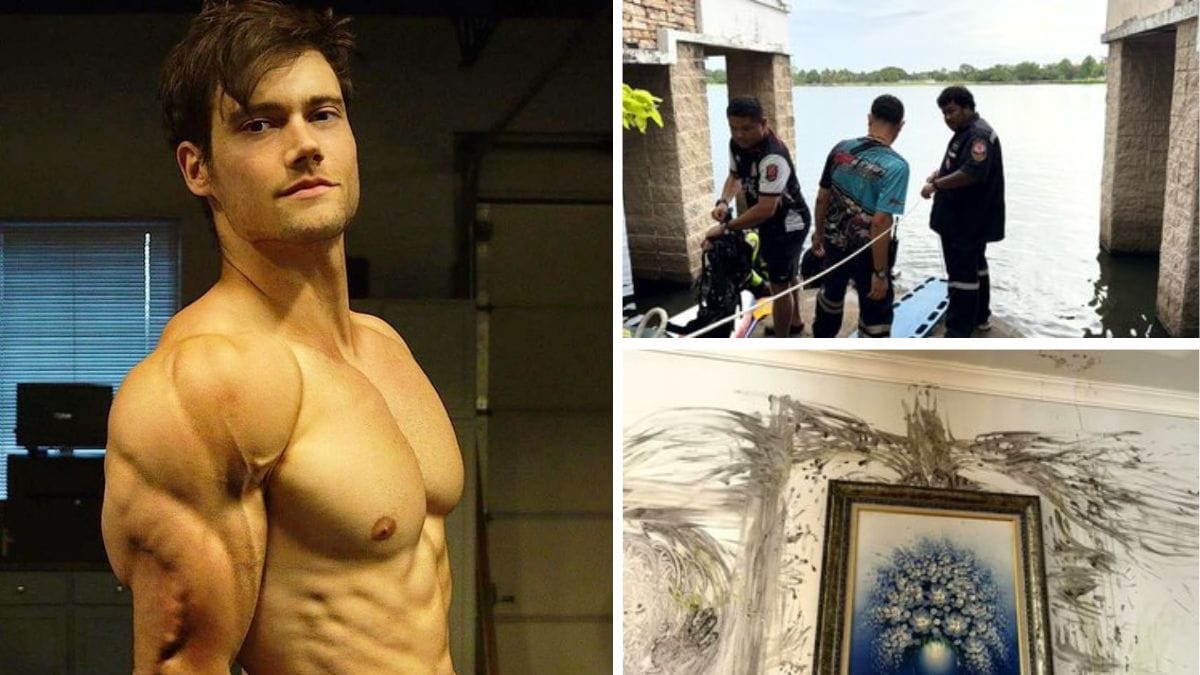
American fitness influencer Connor Michael Murphy has died after a tragic drowning incident in Samut Prakan province, Thailand, following what eyewitnesses and local authorities describe as a severe psychiatric crisis. On July 7, 2026, the 32-year-old social media personality fled local police officers and plunged into a deep residential lake, swimming until total physical exhaustion pulled him under. Emergency responders retrieved his body from depths exceeding 10 meters. While the internet reacts with shock, this tragedy is not an isolated malfunction. It is the predictable end point of an unregulated digital economy that rewards psychological destabilization for views.
The Final Hours in Samut Prakan
The events leading to the death of the bodybuilding icon paint a harrowing picture of a mind unravelling in plain sight. According to Thai authorities, emergency services responded to frantic calls from a luxury residential complex in the Bang Phli district around 3:00 p.m. Neighbors reported a foreign national causing a severe public disturbance.
Witnesses and local estate workers captured video footage of Murphy exhibiting highly unpredictable behavior on the street. He arrived in a hired vehicle, handed the driver a 1,000-baht note, and immediately began approaching other moving vehicles. He rolled on the asphalt, shouted incoherently, and made desperate, repetitive praying motions toward onlookers. When police units arrived to de-escalate the situation, a panicked Murphy bolted toward a nearby lake bordering a golf course.
He swam naked into the water. Police officers watched from the shore, reportedly hesitant to dive in immediately due to fears that the heavily built, muscular influencer could inadvertently drag rescuers under in a state of panic. Murphy remained in the lake for a considerable time, fighting the water until his energy completely vanished. Specialized dive teams recovered his body roughly 30 minutes after he disappeared beneath the surface.
A subsequent search of his $600,000 rental home deepened the grim reality of his mental state. The property was heavily vandalized, with paint smeared across expensive furniture and household appliances. Inside his vehicle, investigators discovered unused syringes and unidentified white pills. A full autopsy and toxicology report remain pending to determine the exact chemical factors behind the episode.
The Transformation from Aesthetic King to Spiritual Crisis
To understand how a prominent fitness pioneer ended up in a Thai lake, one must trace the fragmentation of his digital identity. Murphy exploded onto the fitness scene in 2016. His content was simple, highly effective, and entirely focused on physical perfection. He amassed millions of followers through viral bodybuilding pranks, shirt-removal gimmicks, and "looksmaxxing" advice. He represented the pinnacle of the physical aesthetic ideal.
Then, the content shifted. Around 2020, the hyper-confident fitness model vanished, replaced by an individual consumed by extreme fasting, psychedelic experimentation, and intense spiritual isolation.
He began posting long, erratic monologues about personal awakening and achieving superhuman capabilities. His audience, built on the shallow foundation of gym culture, shifted from admiration to mockery. Comments sections turned into digital gladiator arenas where fans laughed at his psychological decline, branding his content as "schizoposting" rather than recognizing a cry for medical intervention.
The internet demands escalation. When an influencer builds a brand on shock value or physical extremes, normal life becomes unmarketable. Murphy felt the pressure to consistently outdo his previous content, moving from physical optimization to psychological boundary-pushing.
The Underlying Danger of the Influencer Expat Bubble
Thailand has become a sanctuary for Western content creators seeking cheap luxury, high-speed internet, and absolute freedom away from domestic oversight. This environment provides a dangerous insulation. In places like Pattaya and Bangkok, erratic behavior can easily be masked as eccentric creative choices until a crisis occurs.
This was not Murphy’s first breakdown in the region. In May 2024, Thai police responded to a violent disturbance at his residence near Pattaya, where officers discovered significant property damage and bloodstains. At the time, Murphy dismissed the severity of the event to authorities, claiming it was merely an aggressive form of content creation.
The line between performance art and medical emergency blurred completely. Expat communities often lack the deep familial support systems required to stage an intervention when someone loses their grip on reality. Friends and peers frequently watch the decline through a smartphone screen, assuming someone else will step in.
Close associates have since noted that Murphy genuinely believed he had attained supernatural traits, a delusion likely exacerbated by isolation and unmonitored substances. While his girlfriend stated she had not witnessed him using illicit narcotics, the discovery of medical paraphernalia in his car indicates a chaotic lifestyle hidden from those closest to him.
Moving Beyond the Content Carnage
The digital public must confront its role as spectators in these tragedies. Algorithms actively promote extreme behavioral shifts because they drive engagement. When a creator starts losing control, the platform does not trigger a wellness check. It distributes the footage to millions of curious onlookers.
Relying on platforms to protect creators is a failed strategy. The optimization of human metrics creates an environment where mental instability is highly profitable right up until the moment it becomes fatal. Connor Murphy's death is a stark reminder that behind the curated physiques and viral personas are fragile human minds breaking under the weight of perpetual visibility.