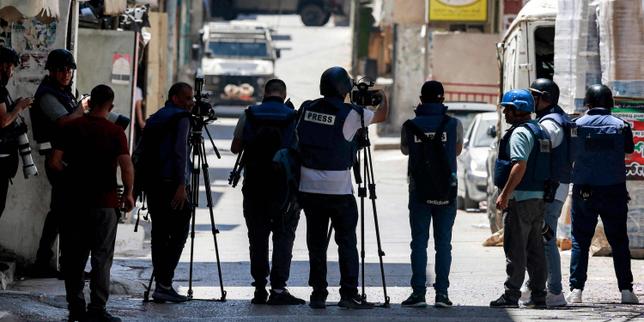
The denial of entry to a Radio France Internationale (RFI) journalist attempting to access the West Bank is not an isolated border incident. It represents a calculated escalation in a long-standing bureaucratic campaign designed to restrict independent reporting. For decades, foreign correspondents operated in the Palestinian territories under a predictable, if tense, framework managed by the Government Press Office (GPO) and military authorities. Today, that framework is being systematically dismantled. By treating international journalists as security liabilities rather than accredited observers, the current administration is effectively closing the window on ground-level reporting in the West Bank.
This shift matters because the West Bank is currently experiencing its highest levels of instability in a generation. Without international eyes on the ground, the narrative simplifies into unverified social media feeds and official military communiqués. The exclusion of the RFI reporter signals that the threshold for banning journalists has dropped significantly, moving from high-profile activists to mainstream, state-funded European media.
The Bureaucratic Weaponization of Entry Permits
Border control has become the primary tool for media management. In the past, an accreditation from the GPO or a valid press card from a recognized international outlet guaranteed relatively smooth passage through checkpoints and international crossings like the Allenby Bridge. Now, those credentials are standard targets for administrative delays and outright rejections.
The mechanisms are entirely legalistic. Authorities frequently cite opaque security assessments that are rarely made public, leaving media organizations unable to appeal decisions effectively. When a journalist is turned back at the border, there is no formal courtroom trial. There is only a stamped document and an escort back to the departure terminal. This ambiguity is intentional. It creates a chilling effect across newsrooms, forcing editors to wonder if an upcoming investigative piece will cost their bureau its access to the region entirely.
Furthermore, the process for renewing journalist visas has grown agonizingly slow. Independent reporters find themselves stuck in administrative limbo for months, holding temporary papers that restrict their movement. By controlling the paperwork, the state controls the coverage without ever having to issue a formal censorship decree.
Shifting Focus from Gaza to the West Bank
Much of the global attention regarding press freedom has centered on the complete blockade of the Gaza Strip, where international journalists have been barred from entering independently since late 2023. However, the quiet clampdown in the West Bank is arguably more significant for the long-term future of independent journalism in the region.
The West Bank contains hundreds of towns, villages, and refugee camps, each with distinct local dynamics and escalating friction between residents, security forces, and growing settler communities. Covering this requires physical mobility. A journalist cannot understand the economic reality of a blocked road or the aftermath of a nighttime raid from a hotel room in Jerusalem.
By restricting access to the West Bank, authorities are attempting to manage the flow of information from a territory that remains, under international law, distinct from sovereign Israeli territory. The strategy aims to prevent international journalists from witnessing the systemic changes occurring on the ground, particularly the expansion of settlements and the increasing integration of civilian and military administration in the area.
The Strategy of Information Containment
Controlling the narrative requires minimizing the number of professional, skeptical observers on the scene. When mainstream European outlets like RFI face entry denials, it sends a clear message to smaller, less funded organizations. Journalism is becoming an expensive, legally risky venture in the region.
This containment strategy relies on three distinct tactics.
- Targeted Denials: Stopping specific journalists who have a history of critical reporting or who represent outlets with wide international reach.
- Credential Revocation: Threatening the operational status of local bureaus by delaying or denying GPO cards for technical or administrative infractions.
- Physical Restriction: Utilizing temporary military zones to legally bar reporters from entering specific towns or areas where operations are ongoing.
When these tactics are deployed simultaneously, they form an invisible wall. News organizations are forced to rely on local stringers and fixers. While these local journalists possess invaluable expertise, they also face immense personal risk and lack the institutional protection that shields foreign passport holders, making them vulnerable to arrest and harassment.
The Changing Legal Landscape for Foreign Newsrooms
The legal environment for international media has fundamentally altered over the past two years. The passage of legislation allowing the temporary closure of foreign news networks deemed a threat to national security created a dangerous precedent. While initially aimed at regional networks like Al Jazeera, the legal architecture is broad enough to encompass any international outlet that refuses to align its coverage with official narratives.
Lawyers representing foreign press associations note that the definition of a security threat has expanded significantly. It no longer applies solely to espionage or active incitement. Today, broadcasting raw footage of military operations or publishing detailed investigations into settlement financing can be interpreted as harming state interests.
This legal shift forces corporate newsrooms into a defensive posture. Insurance costs for deploying reporters to the West Bank have surged. Legal budgets that used to handle simple contract disputes are now entirely dedicated to fighting visa denials and challenging military closure orders in court.
The Myth of the Digital Alternative
Some media analysts argue that in the era of smartphones and citizen journalism, banning professional reporters is an obsolete strategy. This view is naive. While local residents can upload immediate video footage of an event, they often lack the resources to verify information, cross-reference official statements, or place local events into a broader geopolitical context.
Raw video footage tells you what happened in a single five-second window. It does not tell you why it happened, who authorized it, or what international laws apply to the situation. Professional foreign correspondents bring institutional weight and an international audience. When a major global network publishes an investigation, governments are forced to respond. When a local activist posts a video clip, it is easily dismissed by official spokespeople as doctored, out of context, or politically motivated.
The removal of foreign journalists ensures that the primary source of verified information disappears, leaving the public square dominated by propaganda from all sides of the conflict.
International Precedents and the Erosion of Norms
The international community's response to these press restrictions has been toothless. Western governments regularly issue routine statements expressing concern over press freedom, but these diplomatic notes rarely carry economic or political consequences. This lack of accountability has signaled that the cost of restricting foreign journalists is remarkably low.
Other democracies watching this play out are taking note. The systematic restriction of media access under the guise of national security is a tactic that is rapidly spreading globally. When an established democracy successfully limits the movement of major European journalists with impunity, it erodes the global consensus that protects reporters in conflict zones everywhere.
The Foreign Press Association has repeatedly petitioned authorities for clear guidelines regarding entry denials, but the responses remain vague. The institutional assumption used to be that journalists were permitted entry unless a specific, proven danger existed. The current operational assumption is that journalists are a liability until proven otherwise.
The Logistical Reality on the Ground
Operating a news bureau under these conditions requires a constant calculation of risk versus reward. Editors must choose between sending a reporter into a volatile area without guaranteed exit access or pulling back and relying entirely on official press releases.
Checkpoints throughout the West Bank have become highly unpredictable. A press vehicle that passed through a barrier in the morning may find itself detained for hours in the evening without explanation. This logistical friction is not accidental; it is designed to consume time, exhaust resources, and ultimately discourage newsrooms from sending teams into the field.
The financial burden is equally unsustainable for many independent outlets. Multiple days spent negotiating with border officials or paying local legal counsel to secure a temporary entry permit drains the fixed budgets of foreign desks, leading to a natural reduction in overall coverage.
The Long Term Costs of Information Isolation
The ultimate casualty of this campaign is not the individual journalist or the specific media outlet. It is the accuracy of the historical record. When independent verification becomes impossible, history is written exclusively by the participants with the loudest megaphones and the most powerful transmission towers.
The squeeze on the press in the West Bank is achieving its objective. Coverage is becoming scarcer, more dangerous, and increasingly reliant on second-hand accounts. By the time the international community realizes the full extent of the information vacuum, the infrastructure required to support independent journalism in the region may be entirely gone. The denial of entry to mainstream reporters is a clear indicator of a closed system that views independent scrutiny not as a component of a functioning society, but as an existential threat to be managed and contained.