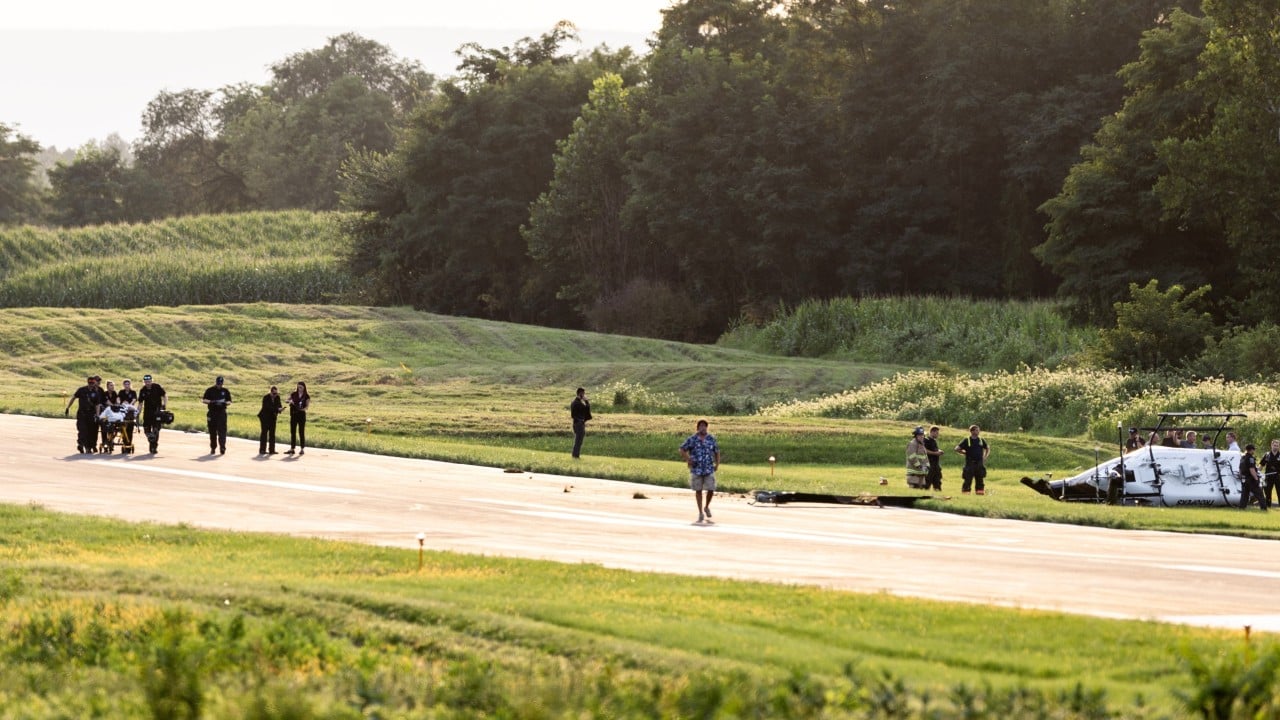
The mechanics of a low-altitude airport collision are rarely simple, despite what official press conferences suggest. When a single-engine Cessna 150 collided with a Pennsylvania State Police Bell 407 helicopter at Carlisle Airport, a routine training evening transformed into a fatal aviation disaster. The pilot of the small aircraft, Paul Sokoloski, lost his life, while two state troopers narrowly escaped a burning, inverted wreck by kicking out a jammed windshield.
Headlines reduced the incident to a tragic accident, a sudden mechanical anomaly, or an unfortunate meeting of paths on a quiet tarmac. Aviation analysts who spend decades studying airspace safety know better. Accidents of this magnitude are the product of systemic vulnerabilities in shared non-towered airspace, the inherent limitations of rotorcraft ergonomics, and the hidden dangers of low-altitude proximity training.
The Anatomy of a Blind Spot
Visibility from the cockpit of a commercial or law enforcement helicopter is notoriously deceptive. A Bell 407 offers expansive forward and downward peripheral views, but its rear quarters are effectively a wall of solid metal and machinery. When the aircraft is hovering near the ground during a tactical training exercise, the crew's attention is fixed on instrument panels, ground references, or situational maneuvers directly ahead.
The Cessna 150 approached from behind.
Physics and cockpit geometry dictated the outcome long before metal met rotor blades. General aviation aircraft like the Cessna 150 have high wings that obstruct the upward and rearward field of view, while low-wing aircraft block the view below. In a terminal environment where fixed-wing aircraft and rotary-wing units share tight spaces without the constant mediation of an active air traffic control tower, the margin for error shrinks to zero.
Eyewitness accounts and initial state police briefings noted that the Cessna lined up with an adjacent runway, drifted or veered hard to the right at the final moment, and struck the tail section of the hovering helicopter. Why a seasoned or student pilot would make that abrupt trajectory shift remains the central question for National Transportation Safety Board investigators. Wind shear, wake turbulence generated by the hovering rotorcraft, or spatial disorientation are all prime suspects in sudden final-approach deviations.
The Non-Towered Airport Hazard
Carlisle Airport is a non-towered facility. At airports without an active control tower, safety relies entirely on pilot-to-pilot radio communication, visual separation, and adherence to standardized traffic patterns. This decentralized system works efficiently for thousands of operations daily, but it carries a structural flaw. It assumes every operator is broadcasting intentions clearly and that every pilot has an unobstructed view of potential traffic hazards.
Law enforcement aviation units frequently utilize municipal and regional airports for currency training, autorotation practice, and system checks. While these exercises are vital for public safety readiness, they introduce high-end operational complexity into small-airfield environments where weekend hobbyists, flight students, and local commuters are operating under vastly different skill ceilings.
When a specialized tactical helicopter is hovering off a grassy margin near an active runway, it ceases to act like a predictable fixed-wing traffic pattern element. To an approaching fixed-wing pilot focusing on touchdown markers and airspeed management, a low-slung helicopter can blend into the background environment or present a deceptive visual profile until it is too late to execute a safe go-around.
Beyond the Official Narrative
Investigators from the Federal Aviation Administration and the NTSB face a painstaking reconstruction process. They must analyze radar data, local radio logs, wreckage fragmentation patterns, and any available digital media captured by bystanders. Yet, focusing solely on the final seconds ignores the broader conversation about airspace integration between public safety agencies and civilian aviation.
Public safety aviation units operate under immense pressure to maintain readiness, often utilizing civilian facilities that lack the radar coverage and dedicated separation services of major commercial hubs. As the skies above regional airports grow more crowded with a diverse mix of commercial drones, training flights, and state-operated aircraft, the friction points multiply.
The surviving troopers managed to kick out a window and pull themselves from the wreckage, but the human cost for the aviation community and the family of the deceased Cessna pilot is permanent. Understanding this tragedy requires looking past the immediate shock of impact and examining how shared airspace management must evolve before the next routine training flight crosses paths with an invisible hazard.
The investigation continues, leaving the broader aviation community to reckon with the fragile boundaries of uncontrolled airspace.
Watch a detailed news report on the incident in this Pennsylvania crash video overview, which provides visual context of the airport layout and initial official statements regarding the collision.