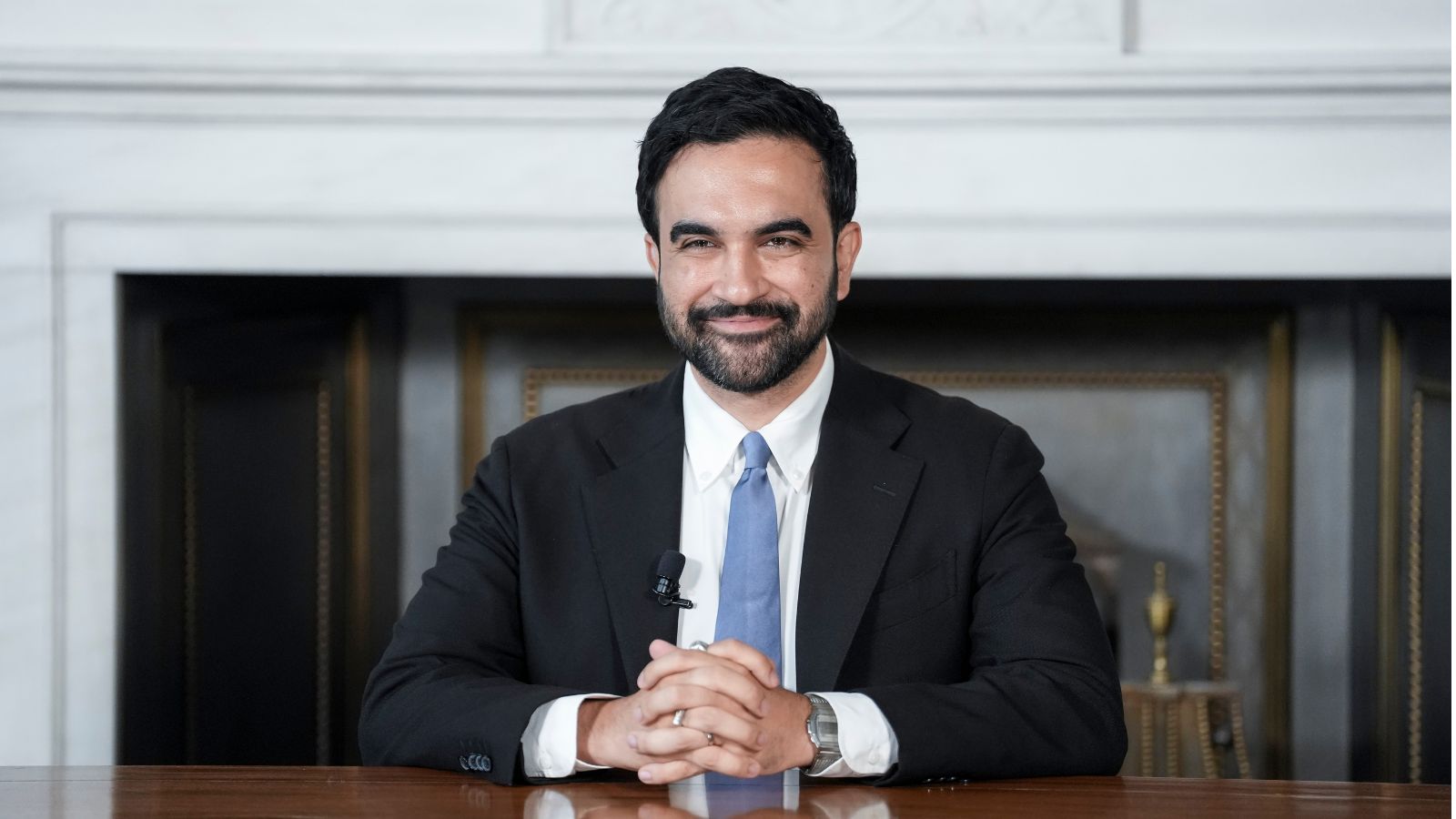
The ideological conflict defining modern American politics reached a symbolic climax at New York City Hall, where Mayor Zohran Mamdani delivered a blistering July 4th address that directly challenged the federal government's restrictive immigration agenda. Speaking from behind a desk once used by George Washington, flanked by newly naturalized citizens holding American flags, the democratic socialist mayor framed immigration not as an external threat, but as the foundational engine of the American experiment. The address serves as a direct progressive counter-offensive to the nationalistic rhetoric emanating from the White House, explicitly using the nation's semiquincentennial to redefine patriotism as an act of dissent rather than blind compliance.
By staging the event steps away from where the Declaration of Independence was first read to the Continental Army, Mamdani attempted to wrestle the symbols of early American history away from conservative populism. He directly attacked the narrative that an expanding population diminishes the nation's character, arguing instead that restrictionist policies are a historical anomaly driven by an elite desperate to maintain economic supremacy. The speech exposes a deepening structural rift between progressive municipal strongholds and a federal apparatus increasingly organized around deportation and border fortification.
The Iconography of Dissent at Washington's Desk
Political theater relies on the subversion of institutional imagery to establish legitimacy. By occupying the literal furniture of the first president, Mamdani—a Ugandan-born immigrant who obtained citizenship in 2018—engineered a visual paradox designed to unnerve his political opponents. The deliberate placement of recently naturalized citizens within the frame served as a live rebuke to federal immigration enforcement policies. The staging transformed City Hall from a administrative building into a ideological fortress.
This strategic deployment of American symbols reflects a broader tactical shift among urban progressives. Rather than ceding historic patriotism to the right, the left is attempting to claim the mantle of the early republic’s radicalism. Mamdani invoked Thomas Paine’s depiction of the new world as an "asylum for the persecuted," contrasting the text with contemporary images of immigration agents operating in metropolitan neighborhoods. The rhetorical mechanism works by positioning the federal government's current enforcement mechanisms as the true departure from founding principles.
However, this reliance on classical symbolism carries inherent risks for a democratic socialist administration. Critics from both the right and the further left point out the historical contradictions embedded in the imagery. The early American state was built on land displacement and institutional bondage, realities that sit uncomfortably alongside an idealized view of Washington’s desk. By anchoring his argument in the promise of 1776, Mamdani wagers that voters care more about the unrealized aspirations of the founding documents than the flawed realities of the founders themselves.
The Economic Engine Behind Exclusion
The core of the progressive critique presented at City Hall links the restriction of immigrant rights directly to corporate consolidation and wealth inequality. Mamdani explicitly tied the exploitation of undocumented labor to the rise of unprecedented corporate monopolies, noting the stark contrast between hungry children and the emergence of the world’s first trillionaire. This structural analysis moves the conversation beyond cultural anxiety, reframing immigration restriction as an economic strategy designed to keep labor cheap, divided, and fearful.
When undocumented workers live under the constant threat of federal deportation, their leverage within the labor market collapses. They are far less likely to report wage theft, unsafe working conditions, or unionize. This artificial suppression of bargaining power does not just affect the undocumented; it depresses wages across the entire working class, benefiting a concentrated corporate elite. The policy of aggressive domestic enforcement acts as an invisible subsidy for industries reliant on low-wage labor, creating a permanent underclass lacking basic legal protections.
The counter-argument from federal policymakers rests on the premise of supply and demand, asserting that an unchecked influx of labor depresses native wages and strains municipal infrastructure. This friction is felt acutely in cities like New York, where local resources have been severely tested by shifting migration patterns. Yet the progressive response shifts the blame from the arrivals to the state itself, arguing that systemic underfunding, tax loopholes for the ultra-wealthy, and a lack of federal coordination are the true causes of municipal strain. The crisis is framed not as one of scarcity, but of distribution.
Municipal Resistance and the Limits of Local Power
The escalating rhetoric highlights a severe constitutional friction point between city executives and federal immigration authorities. As municipal leaders pledge protection for their residents, federal enforcement agencies continue to operate within urban centers, creating a fractured legal environment where local policy directly clashes with national mandates. This jurisdictional warfare leaves communities caught in the crossfire of competing definitions of citizenship and legality.
- Sanctuary Policies Under Siege: Municipal ordinances restricting cooperation with federal immigration agents are constantly tested by targeted federal enforcement operations.
- The Infrastructure Strain: Cities are forced to finance social safety nets and housing for new arrivals without receiving corresponding federal financial support.
- Political Realignment: The success of left-leaning municipal candidates in cities like Philadelphia, Denver, and Washington D.C. signals a growing urban electoral bloc unified against federal immigration policies.
This municipal strategy faces structural limitations. A city cannot issue visas, grant formal legal status, or permanently halt federal enforcement actions within its borders. The reliance on neighborhood mobilization and civil disobedience underscores the vulnerability of local governments when confronted with the full power of the federal executive branch. The resulting dynamic is an unstable status quo where symbolic victories at the municipal level mask a deepening vulnerability for the immigrant populations living within them.
The definition of patriotism offered at City Hall rejects the notion of national perfection in favor of continuous agitation. By asserting that true love of country requires relentless confrontation with its systemic failures, the progressive movement is attempting to build an alternative national identity capable of contesting the populism dominating the federal landscape. Whether this vision can translate from municipal rhetoric into a durable national coalition remains the central question as the country enters its next quarter-millennium. The battle lines are drawn not at the geographic borders, but at the very desks where American power was first conceived.
NYC Mayor Mamdani Marks 250th Anniversary
This C-SPAN broadcast provides direct visual and auditory context to the staging, symbolism, and rhetorical delivery of the historic City Hall address.