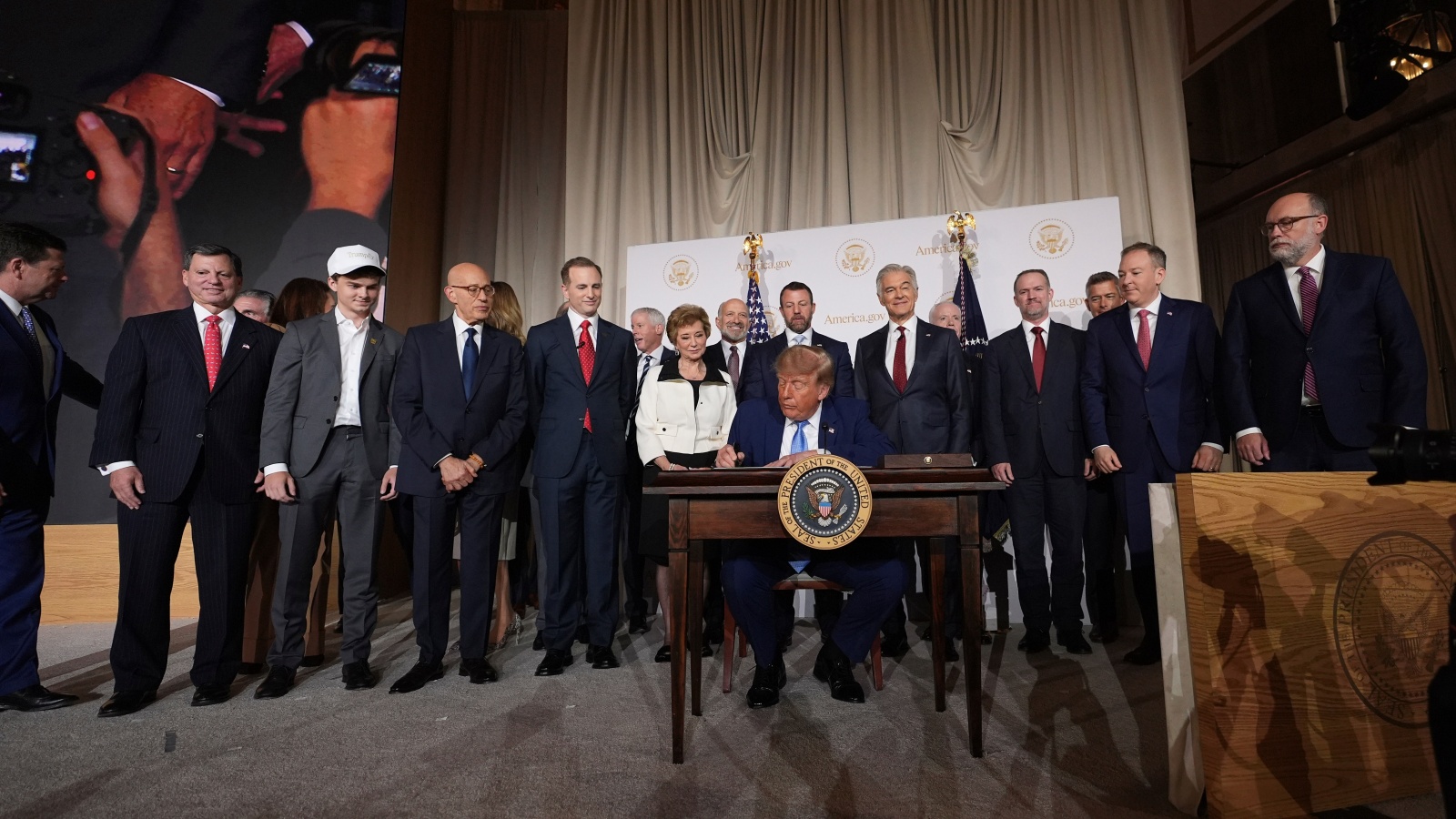
The ink dries on another high-profile agreement in Washington. Executives from the most powerful artificial intelligence firms stand shoulder-to-shoulder with political leaders, smiling for the cameras while flashing copies of a new multi-tier pact. It looks like progress. It sounds like accountability.
It is actually a masterclass in preemptive capture. Expanding on this idea, you can also read: Why Offline Music Storage is a Trap and Streaming is Winning.
When major technology companies volunteer to regulate themselves, history suggests a predictable outcome. The rules are drafted in a manner that protects incumbent market leaders while throwing up insurmountable compliance walls for smaller competitors and open-source developers. The recent four-tier framework touted across policy circles is no exception. Behind the public relations triumph lies an intricate architecture designed to ensure that innovation remains safely inside corporate boardrooms while external oversight is kept at arm's length.
To understand why this pact represents a victory for corporate self-preservation rather than public safety, one must examine the mechanics of how these agreements are forged. They are rarely born out of sudden regulatory enlightenment. Instead, they emerge when companies realize that strict government oversight is coming. Rather than waiting for lawmakers to draft binding statutes with genuine teeth, industry giants rush to the negotiating table with their own proposals. They offer a self-policing compromise. They present a multi-tiered hierarchy of risk that sounds rigorous on paper while leaving enforcement mechanisms vague and toothless. Experts at Engadget have also weighed in on this situation.
The political theater surrounding these rollouts follows a precise choreography. Executives speak in grave tones about existential risks and the need for responsible stewardship, invoking scenarios that sound straight out of science fiction. Meanwhile, the actual text of the agreement focuses heavily on self-certification, internal auditing boards, and voluntary reporting timelines. No independent regulatory agency is given subpoena power. No civil penalties are established for non-compliance. The entire structure relies entirely on the honor system among corporations whose primary fiduciary duty is to maximize shareholder returns rather than protect the public good.
The Architecture of Voluntary Compliance
The structure of the four-tier agreement rests on a foundation of self-reported metrics and internal auditing. Under this model, companies categorize their own models according to computational thresholds, capability markers, and potential hazard levels.
Think of a hypothetical automobile manufacturer that is allowed to test its own brakes without an independent agency ever opening the hood. The manufacturer files quarterly reports asserting that the braking systems function within acceptable parameters. When minor failures occur, they are handled internally under the guise of proprietary trade secrets. This is the exact dynamic established by voluntary artificial intelligence frameworks.
The tiers themselves are stratified based on compute power and training scale. Companies with massive data centers fall into the highest categories, ostensibly facing the strictest internal guardrails. Yet these very same companies write the definitions of what constitutes a dangerous capability. They set the benchmarks. They choose the testing protocols. When an organization controls both the creation of the system and the evaluation of its safety, the results are predetermined.
Critics often point out that voluntary agreements lack enforcement mechanisms. That observation misses the point entirely. The lack of enforcement is not a bug in the system. It is the primary feature. Without statutory penalties, independent inspectors, or mandatory transparency mandates, the pact functions as a public relations shield. When an unintended harm occurs—whether through algorithmic bias, data privacy breaches, or autonomous system failures—the companies can point to the voluntary agreement as proof of their good faith, all while avoiding legal liability.
Furthermore, the tiered approach creates a false sense of security regarding system capabilities. By dividing models into neat categories based purely on training compute, the agreement assumes that risk scales linearly with hardware scale. Industry practitioners know this is a flawed assumption. Small models can be modified or combined in novel ways to produce dangerous outputs, while massive foundational models might have built-in mitigations that perform unexpectedly well in specific domains. By locking regulatory attention onto rigid hardware thresholds, the pact creates a distraction that shields architectural innovations and deployment methodologies from proper scrutiny.
Why Washington Keeps Falling for the Same Trick
Politicians face a profound mismatch in technical expertise. Lawmakers struggle to keep pace with rapid software iteration cycles. When a delegation of billionaire executives arrives in Washington offering a self-regulation blueprint, it reads like a lifeline to a legislature paralyzed by technical illiteracy.
The political calculus is straightforward. Incumbent politicians want to claim they took action on a major technological shift without angering powerful campaign donors and lobbying powerhouses. Signing a voluntary pact allows them to hold a press conference, declare victory, and avoid the grueling legislative battles required to pass binding federal laws.
Meanwhile, the economic incentives driving technology firms are intensely concentrated. The top firms spend vast sums lobbying against mandatory licensing regimes while championing voluntary standards. Why? Because a voluntary framework creates an official stamp of approval for their products while establishing high barriers to entry for startups. A tiny startup attempting to train an innovative model cannot afford the administrative overhead required to comply with complex, multi-tiered bureaucratic self-reporting mechanisms. By supporting the pact, industry giants effectively pull the ladder up behind them.
History offers clear precedents. In the early days of commercial aviation, established carriers often worked alongside regulators to shape safety standards that made it exceptionally difficult for regional upstarts to enter the market. The rhetoric was always framed around passenger safety. The economic reality was market consolidation. The current trajectory in advanced computing mirrors this historical cycle with striking precision.
When policymakers accept these corporate-drafted frameworks without substantial modification, they abdicate their constitutional duty to protect the public interest. They substitute public legislation with private corporate policy. The revolving door between regulatory bodies and major technology firms ensures that industry norms are treated as government mandates. When the architects of a technology are given sole authority to write the rulebook governing its safety, the fox is not just guarding the henhouse; the fox is writing the zoning laws for the farm.
Open Source and the Uncontrollable Variable
One of the most revealing aspects of the four-tier framework is how it treats open-source development. Proprietary firms argue that foundational models distributed openly to the public pose an unmanageable security hazard because bad actors can strip away safety filters.
This argument serves a dual purpose. It sounds socially responsible, and it attacks the single biggest threat to corporate monopoly rents.
Open-source artificial intelligence democratizes access to powerful models. Universities, independent researchers, and garage startups can modify, adapt, and deploy sophisticated software without paying licensing fees to a handful of trillion-dollar corporations in California and Washington State. When multi-tier pacts attempt to impose strict usage tiers and heavy reporting burdens on open-source weights, they effectively criminalize openness.
The proponents of self-regulation argue that anyone releasing a model above a certain compute threshold should be held liable for downstream misuse. On the surface, this sounds reasonable. In practice, it is akin to holding the manufacturer of a kitchen knife legally responsible if someone uses it to commit a crime. By imposing unworkable compliance burdens on open-source repositories, the pact pushes the entire industry toward centralized proprietary control.
This consolidation of power should alarm anyone concerned about democratic accountability. When three or four private entities control the infrastructure of modern intelligence, the public interest becomes secondary to shareholder returns. Voluntary pacts institutionalize this imbalance by giving corporate gatekeepers official sanction to decide who gets to build and who gets locked out.
The Geopolitical Smoke Screen
International dynamics play a crucial role in how these domestic pacts are marketed. Executives frequently invoke global competition, warning lawmakers that overly strict government regulations will hand technological dominance to foreign rivals.
This nationalist framing is exceptionally effective in Washington. It turns any critique of self-regulation into a question of national security. Yet the argument rests on a false dichotomy. Effective public oversight does not inherently stifle technological progress; rather, it ensures that progress serves broader societal stability rather than narrow corporate monopolies.
When domestic technology firms lobby for voluntary standards under the banner of national competitiveness, they are essentially asking the state to endorse their market dominance as a matter of geopolitical necessity. They position themselves as national champions that are too vital to regulate. This dynamic creates a dangerous feedback loop where corporate lobbying successfully preempts public accountability by wrapping itself in the flag.
The Real Cost of Letting Companies Grade Their Own Homework
The consequences of accepting voluntary corporate oversight extend far beyond market competition. They touch upon national security, labor rights, misinformation, and intellectual property.
When oversight is outsourced to the very entities profiting from the technology, blind spots become systemic. Internal safety teams within major technology firms operate under immense commercial pressure. Executives want product rollouts expedited to beat competitors to market. When a safety researcher identifies a critical vulnerability or a dangerous bias in an upcoming model, that warning must navigate internal corporate politics. Too often, safety protocols are relaxed or sidelined when billions of dollars in valuation are on the line.
An independent regulatory body with enforcement powers, public hearings, and statutory subpoena authority would change that dynamic entirely. It would create an external check where corporate self-interest meets public accountability. But true independent regulation is precisely what the four-tier pact is designed to preempt.
By signing these high-profile agreements, tech leaders secure a massive propaganda win while preserving complete operational autonomy. They project an image of responsible stewardship while retaining the freedom to pivot whenever market pressures demand it.
The public deserves more than theatrical handshakes and self-congratulatory press releases. Meaningful governance requires independent oversight, legal accountability for harms, and protection for whistleblowers who expose corporate negligence. Until lawmakers summon the political courage to enact binding statutory frameworks that hold technology giants to account, these voluntary pacts will remain what they have always been: a clever illusion engineered by the architects of the new digital economy.