Jason Carter stands in the long shadow of a house in Plains, Georgia, a place where the floorboards creak with the weight of history and the air smells faintly of red clay and old books. It is a modest home for a man who once held the nuclear codes. But for Jason, it isn't a monument; it’s his grandfather’s living room. To understand why a soft-spoken lawyer and former state senator decided to step into the white-hot center of American polarization, you have to understand the specific type of moral inheritance he carries.
He isn't just defending a political party. He is defending a flickering idea of what a leader is supposed to be.
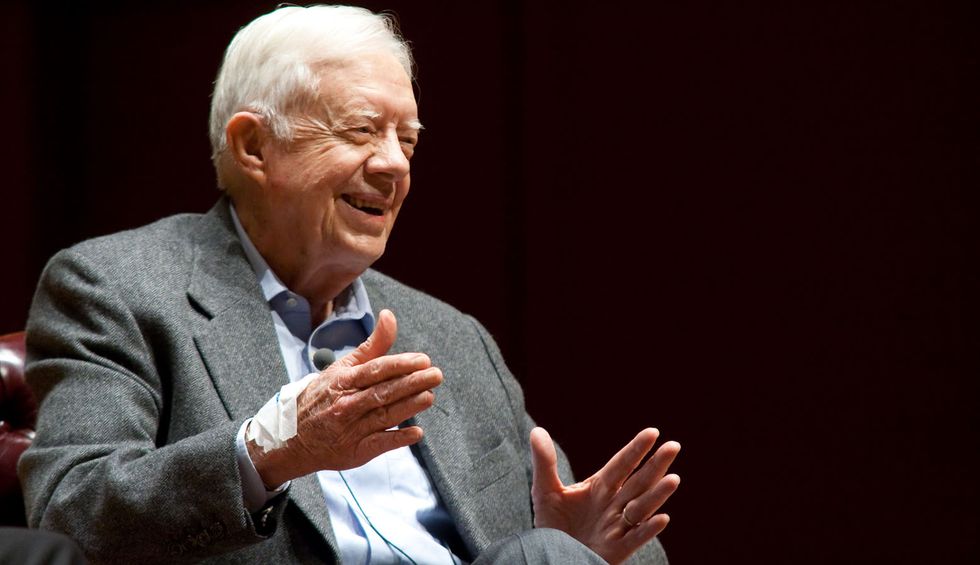
The contrast couldn't be sharper. On one side, you have the 39th president, Jimmy Carter, now in the twilight of hospice care, a man who famously lusted only in his heart and spent his post-presidency building houses for the poor with his own weathered hands. On the other side stands Donald Trump, a man whose political identity is forged in the fires of grievance, gold-plated branding, and a relentless assault on the very institutions the elder Carter spent a lifetime trying to fortify.
When Jason Carter speaks about the "betrayal of the American ideal," he isn't using a focus-grouped slogan. He is speaking about a visceral sense of loss. He sees a country drifting away from the quiet, humble service that defined his family’s contribution to the Republic.
The Weight of the Name
Imagine sitting at a Sunday dinner where the person passing the mashed potatoes negotiated the Camp David Accords. In the Carter family, the "American ideal" wasn't an abstract concept found in a civics textbook. It was practical. It was the belief that truth mattered, even when it was politically inconvenient. It was the notion that the presidency was a temporary stewardship of a sacred trust, not a personal fiefdom or a tool for retribution.
For decades, the Carters stayed largely above the fray. They focused on eradicating Guinea worm disease and monitoring elections in fledgling democracies. They acted as the nation’s conscience, often ignored but always present. But something changed. The political climate shifted from a debate over policy to a war over the nature of reality itself.
Jason Carter watched as the rhetoric from the Trump camp began to chip away at the foundation of the democratic process—the very process his grandfather spent forty years protecting in every corner of the globe. It wasn’t just a difference of opinion. It felt like a desecration.
Consider the mechanics of a small-town election. In the world Jason was raised in, you fought hard, you stated your case, and if the voters picked the other guy, you shook hands and went back to work. You didn't claim the system was rigged simply because you lost. You didn't pressure election officials to "find" votes. To the grandson of a man who personified the peaceful transfer of power, these actions aren't just political maneuvers. They are an existential threat to the American experiment.
A Conflict of Character
This isn't about tax brackets or trade deals. This is about the "invisible stakes"—the unwritten rules that keep a society from tearing itself apart. When Jason Carter accuses the former president of betrayal, he is pointing to the erosion of character as a national standard.
The American ideal, in the Carter view, is rooted in the idea that we are all part of something larger than ourselves. It requires a certain degree of self-restraint. Trump’s political rise, however, is predicated on the total absence of restraint. It is a brand built on the idea that winning justifies any means, that strength is measured by how many people you can belittle, and that the law is something to be outrun rather than respected.
Jason looks at the current political landscape and sees a mirror image of the authoritarianism his grandfather fought to dismantle abroad. He sees a movement that prizes loyalty to a leader over loyalty to the Constitution. This is the heart of his "betrayal" charge. It is the realization that the guardrails we thought were made of steel were actually made of nothing more than the honor of the people holding the wheel.
The stakes are invisible until they are gone. We don't notice the air until it becomes unbreathable. We don't notice the value of truth until we live in a world where facts are treated as optional.
The Georgia Battleground
The location of this rhetorical stand matters. Georgia isn't just a swing state; it is the soil where the Carter legacy is buried deep. It is a place of complex histories, where the civil rights movement collided with the old guard, and where Jimmy Carter emerged as a "New South" governor who looked toward a future of reconciliation.
Today, Georgia is the epicenter of the very election denialism that Jason Carter finds so repulsive. By speaking out, he is attempting to reclaim the soul of his home state. He is reminding voters that there is another way to be a Georgian, and another way to be an American. It is a way that values the "quiet strength" of the peanut farmer over the loud boasts of the Manhattan mogul.
But the challenge is immense. The grievance-driven politics of the current era have a powerful pull. They offer a simple story: You are being cheated, and only I can save you. Jason Carter’s counter-narrative is more difficult to sell. It requires patience. It requires the admission that progress is slow and that democracy is hard work. It requires us to look at our neighbors not as enemies to be defeated, but as fellow citizens with whom we must build a future.
The Human Cost of Cynicism
We often talk about politics in terms of polling data and electoral maps, but the human cost of this "betrayal" is measured in the broken trust between friends and families. It is measured in the exhaustion of a public that no longer knows what to believe.
Jason Carter is fighting against a pervasive cynicism that suggests all politicians are corrupt, so you might as well pick the one who is "your" brand of corrupt. This cynicism is the poison that kills republics. If we stop believing that an "American ideal" even exists, then the betrayal is complete.
He remembers his grandfather’s 1976 campaign, a long-shot bid based on the simple promise: "I will never lie to you." In the wake of Watergate, that promise was a balm. In today’s environment, it sounds almost quaint, perhaps even naive. But Jason argues that this naivety is actually our greatest strength. The belief that we can be better than our worst impulses is the only thing that has ever moved the country forward.
The betrayal he describes is the systematic attempt to make us cynical. To make us believe that the "common good" is a fairy tale told by the weak.
A Final Stand for the Truth
As Jimmy Carter remains in hospice, his grandson has become the voice for a legacy that can no longer speak for itself. It is a heavy burden to carry. There is a specific kind of grief involved in watching the country you love turn its back on the values your family spent nearly a century defending.
But there is also hope. It is the hope found in the fact that millions of people still care about things like integrity and the rule of law. It is the hope that, eventually, the fever of grievance will break, and we will look back on this era with a sense of collective bewilderment.
Jason Carter isn't just an observer. He is a participant in a struggle that will determine the character of the country for the next century. He isn't interested in a "seamless" transition or a "paradigm shift." He is interested in the grit and the reality of keeping a promise.
The American ideal isn't a trophy we won in 1776; it’s a garden that has to be weeded every single day. Some people have spent the last decade throwing salt on the earth. Jason Carter is simply showing up with a shovel, looking at the damage, and deciding it’s time to start planting again.
The sun sets over the fields in Plains, casting long, thin shadows across the rows of crops. The house stays quiet. The man inside is fading. But the ideas he stood for—the ones his grandson is now shouting from the rooftops—are surprisingly stubborn. They are as old as the country and as resilient as the red Georgia clay. They are waiting for us to remember they are there.



