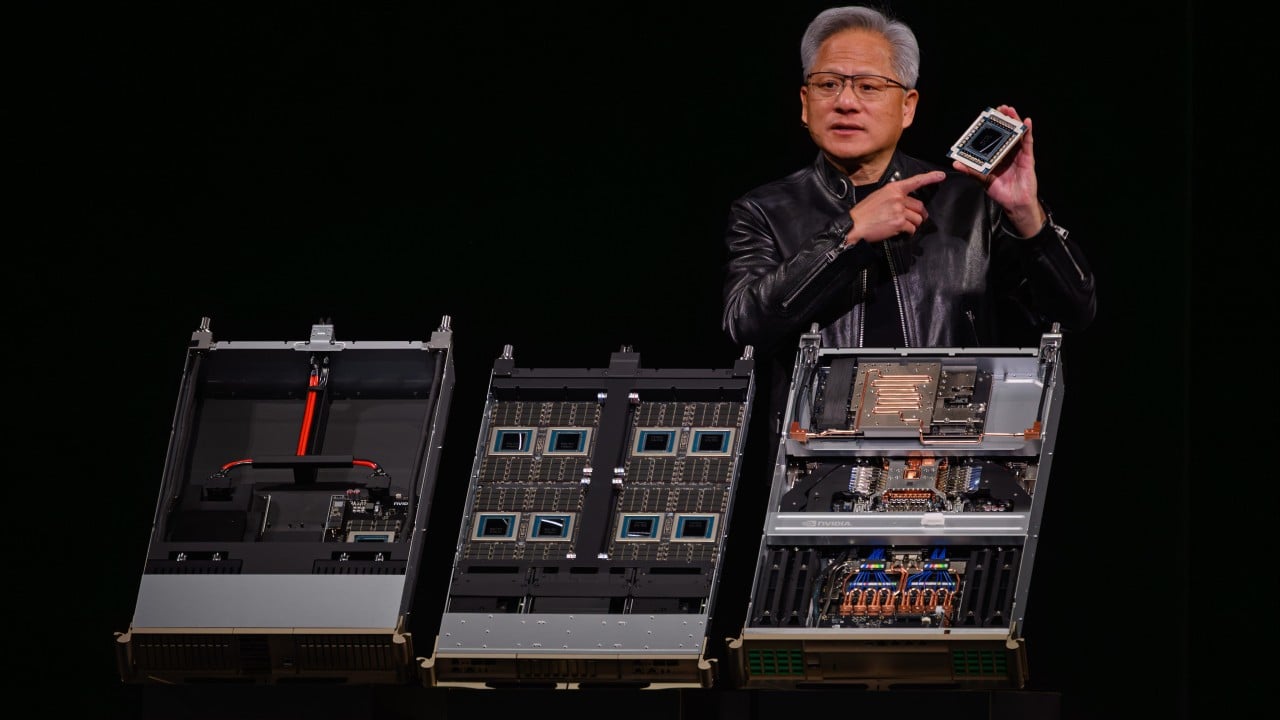
The shift from generative pre-training to large-scale inference deployment represents a fundamental transition in the global semiconductor hierarchy. While the initial "compute war" centered on raw Flops for training massive models, the current theater of operations has moved to the cost-efficiency of tokens-per-second and the energy density of the inference stack. Nvidia’s Blackwell architecture, specifically the GB200 NVL72 system, is not merely an incremental hardware update; it is a structural realignment of the cost-of-intelligence. For China’s domestic semiconductor industry, this creates a double-bind: they must replicate not just a single chip, but an entire integrated liquid-cooled rack architecture while navigating increasingly stringent export controls on high-bandwidth memory (HBM) and interconnect interconnectivity.
The Three Pillars of Inference Dominance
To understand the challenge facing Chinese hyperscalers (Alibaba, Tencent, Baidu), one must decompose the inference problem into three technical variables: memory bandwidth, interconnect throughput, and numerical precision.
- Memory Bandwidth Bottlenecks: LLM inference is frequently memory-bound, meaning the processor spends more time waiting for data to move from memory to the compute cores than it does performing calculations. Blackwell’s move to HBM3e provides the requisite bandwidth to feed massive parameter counts without the "memory wall" stalling the pipeline.
- The Interconnect Tax: Individual GPUs no longer suffice for frontier-model inference. The GB200 system treats 72 GPUs as a single logical unit via NVLink 5. This eliminates the latency penalties associated with traditional PCIe or standard Ethernet networking, which remains the primary fallback for Chinese firms using domestic chips like the Huawei Ascend 910B.
- Numerical Precision (FP4): The introduction of a dedicated second-generation Transformer Engine supporting 4-bit floating point (FP4) precision allows for a 2x increase in throughput compared to FP8, with minimal loss in model accuracy. This effectively doubles the "effective compute" without increasing the physical silicon footprint.
The Chinese Substitution Lag
The Chinese semiconductor ecosystem is currently operating under a "forced decoupling" model. While domestic firms have made strides in creating functional GPGPUs (General-Purpose Graphics Processing Units), the gap between a functional chip and a competitive inference platform is widening due to systemic constraints.
The Interconnect Ceiling
China’s primary hurdle is not the logic gate, but the wire. Nvidia’s NVLink provides 1.8 TB/s of bidirectional throughput per GPU. In contrast, Chinese domestic interconnects often rely on proprietary versions of PCIe 5.0 or specialized Ethernet protocols that offer a fraction of that bandwidth. When an LLM is distributed across a cluster, the "communication overhead" consumes a larger percentage of the total compute time on Chinese hardware. This results in a higher Total Cost of Ownership (TCO) per token, even if the domestic chips are subsidized or cheaper at the point of purchase.
The HBM Supply Chain Fragility
High-bandwidth memory is the lifeblood of high-performance inference. While SK Hynix, Micron, and Samsung provide the HBM3e modules for Blackwell, Chinese manufacturers like CXMT are still refining HBM2 or early-stage HBM3 processes. US export restrictions on the equipment necessary to manufacture advanced HBM stacks create a persistent performance ceiling. If a domestic Chinese chip cannot access HBM3e, it must compensate by adding more chips to reach the same memory capacity, which exponentially increases energy consumption and physical space requirements.
The Cost Function of Sovereign AI
The economic viability of AI in China depends on the cost-per-query. In a globalized market, Nvidia-based providers can lower prices for API access because their hardware efficiency is higher. For Chinese firms, the "Sovereign AI" mandate creates a non-economic requirement to use domestic hardware, even if it is 3x to 5x less efficient.
$Total Cost of Inference = (Hardware Capex + Energy Opex) / (Throughput \times Utilization)$
In this equation, the denominator for Chinese firms is suppressed by lower throughput (due to interconnect bottlenecks) and lower utilization (due to software stack immaturity). The numerator is inflated by the need for massive liquid cooling infrastructure to handle the heat generated by less efficient, older-node domestic silicon. This creates an "Inference Tax" on Chinese tech companies, potentially slowing the adoption of AI agents and complex reasoning models across their domestic economy.
Strategic Divergence in Model Architecture
Because Chinese developers know they face a hardware deficit, we are observing a forced evolution in their model architectures. This is not a choice, but a biological response to a resource-constrained environment.
- Mixture-of-Experts (MoE) Dominance: Chinese labs are aggressively pursuing MoE architectures. By activating only a fraction of the total parameters for any given token, they can run larger models on hardware with lower memory bandwidth. DeepSeek’s recent breakthroughs are a primary example of this "efficiency-first" engineering.
- Aggressive Quantization: Without FP4-native hardware, Chinese researchers are leading the world in sophisticated quantization techniques (e.g., 2-bit or 1.5-bit weights). They are attempting to solve in software what Nvidia has solved in silicon.
- Vertical Integration: Since they cannot rely on a horizontal hardware market, companies like Huawei are building vertically integrated stacks—from the EulerOS operating system and MindSpore framework down to the Ascend hardware. This reduces the "translation loss" between software and silicon.
The Sovereign Cloud Moat
Despite the hardware disadvantage, China maintains a significant advantage in data sovereignty and application-level integration. The Chinese government’s control over data flows allows for the creation of "National Compute Pools." By aggregating fragmented domestic compute resources into unified clouds, they can provide a subsidized floor for startups that would otherwise be priced out of the market by the high TCO of domestic chips.
Furthermore, the "Inference Gap" is most pronounced at the frontier—the largest, most complex models. For 80% of commercial AI tasks (sentiment analysis, basic coding assistance, customer service), mid-tier hardware is sufficient. Nvidia’s GTC announcements widen the gap for the top 20% of use cases, but they do not necessarily kill the viability of domestic Chinese AI for the bulk of the domestic market.
The Physical Constraints of the Blackwell Era
The transition to Blackwell also marks a transition to liquid cooling as a mandatory requirement. The GB200 NVL72 rack has a power density that exceeds the cooling capacity of traditional air-cooled data centers. This presents a secondary challenge for China: retrofitting existing data center infrastructure.
Nvidia’s "system-as-a-chip" approach means that a competitor cannot just replace the GPU; they must replace the rack, the power delivery, and the cooling manifold. This creates a massive barrier to entry for domestic Chinese hardware providers who lack the ecosystem partnerships (with companies like Vertiv or Delta Electronics) to deliver a turnkey, liquid-cooled AI factory.
The strategic play for China is no longer to "catch up" to Nvidia's peak performance, which is a moving target protected by a multi-billion dollar R&D moat and the physics of the HBM supply chain. Instead, the path forward involves a radical pivot toward specialized, application-specific integrated circuits (ASICs) that ignore general-purpose flexibility in favor of extreme efficiency in specific domains like vision or localized language processing.
Western observers often mistake China's lack of an "Nvidia-killer" for a lack of progress. In reality, the divergence is creating two distinct AI species: one optimized for infinite compute (The Nvidia Path) and one optimized for compute-scarcity (The China Path). The ultimate winner will not be determined by who has the most TFLOPS, but by which ecosystem can first drive the marginal cost of a "reasoning token" to near-zero.
To compete in this environment, firms must stop evaluating chips in isolation and begin auditing the entire thermal and interconnect path. The focus must shift from the silicon die to the rack-scale architecture, as the bottleneck has officially moved from the processor to the environment surrounding it.
Would you like me to analyze the specific power-delivery constraints of the Blackwell rack and how they compare to current Tier 3 data center specifications?