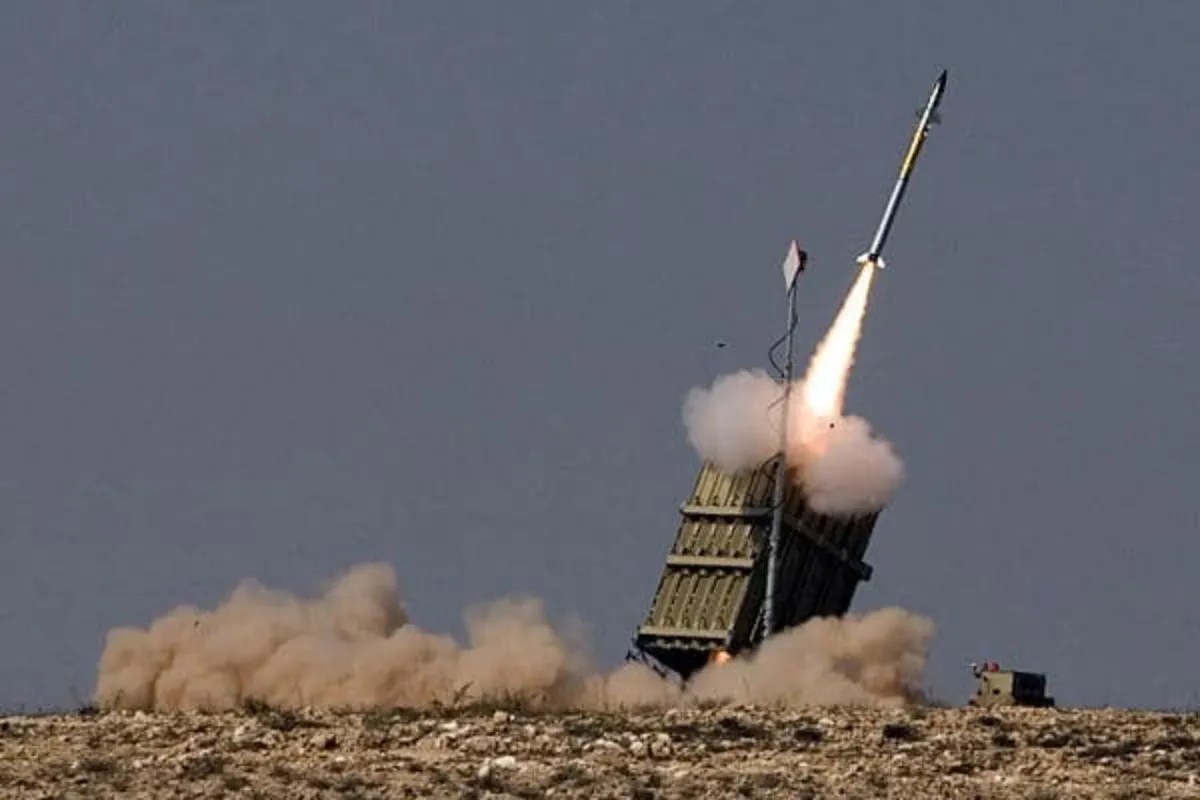
Reports that Israeli defense contractors plan to manufacture Iron Dome interceptor missiles in India are sparking intense excitement in New Delhi defense circles. On the surface, the proposition is brilliant. India gets a piece of the world’s most famous air defense system, while Israel secures a low-cost, high-capacity manufacturing base to replenish its own critically depleted stockpiles.
Yet, this partnership is not the strategic masterstroke its boosters claim. The hard reality is that the Iron Dome is fundamentally misaligned with India's actual national security threats. While the system excels at swatting down unguided, low-tech rockets fired by non-state actors at short range, India faces a vastly different class of adversaries. Moving the production of Tamir interceptor missiles to Indian soil is a lucrative manufacturing contract disguised as a major national security upgrade. It does little to address India's primary defensive vulnerabilities against high-tech peers like China or Pakistan. Recently making headlines in this space: The Nygard Guilty Plea Proves the Fashion Industry Legal Shield Just Cracked.
The Mirage of Transferring Technology
The centerpiece of the proposed manufacturing arrangement is the local production of the Tamir interceptor missile, the active heart of the Iron Dome system. Proponents argue this will inject vital technical capabilities into the Indian defense manufacturing sector, specifically through joint ventures with Indian defense majors.
Do not expect Israel to hand over the crown jewels. Additional insights regarding the matter are explored by NPR.
Historically, Israeli defense companies are fiercely protective of their intellectual property. The critical components of the Tamir missile—specifically its advanced active radar seeker and its electro-optical sensors—are highly guarded secrets. When Israel partners with foreign nations for local production, the arrangement typically involves assembling kits or manufacturing low-tech structural components like the missile casing, control fins, and solid-propellant rocket motors.
The sophisticated guidance systems and software algorithms remain black boxes, sealed in Israel and shipped for final integration. India's defense sector has repeatedly run into this wall with previous joint projects. Joint ventures often turn Indian facilities into high-end assembly plants rather than centers of genuine technological innovation. For India, the dream of acquiring the deep, foundational knowledge required to design its own advanced seeker systems remains out of reach under these restrictive assembly-only models.
Why the Iron Dome Fails the Himalayan Test
To understand why the Iron Dome is a poor fit for India, one must look at the geography of threat. The Iron Dome was engineered for a highly specific environment: small, densely populated territories threatened by short-range, unguided artillery rockets and mortars fired from just across a flat border.
India's borders are defined by the brutal topography of the Himalayas.
+-----------------------------+------------------------------------+------------------------------------+
| Feature                     | Iron Dome (Israel)                 | Himalayan Theater (India)          |
+-----------------------------+------------------------------------+------------------------------------+
| Primary Threats             | Short-range unguided rockets,      | Ballistic missiles, cruise         |
|                             | mortars, low-altitude drones       | missiles, hypersonic weapons       |
+-----------------------------+------------------------------------+------------------------------------+
| Terrain                     | Flat, compact, desert/urban        | Mountainous, high altitude, vast   |
+-----------------------------+------------------------------------+------------------------------------+
| Intercept Altitude          | Low-altitude, short-range          | Medium-to-high altitude, long-range|
+-----------------------------+------------------------------------+------------------------------------+
In the high-altitude regions of Ladakh or Arunachal Pradesh, radar signals are severely degraded by mountain peaks and deep valleys, creating massive blind spots. An incoming cruise missile or a swarm of attack drones can use mountain terrain to mask their approach, popping up on radar only seconds before impact. The Iron Dome’s radar, the ELM-2084, is exceptional, but it cannot bend physics.
Furthermore, China's military posture relies heavily on long-range guided ballistic missiles, precision-guided cruise missiles, and high-speed loitering munitions. The Iron Dome is practically useless against a theater ballistic missile plunging from the upper atmosphere at hypersonic speeds. Against such threats, India requires heavy, long-range systems like the Russian-made S-400 or its own indigenous Project Kusha long-range surface-to-air missile system. Investing precious capital and manufacturing capacity into a short-range system designed for Gaza-style threats diversion of resources from India’s real air defense priorities.
The Economic Trap of Short Range Attrition
The economics of the Iron Dome are brutal, even when the system works perfectly. Each Tamir interceptor missile costs between $40,000 and $100,000. While this is cheap compared to a million-dollar Patriot missile, it becomes financially ruinous when deployed against a massed adversary.
In Israel, the math works because the rockets being intercepted are aimed at major civilian population centers, making the protection of human life and infrastructure worth the steep price of the interceptor. However, in a conflict between India and a peer state, an adversary would not rely on cheap, unguided rockets. They would deploy thousands of low-cost, mass-produced attack drones, similar to the Shahed-series systems seen in modern European conflicts.
Attempting to counter a swarm of $20,000 drones with $80,000 interceptors is a fast track to strategic bankruptcy. An adversary can easily overwhelm the system's radar processing capacity and deplete its ready-to-fire interceptors within hours simply by throwing waves of cheap decoys at the line. Once the interceptor magazines are empty, the high-value military assets behind them—airfields, command nodes, and fuel depots—lie completely exposed.
The Overlooked Indigenous Alternatives
The push to manufacture Israeli interceptors in India also ignores a vital domestic reality. India has already spent decades and billions of dollars developing its own formidable air defense ecosystem.
The Akash surface-to-air missile system is already active and widely deployed. It has proven highly effective at engaging helicopters, drones, and subsonic cruise missiles at medium ranges. For shorter-range threats, India's Defense Research and Development Organisation (DRDO) has developed the Very Short Range Air Defence System (VSHORADS) and is actively working on national cruise missile defense initiatives.
Overlapping Capabilities
Introducing an Indian-made Iron Dome variant creates immediate operational redundancies. The Indian military is already struggling with a chaotic mix of Soviet, Russian, French, Israeli, and indigenous air defense hardware. Adding yet another missile system, with its own unique maintenance cycles, proprietary software, and distinct supply chains, turns an already complex logistics network into a nightmare.
Every rupee spent setting up assembly lines for Israeli missiles is a rupee taken away from perfecting and scaling India's own indigenous defense projects. If New Delhi wants true strategic autonomy, it must prioritize refining its own home-grown tech over assembling foreign designs under restrictive licensing agreements.
Israel's True Motivation for Indian Production
To truly understand this deal, we must look beyond India's borders. Israel's push to set up manufacturing facilities abroad is driven by its own urgent domestic crises.
Years of sustained conflict have stretched Israel’s military-industrial complex to its absolute limits. Its domestic factories are running round-the-clock, but they cannot keep up with the sheer volume of interceptor missiles required to protect its skies. Furthermore, Israel relies heavily on US financial aid to fund these interceptors, and US manufacturing facilities are already choked with global orders.
By establishing a parallel production line in India, Israeli defense contractors solve two massive problems simultaneously. First, they tap into India’s vast, low-cost engineering workforce and manufacturing infrastructure, allowing them to scale up production of Tamir components rapidly. Second, it allows Israel to circumvent domestic capacity constraints and build a resilient, geographically distributed supply chain that is safe from direct missile attacks.
India is not being offered a partnership of equals. It is being utilized as a low-cost, high-volume offshore factory to support Israel's global defense commitments.
The Indian government must look past the flashy demonstrations and the allure of high-tech defense branding. If India allows itself to become a mere assembly hub for interceptors that do not fit its own threat matrix, it will have traded genuine defense modernization for a high-profile, low-yield public relations victory.