Journalism has a massive cash problem. For years, the conventional wisdom told independent publishers that if they built an audience, the money would follow. It didn't. Instead, small newsrooms found themselves trapped on a treadmill, chasing algorithm whims and chasing page views that paid pennies. Visibility did not translate into financial survival.
The Samir Kassir Foundation (SKF) decided to address this flaw directly. Based in Beirut, Lebanon, an area scarred by economic instability and intense political pressure, the foundation knows that editorial independence is impossible without financial stability. They shifted the focus entirely. They stopped looking at audience metrics as the ultimate goal and started looking at concrete commercial assets.
If you run an independent media outlet or work as a freelance creator, the old playbook is dead. The survival of your business relies on pooling infrastructure, collective bargaining, and monetizing your actual creative production capacity rather than relying solely on programmatic ad networks.
The Myth of Scale for Independent Publishers
Most media advice originates from massive Western newsrooms. They talk about paywalls, membership drives, and native advertising at a scale that smaller operations cannot match. If you operate in a restricted market or a small geographic region, trying to scale your audience to millions of users is a fool's errand. Big tech platforms pocket the vast majority of digital ad spending anyway, leaving independent publishers to fight over crumbs.
Real independence requires a total decoupling from the traffic-chasing model. The Samir Kassir Foundation proved this by looking at what independent outlets actually possess: raw creative talent, high-quality production capabilities, and trusted relationships with niche audiences. Instead of selling programmatic ad space for fractions of a cent, newsrooms can treat their operations as high-value creative agencies.
This means looking at your newsroom not just as a distribution pipe for information, but as a production house. You have videographers, researchers, writers, and designers. Those are commercial assets that businesses and organizations outside of journalism will pay real money to use.
Reclaiming the Local Ad Market Through Collective Power
When a small media outlet tries to pitch a regional corporate advertiser, they usually get ignored. The buyer wants reach, and a small, independent investigative site cannot offer the raw numbers of a state-funded network or a massive tabloid.
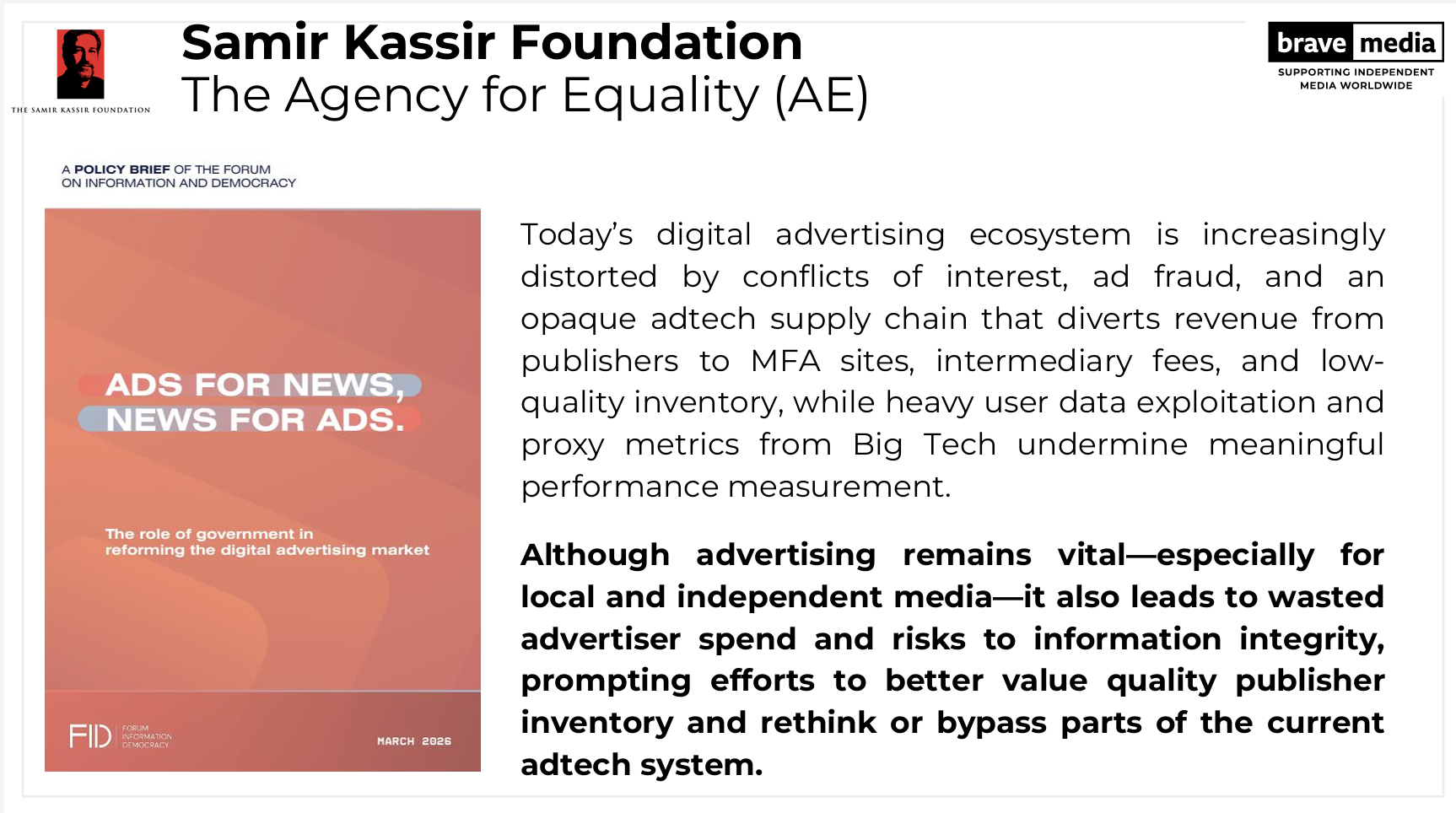
SKF bypassed this hurdle by launching the Agency for Equality. This initiative acts as a bridge, allowing independent outlets to market their combined production strengths to commercial advertising markets.
Instead of fighting for individual survival, independent publishers can use shared infrastructure to pitch larger clients. Think about it. If three or four high-quality, independent outlets pool their creative teams, they can pitch comprehensive multimedia campaigns that rival traditional creative agencies. The revenue from these projects funds the core, public-interest journalism that wouldn’t otherwise survive. It turns an outlet's cost center—content production—into a direct revenue generator.
Fighting Algorithm Suppressions Together
Even if you produce incredible journalism, platform algorithms are actively rigged against political reporting, investigative work, and independent commentary. Relying on social networks for discovery is a slow corporate death sentence.
The solution is collective visibility. SKF created an initiative called Skroll, a shared platform designed to aggregate independent journalism in one place. It operates on a simple premise: independent media outlets are stronger when audiences can discover them collectively.
[Independent Publisher A] \
[Independent Publisher B]  --> [ Skroll Aggregator ] --> [ Combined Audience Discovery ]
[Independent Publisher C] /
This reduces the visibility challenges caused by fragmented digital apps and shifting distribution networks. When you convince your audience to visit a shared hub of trusted independent voices, you break your dependency on third-party algorithms. You also build a collective audience profile that is far more attractive to ethical advertisers and philanthropic sponsors than a single, isolated website could ever manage.
Monetizing the Individual Creator
Media sustainability discussions usually stall out at the executive or publisher level. People forget that individual journalists, especially freelancers and photojournalists, face the exact same brutal economic realities. Visual journalism is expensive to produce, highly sought after, but routinely undervalued by major networks who scrape images or pay measly stringer rates.
To fix this gap, SKF developed Soora, a dedicated initiative designed to create fair market opportunities for photojournalists. By treating visual archives and real-time assignments as premium commercial products, the project secures immediate revenue for the creators while protecting the intellectual property of their work.
If you are an individual media creator, you cannot keep giving your work away to platforms for exposure. You have to establish clear syndication terms, build collective registries with your peers, and demand baseline commercial rates for your creative output.
Steps to Take Right Now
You don't need a massive international grant to start applying these principles to your own media operation. Transitioning from basic visibility to true financial viability requires shifting your daily operational focus.
First, catalog your internal production strengths. Determine if your team excels at short-form video, deep data research, audio engineering, or graphic design. Stop viewing these skills solely as tools for your own articles and start viewing them as services you can contract out to mission-aligned organizations, educational institutions, or local businesses.
Second, schedule conversations with alternative publishers in your region. Identify where you compete, but more importantly, identify where your infrastructure overlaps. You can share the costs of legal defense, digital security tools, or even ad-sales representation.
Financial sustainability and editorial independence are not competing forces. They are completely dependent on each other. You cannot speak truth to power if you are worried about whether your website will get kicked off its servers next month because you can't pay the bill. Build the business engine first, and the journalism will have a safe place to live.