The glow of a late-summer television screen often projects a specific kind of American mythology.
Picture a living room in Ohio. The air conditioning hums a low, tired tune against the heavy September humidity. On the wall-mounted display, helmets crash against leather shoulder pads under the blinding halogen glare of a Thursday Night Football opener. The green turf looks impossibly vibrant, almost radioactive. Millions of pairs of eyes are glued to that glowing rectangle, locked into the rituals of autumn.
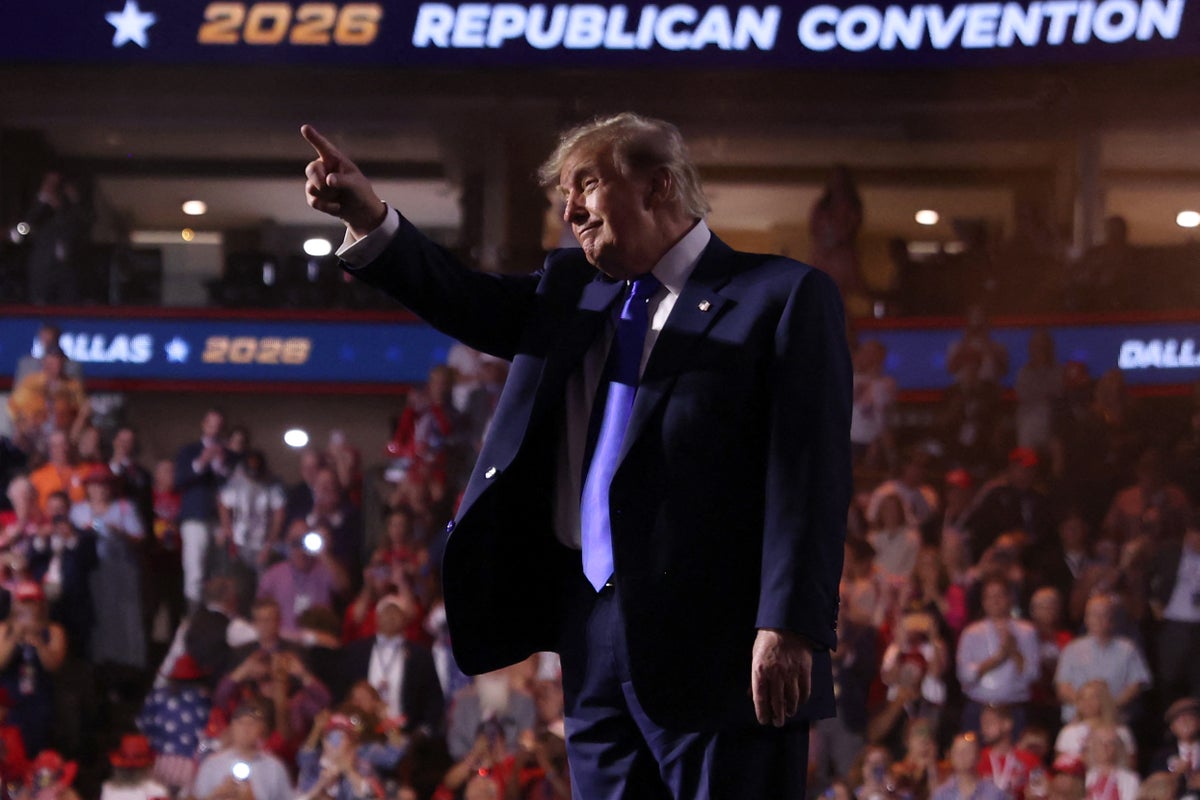
Now, shift the lens a few hundred miles away to a convention center auditorium. Red, white, and blue banners hang motionless in the recycled air. Rows of plastic chairs sit half-empty, waiting for an audience that never quite materializes in the physical seats or on the major cable networks. The broadcast feeds are dark. The cable news control rooms have other priorities.
Yet, in the quiet aftermath, a digital pronouncement is made. The numbers, according to one man, defied gravity. The convention, he insists, won the night. It beat the monolithic juggernaut of the National Football League in the ratings battle.
Silence. Then, a quiet cognitive dissonance settles over anyone paying attention to the actual mechanics of media consumption.
How do you measure a victory when the cameras are looking the other way?
To understand this strange collision of politics and sports entertainment, we have to look past the punchlines and examine the architecture of modern attention. We live in an era where data is no longer a compass used to find the truth; it is a lump of clay molded into whatever shape serves the storyteller.
Let us be entirely honest about the baseline reality. Major television networks—the traditional gatekeepers of public attention—largely bypassed live, gavel-to-gavel coverage of the political gathering in question. They had balance sheets to protect, advertiser demands to meet, and audience analytics screaming that Americans on a crisp September evening wanted football, not stump speeches. When ABC, CBS, NBC, and the primary cable news networks decide to point their massive lenses elsewhere, a fundamental law of mass media applies: if it is not broadcast into millions of living rooms simultaneously, the traditional ratings simply do not exist.
And yet, the claim persisted.
Why? Because the metrics of modern influence have fractured.
Imagine an algorithmically generated universe where a speech given to a sparse room is sliced, diced, and filtered into ten-second vertical videos. These clips travel across smartphones at midnight. They pop up between dance trends and cooking tutorials. By morning, millions of algorithmic impressions have accumulated.
To a traditional television executive, those digital views are not television ratings. They are scattered digital debris. But to a political strategist whose entire brand is built on defying institutional gravity, digital impressions and television ratings are treated as interchangeable currency. If enough people scrolled past a clip on a glowing phone screen while sitting in bed, that counts as a victory. It beats the stadium. It beats the gridiron. It beats the establishment.
This is where the human element curdles into something strange.
We crave certainty. We want our side to win, even if the scoreboard has to be invented out of thin air. When a public figure looks at a room of empty chairs and declares it the biggest crowd in history, or looks at un-televised hours and declares a ratings landslide over the NFL, they are not talking to statisticians. They are talking to the believers. They are offering an alternate reality where the mainstream media is always lying, the establishment is always plotting, and the underdog leader is always triumphant against impossible odds.
Consider the psychological comfort of that delusion. Admitting that an event failed to capture the public's imagination is painful. It requires humility. It requires looking at the data and accepting that millions of Americans simply cared more about a football game than a political rally on a given Thursday night.
Football is safe. Football is a communal religion that transcends partisan lines for three hours a week. It offers clear rules, instant replays, and a definitive winner when the clock hits zero. Politics, by contrast, has become an exhausting, unending war of attrition that leaves citizens hollowed out and suspicious.
So, rather than accepting the pull of the football game, the narrative machinery spins a counter-narrative. The lack of network coverage is framed not as journalistic indifference, but as a conspiracy of silence. The lower crowd counts are dismissed as fake news. The victory is declared simply because saying it makes it feel true to the people who desperately need it to be true.
We have seen this movie before. We watch powerful figures retreat into insulated bubbles where objective reality is treated as an optional subscription service. But the danger goes beyond mere delusion. When basic, verifiable facts—like television ratings and broadcast schedules—become matters of partisan faith, the shared foundation of public discourse cracks.
If a political candidate can claim dominance over the most-watched sports broadcast of the week while cameras sat idle, what else can be conjured from thin air? If truth is reduced to whatever performs best on an algorithm, objective truth ceases to be a useful tool for democracy. It becomes merely another brand attribute.
Back in that Ohio living room, the football game ends. The final score flashes on the screen. The exhausted fans click off the television, plunging the room back into darkness, and head to bed with a clear score etched into their minds. Win or lose, the numbers on the scoreboard were real. The grass on the field was torn up. The sweat was genuine.
Out in the wider world, the digital noise continues to hum, looping a speech to an empty room, counting views that never happened on screens that were never tuned in, chasing a ghost victory in a stadium where the lights went out hours ago.


