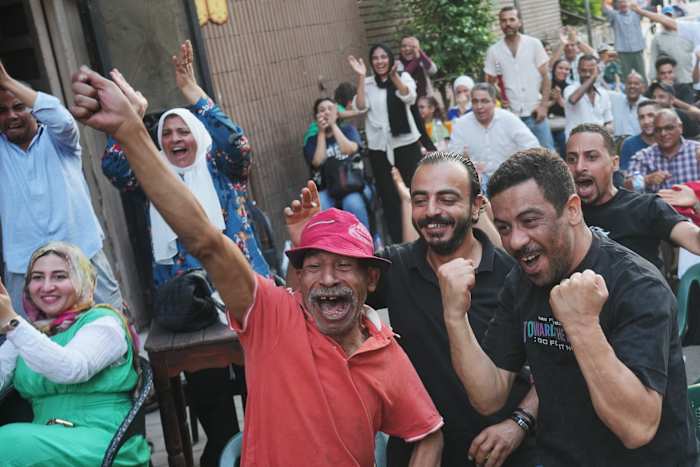
When the final whistle blew and Egypt’s World Cup ambitions evaporated against Argentina, the silence that blanketed Cairo’s coffee houses was not just the sound of sporting heartbreak. It was the sudden deflation of a massive, state-sanctioned pressure valve. For ninety minutes, millions of Egyptians were bound by a singular, desperate hope that eleven men on a pitch could deliver a sense of triumph that everyday life currently denies them. Then, reality rushed back in.
The intersection of football and geopolitics in North Africa runs far deeper than simple fandom. In Egypt, football is a mirror of the state's internal anxieties and a tool used by successive regimes to manage public morale. When the national team wins, the streets erupt in a carefully tolerated collective euphoria that papers over soaring inflation, currency devaluations, and political stagnation. But when the team loses, the silence exposes the raw nerve of a nation left with nothing to distract it from its economic reality. To understand why a football match can paralyze an entire capital city, one must look past the tactics on the pitch and examine how the sport became the country's most vital social currency.
The Anatomy of the Cairo Coffee House Economy
Ahwas—the traditional street-side coffee houses—form the literal and figurative nervous system of Cairo. They are not merely businesses; they are public squares in a society where literal public squares are heavily policed and monitored.
During a major tournament, these spaces undergo a commercial and social transformation. Owners cram plastic chairs onto sidewalks, string up makeshift projection screens, and charge premium rates for a seat. For the duration of a match, the rigid social stratifications of Cairo melt away. A wealthy professional from New Cairo sits shoulder-to-shoulder with an underemployed youth from the informal settlements of Imbaba.
This temporary unity is precisely what makes the subsequent defeat so devastating. The coffee house functions as a pressure cooker. The collective energy builds with every attack, every save, and every refereeing decision. When Argentina scored, it did not just alter the scoreboard; it punctured the collective delusion that football could provide an escape from the systemic hardships waiting outside the café perimeter. The sudden silence observed in these hubs after a loss is a physical manifestation of a populace returning to its default state of endurance.
Football as the Ultimate Governance Tool
The relationship between Egyptian authorities and football has always been transactional. For decades, the state has viewed the national team's success as a shortcut to domestic stability.
Historically, former President Hosni Mubarak mastered this playbook. During the late 2000s, when Egypt won three consecutive Africa Cup of Nations titles, Mubarak and his sons routinely embedded themselves with the team, positioning the regime as the ultimate patron of Egyptian excellence. The message was clear: the success of the Pharaohs was the success of the state. It was a highly effective distraction from the nepotism and economic decay that eventually sparked the 2011 revolution.
Today, the stakes are even higher. The current administration faces severe macroeconomic headwinds, including a crushing debt burden and a populace struggling with the rising cost of basic commodities. In this environment, a deep World Cup run is worth more than billions in foreign aid. It buys time. It offers a fractured society a shared identity that does not center on economic grievances. When that run ends prematurely, the government loses its most potent psychological buffer, leaving a frustrated populace alone with its thoughts and its bills.
The Structural Rot Behind the On-Field Failures
While fans grieve the tactical errors that led to the defeat against Argentina, the true failure lies within the structural mismanagement of Egyptian football. The domestic game is broken, plagued by corruption, cronyism, and a total lack of long-term vision.
The Egyptian Premier League is one of the most volatile football environments in the world. It is dominated by a duopoly—Al Ahly and Zamalek—whose political and financial clout suffocates the rest of the pyramid. More critically, the league has spent years playing matches in empty or heavily restricted stadiums due to security fears stemming from the 2012 Port Said stadium riot. A generation of domestic players has grown up competing in echo chambers, entirely unaccustomed to the intense, high-pressure environments of international football.
Furthermore, the grassroots development system in Egypt is practically non-existent. Wealthy clubs focus on buying short-term success rather than investing in youth academies or scouting networks in the marginalized Upper Egypt or Delta regions. The country relies almost entirely on sporadic, generational talents like Mohamed Salah to carry the weight of the entire national infrastructure. When an opponent like Argentina systematically neutralizes that single point of failure, the entire Egyptian system collapses because there is no structural depth behind it.
The Global Superpowers and the Widening Gap
The match against Argentina also highlighted a bitter truth that many Egyptian football analysts refuse to accept: the gap between North African football and the global elite is widening, not shrinking.
European and South American football operations are built on sophisticated data analytics, rigorous sports science, and institutional stability. They operate like multinational corporations. Egypt, by contrast, relies on emotional intensity, individual brilliance, and reactive management. The national team frequently changes managers based on media backlash rather than sporting merit. Training camps are chaotic, and logistical failures are common.
To compete with a powerhouse like Argentina, a federation needs more than passion; it needs an elite pipeline of talent playing in the top flights of Europe. While nations like Morocco have successfully integrated their diaspora and modernized their domestic structures, Egypt remains insular, hesitant to reform its corrupt administrative bodies, and overly reliant on past glories.
The Morning After and the Return to Reality
By midnight in Cairo, the plastic chairs are stacked against the walls. The projection screens are turned off, and the smoke from the shisha pipes clears. The flags that were selling for fifty pounds on the street corners a few hours prior are left discarded in the gutters.
The tragedy of Egyptian football is that the game is forced to carry a burden it was never meant to bear. A sport cannot fix a broken economy. It cannot lower the price of meat, it cannot provide jobs for millions of university graduates, and it cannot restore a sense of political agency to a disenfranchised youth.
When the whistle blew, the illusion broke. The millions of Egyptians who walked home in silence were not just mourning a missed opportunity on the global stage. They were coming to terms with the fact that the distraction was over, and the grueling reality of their daily lives was waiting for them exactly where they left it.