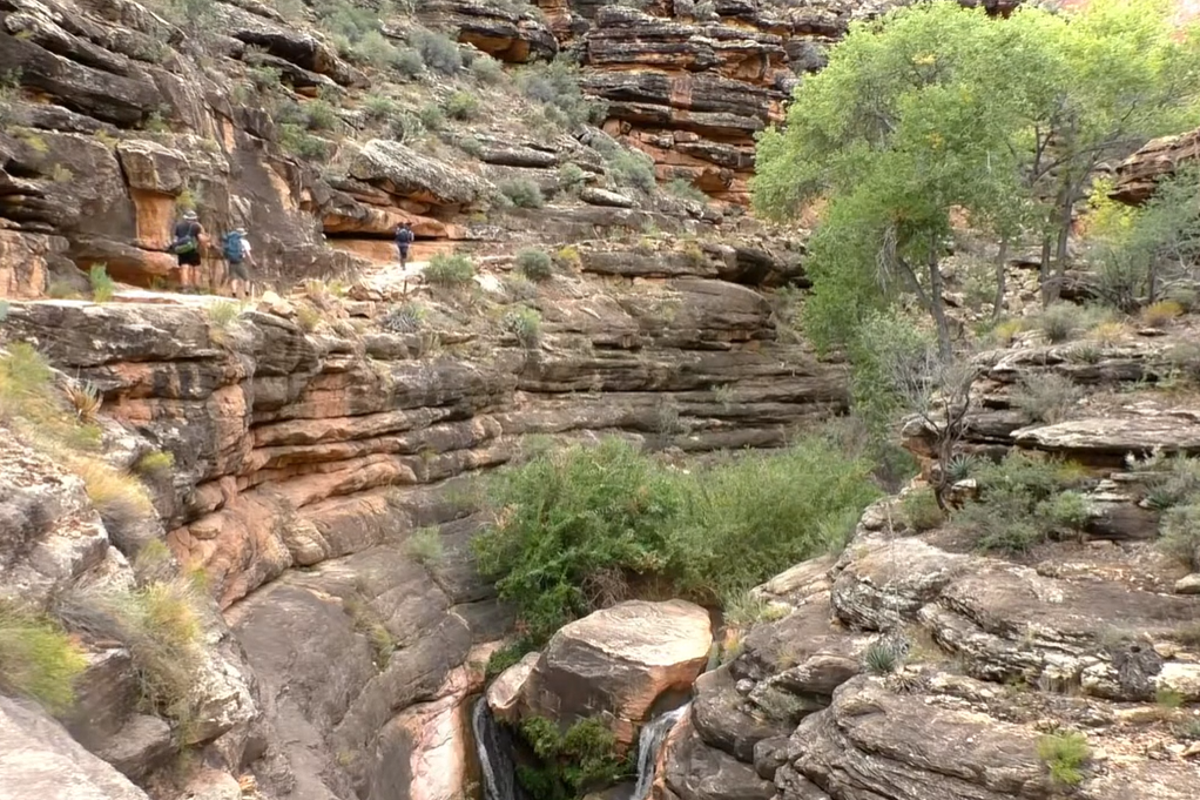
The dirt under your boots at the South Rim of the Grand Canyon feels solid, eternal, and deceptively safe. You stand at the edge, looking down into a cathedral of red rock that drops away for a mile. The air up there, at 7,000 feet, is crisp. It tricks your skin. It tells you that the desert is a place you can conquer with a couple of plastic water bottles and a good pair of sneakers.
That is the trap.
Every year, millions of people walk up to that rim. They look down into the throat of the earth, and they see a postcard. They do not see a furnace. But as you descend into the canyon, the world flips. For every thousand feet you drop, the temperature spikes. It is an inverted mountain, a place where the summit is the easiest part of the journey and the summit is where you start. By the time you reach the floor, you are standing in an environment that wants to boil you from the inside out.
A fourteen-year-old boy from California learned this truth in the most brutal way possible. He was hiking the Bright Angel Trail, a path traveled by thousands of tourists every summer. He was young, presumably fit, and full of the casual confidence that belongs exclusively to youth. He did not survive the day. He collapsed on the trail, his body overwhelmed by heat-related illness, joining a quiet but steady statistics column of lives cut short by a landscape that tolerates zero mistakes.
We read these headlines and we distance ourselves. We think about poor planning, or lack of water, or pre-existing conditions. We tell ourselves we would know better.
We are wrong.
The Physiology of a Thermal Trap
To understand what happened on that trail, you have to understand what happens to a human body when the ambient temperature surpasses its ability to cope. It is a slow, silent cascade of failures.
Imagine your body as a high-performance engine. Its optimal operating temperature is tightly regulated around 98.6 degrees Fahrenheit. When you exercise, that engine generates heat. To dump that heat, your heart pumps blood away from your core and toward your skin, where sweat can evaporate and cool you down. It is a beautiful, elegant system.
But it requires cooperation from the air around you.
When the temperature in the inner depths of the Grand Canyon climbs past 100 degrees—and it routinely hits 120 degrees in the shade during peak summer—the system breaks. The air is no longer cooling your skin; it is heating it. Sweating becomes frantic, but if the humidity is extremely low, the sweat evaporates so fast you do not even realize you are losing water. You feel dry. You feel fine.
Until you don't.
"The desert does not warn you when you are crossing the line. It lets you walk right over it, smiling, until your core temperature hits 104 degrees."
At that threshold, clinical heat stroke takes hold. Your brain, cooked by your own blood, begins to misfire. Confusion sets in. Delusion follows. Hikers suffering from severe heat stroke have been known to strip off their clothes, convinced they are burning up, or wander off the trail entirely. Your heart, beating at maximum capacity to push blood to the skin, begins to fail. Your organs, deprived of oxygenated blood because everything is being diverted to the cooling effort, start to shut down one by one.
It happens in minutes. One moment you are resting on a boulder, complaining about a headache. The next, your body is seizing on the dirt.
The Psychology of the Point of No Return
The real danger of the Grand Canyon is not the physics of heat; it is the psychology of the hiker.
Consider a hypothetical family making the trek. Let's call them the Millers. They arrive at the rim at 8:00 AM. The air is 72 degrees. They decide to hike down to Indian Garden, a popular resting spot about four and a half miles below the rim. The walk down is a breeze. Gravity does all the work. They are laughing, taking photos, watching the squirrels.
They do not notice that the air is getting heavier. They do not realize that the heat radiating off the ancient Vishnu schist walls is acting like a brick oven.
By the time they reach their destination, they have used half their water. They are tired, but they feel accomplished. Then they turn around.
Now, they must climb four and a half miles back up. Every step is an grueling effort against gravity. The sun is now directly overhead, baking the canyon walls. The temperature has soared to 105 degrees. The effort of climbing doubles their internal heat production. Their water is gone within the first mile of the ascent.
This is the psychological trap: the illusion of the easy start. In a normal mountain range, you do the hard work first. You climb when you are fresh, and if you get too tired, you turn around and coast back down to safety. In the Grand Canyon, safety is at the top. You do the easiest part of the hike when you have the most energy, and you are forced to do the most dangerous, exhausting work when you are already depleted, dehydrated, and overheating.
It is a design flaw in human judgment. We are wired to think that if a path is easy to walk down, it must be manageable to walk up. The canyon shatters that assumption.
The Mirage of Preparation
People talk about preparation as if it is a shield. They buy the expensive hydration packs, the moisture-wicking shirts, the high-calorie trail mixes. They read the brochures distributed by the National Park Service.
But preparation is useless without humility.
The park rangers at the Grand Canyon are some of the most hardened search-and-rescue professionals in the world. They spend their summers pulling marathon runners, military personnel, and young athletes off the trails. These are people in peak physical condition. If fitness could save you from heat stroke, these people would be invincible.
It turns out that a finely tuned athletic body actually generates more heat during intense exertion than an unconditioned one. If you push that body past its thermal limits, it will fail just as catastrophically as anyone else's. The heat does not care about your fitness routine. It does not care that you are fourteen and have your whole life ahead of you. It only cares about thermodynamics.
When the call comes in that a hiker has collapsed, a frantic race against time begins. But the geography of the canyon means that help is never immediate. Helicopters cannot always fly in the turbulent, super-heated air currents inside the gorge. Rangers must often hike down to the victim, carrying heavy medical gear through the same suffocating heat that felled the tourist.
For the fourteen-year-old boy on the Bright Angel Trail, the emergency response was swift, but the heat had already won. By the time medical personnel reached him, his body had crossed a line from which there is no returning.
Re-evaluating Our Relationship with the Wild
We have domesticated our world to such an extent that we have forgotten what true wilderness feels like. We live in climate-controlled bubbles, moving from air-conditioned homes to air-conditioned cars to air-conditioned offices. We view nature as a playground, a backdrop for an Instagram post, or a bucket-list item to check off.
We treat the Grand Canyon like a theme park. We assume that because there is a paved trail and a gift shop at the top, there must be a safety net at the bottom.
There is no safety net.
The wilderness is indifferent. It does not hate us, but it does not love us either. It exists on its own terms, governed by ancient laws of geology and meteorology. When we step off the rim and into the gorge, we are guests in an environment that has spent millions of years carving stone with nothing but water and time. It will not change its rules for our convenience.
The death of a teenager in the dirt of a desert trail is a tragedy that reverberates far beyond the canyon walls. It leaves a family shattered, a community mourning, and a group of traumatized rangers wondering what else they could have said or done to prevent it.
But perhaps the greatest tragedy would be to look at this event, sigh, and move on without changing how we look at the natural world.
The next time you stand at the edge of a great wilderness, feel the wind on your face. Appreciate the vastness. But look closely at the shadows in the depths. Respect the heat that lives there. Remember that the beauty of the wild is inseparable from its danger, and that the line between a memorable vacation and a fatal miscalculation is as thin as a single drop of sweat evaporating into the dry desert air.