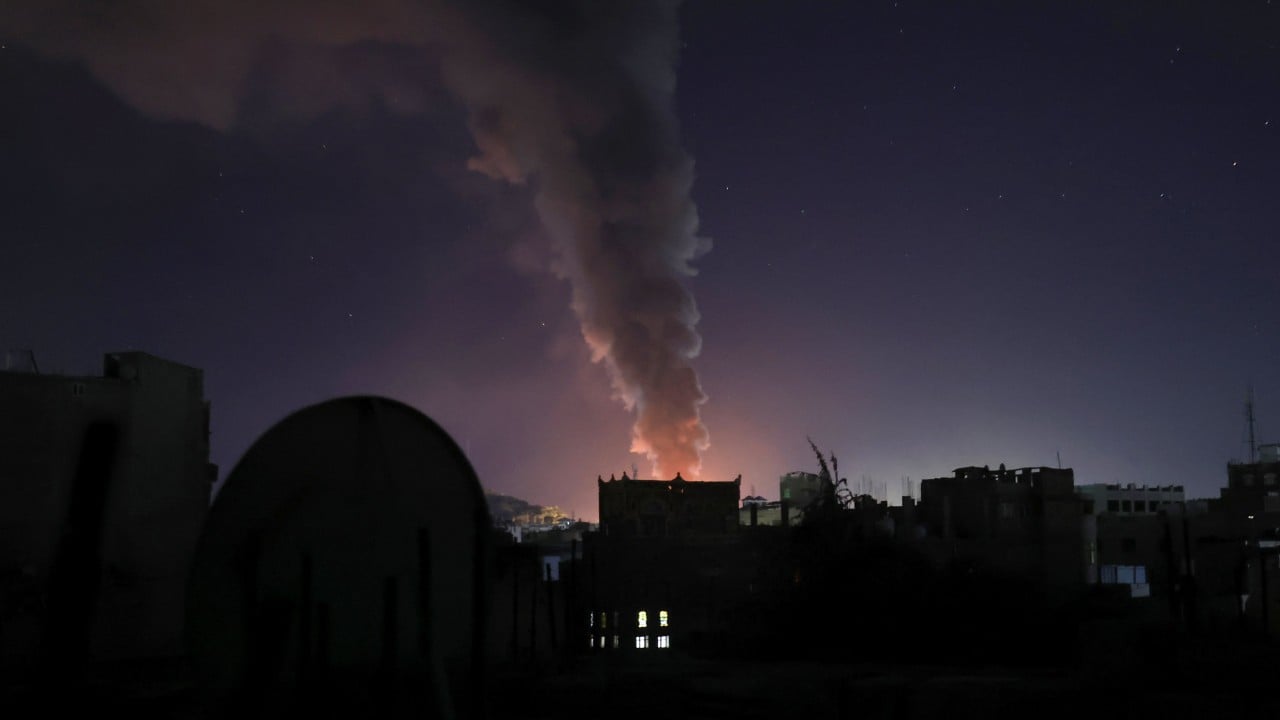
Yemen’s Houthi movement launches retaliatory drone and missile strikes against Riyadh whenever the Saudi-led coalition conducts targeted raids or "special operations" inside Yemeni territory, using asymmetric aerial warfare to impose direct political and economic costs on the Saudi capital. These cross-border attacks are designed not to achieve conventional military victory, but to shatter the illusion of Saudi domestic security, strain expensive Western air defense networks, and force Riyadh back to the negotiating table on Houthi terms.
That is the surface reality. The deeper truth is far more uncomfortable for military planners in Washington and Riyadh. For another view, consider: this related article.
Every time a coalition special operations unit crosses a border, intercepts a maritime smuggling vessel, or conducts a precision strike on a Houthi command node, the group responds with a calibrated barrage aimed hundreds of miles north. To understand why this cycle persists—and why billions of dollars in interceptor missiles have failed to stop it—you have to look past the press releases from both sides and examine the brutal math of modern asymmetric conflict.
The Anatomy of a Retaliatory Cycle
The pattern is predictable. First comes the coalition announcement of a "special operation." In the lexicon of the Saudi-led coalition, this phrase covers a wide spectrum of military activity. It can mean a clandestine raid by special forces targeting Houthi logistics, an airstrike on an underground ballistic missile assembly facility, or a naval interdiction in the Red Sea aimed at severing Iranian supply lines. Related analysis on this trend has been provided by NBC News.
Then comes the response. Within hours or days, Houthi military spokesmen announce a deep-strike operation targeting Riyadh, Abha, or Jeddah.
The Houthis, formally known as Ansar Allah, do not operate like a traditional state army. They operate like an adaptive insurgency equipped with state-level weaponry. When the coalition strikes a high-value target, the Houthi leadership faces an immediate internal pressure to demonstrate strength to its domestic base in Sanaa and prove to its regional backers that its deterrent remains intact.
A strike on Riyadh serves multiple purposes at once:
- Psychological disruption: Explosions in the skies above a G20 capital dominate international headlines, instantly overshadowing whatever tactical success the Saudi coalition achieved in the mountains of Yemen.
- Economic friction: Even when incoming projectiles are intercepted, falling debris damages infrastructure, disrupts commercial air traffic at King Khalid International Airport, and forces multinational corporations to recalculate the risk of operating in the Kingdom.
- Strategic signaling: Firing at Riyadh tells Saudi decision-makers that the war cannot be compartmentalized. The front line is not confined to the rugged terrain of Marib or Saada; it extends directly to the royal palaces and financial districts of the capital.
Inside the Asymmetric Arsenal
To hit Riyadh from northern Yemen, a projectile must travel roughly 600 miles (nearly 1,000 kilometers). Ten years ago, the idea that a Yemeni militia could reliably threaten targets at that distance would have been dismissed by most defense analysts. Today, it is a routine operational reality.
The Houthis rely on a tiered inventory of long-range systems, largely developed through indigenous reverse-engineering combined with technical assistance and smuggled components from Iran's Islamic Revolutionary Guard Corps (IRGC).
Long-Range One-Way Attack Drones
The workhorse of the Houthi deep-strike capability is the Samad series of unmanned aerial vehicles (UAVs), particularly the Samad-3 and Samad-4 variants. These are slow, low-flying, propeller-driven drones carrying relatively small warheads—typically between 40 and 90 pounds of high explosive.
They are cheap. A single Samad drone costs a fraction of a luxury sedan to assemble. Because they fly low to the ground, they exploit gaps in traditional radar coverage designed to spot high-altitude ballistic trajectories. They are not built to level city blocks; they are built to swarm, confuse, and exhaust.
Ballistic and Cruise Missiles
When the Houthis want speed and kinetic punch, they turn to the Burkan series of short- and medium-range ballistic missiles (variants of the Soviet-era Scud) and the Quds series of land-attack cruise missiles.
Ballistic missiles exit the atmosphere and plunge toward Riyadh at supersonic speeds, giving radar operators mere minutes to react. Cruise missiles, conversely, hug the terrain at subsonic speeds, maneuvering around air defense batteries to strike from unexpected angles.
By combining drones, cruise missiles, and ballistic missiles into a single, synchronized salvo—a tactic known in military doctrine as a complex attack—the Houthis force Saudi air defenders to track multiple threats moving at wildly different speeds and altitudes simultaneously.
The Brutal Math of Air Defense
Saudi Arabia possesses one of the most heavily funded air defense networks on earth. Protecting Riyadh are batteries of American-made Patriot PAC-2 and PAC-3 systems, alongside Terminal High Altitude Area Defense (THAAD) interceptors and advanced radar arrays.
On paper, this shield is formidable. In practice, it suffers from a crippling structural flaw known as the cost-exchange ratio.
Consider a hypothetical engagement over Riyadh. The Houthis launch six Samad-3 drones and two Quds cruise missiles. The total production and launch cost to the Houthis might be $200,000. To ensure zero penetrations over a densely populated capital, Saudi Patriot batteries typically fire two interceptors at each incoming target—a standard doctrine known as "shoot-look-shoot."
A single PAC-3 interceptor missile costs roughly $4 million. Firing twelve of them to stop a $200,000 raid costs the defender $48 million in a matter of seconds.
In asymmetric warfare, the attacker does not need to hit the target to win the exchange. Forcing the defender to fire a multi-million-dollar interceptor at a plywood-and-fiberglass drone is a victory in itself.
Beyond the financial drain, there is the problem of magazine depth. Interceptor missiles cannot be manufactured overnight. Global supply chains for solid rocket motors, microchips, and seeker heads are severely constrained. Every time Riyadh expends a salvo of interceptors to swat down Houthi drones, it depletes a finite stockpile that takes months or years to replenish.
What Coalition Special Operations Actually Target
If the retaliation is so costly, why does the Saudi coalition continue launching the special operations that trigger it?
Because doing nothing is even worse. Without active disruption, the Houthi missile and drone industrial base expands unchecked. Coalition intelligence relies heavily on human sources on the ground in Yemen, overhead surveillance, and signals intelligence to identify critical bottlenecks in the Houthi supply chain.
When a coalition special operation is announced, it usually targets one of three specific vulnerabilities:
- Foreign Technical Advisors: Houthi engineers rely on specialized guidance from external advisors—historically linked to the IRGC and Lebanese Hezbollah—to calibrate gyroscopes, program flight paths, and assemble solid-fuel rocket motors. Eliminating or capturing these specialists degrades the accuracy of future strikes.
- Smuggling Chokepoints: Despite naval blockades, illicit shipments of dual-use electronics, carbon fiber, and engine components continually enter Yemen via dhows along the Red Sea coast or overland through rugged desert corridors. Special operations teams frequently target these transshipment hubs before the components can be dispersed into underground bunkers.
- Mobile Launchers and Fuel Depots: Ballistic missiles require specialized Transporter Erector Launchers (TELs) and volatile liquid or solid propellants. Destroying a launcher in the field removes a critical delivery mechanism that is far harder to replace than the missile itself.
The coalition is trapped in a classic security dilemma. Conducting a special operation provokes an immediate, headline-grabbing strike on Riyadh. Failing to conduct the operation allows the Houthis to stockpile more accurate, longer-range weapons for a much larger assault later.
The Information War Over Riyadh
Whenever missiles streak toward the Saudi capital, a second battle erupts immediately on social media and state television. Both sides manipulate the narrative to serve their domestic audiences, creating a fog of war that obscures what actually happened on the ground.
Houthi military spokesmen routinely claim direct hits on sensitive military bases, intelligence headquarters, or royal facilities in Riyadh. They frame these attacks as legitimate, proportional responses to coalition aggression, casting themselves as the defenders of Yemeni sovereignty standing up to a wealthy neighbor backed by Western powers.
Conversely, Saudi state media almost always reports that 100 percent of incoming threats were intercepted and destroyed in mid-air, attributing any ground damage or casualties solely to falling shrapnel.
The truth usually sits somewhere in the gray area between these two extremes.
Independent open-source intelligence (OSINT) analysts, examining satellite imagery and geolocated smartphone videos filmed by Riyadh residents, have repeatedly confirmed high interception rates by Saudi Patriot batteries. The bright flashes in the night sky and the sonic booms rattling windows across the city are usually the sound of interceptors doing their job.
However, "interception" does not mean vaporization. When a Patriot missile slams into a ballistic missile at 20,000 feet, tons of twisted metal, unburned rocket fuel, and high-explosive warhead fragments still plummet toward the city below. Furthermore, low-flying cruise missiles and drones have occasionally slipped beneath radar horizons to strike energy facilities, airports, and urban districts.
The Geopolitical Leverage Behind the Launches
To view these strikes purely as military tit-for-tat is to miss the broader strategic game playing out across the Arabian Peninsula.
For Riyadh, the overarching priority has shifted dramatically over the past several years. The Saudi leadership is pouring hundreds of billions of dollars into massive domestic economic transformation projects, tourism infrastructure, and foreign direct investment initiatives. Stability is the bedrock of that vision. You cannot easily convince global hedge funds, tech executives, and international tourists to relocate to Riyadh if air raid sirens are wailing over the financial district.
The Houthis understand this vulnerability intimately. They know Riyadh wants an exit ramp from the Yemen quagmire, and they use long-range strikes as a lever to extract maximum concessions during back-channel peace negotiations.
Every time the Saudis attempt to maintain military pressure through targeted special operations, the Houthis pull that lever. By demonstrating that they can still reach the heart of the Kingdom despite years of airstrikes, blockades, and covert raids, the Houthis reinforce their primary negotiating demand: that they must be recognized as the dominant political and military power in northern Yemen, with full control over state revenues, ports, and airspace.
Meanwhile, external patrons benefit without firing a shot directly. By providing the Houthis with the blueprints and components to threaten Riyadh, Iran maintains a low-cost, high-impact pressure point on its regional rival's southern border, keeping Saudi air defenses pinned down and reminding Riyadh of the cost of regional confrontation.
Why Conventional Deterrence Fails Against Insurgencies
Decades of military history—from Israel’s conflicts in Lebanon and Gaza to coalition operations in Iraq and Afghanistan—demonstrate a fundamental rule of modern warfare: conventional military superiority cannot reliably deter a decentralized, ideologically driven movement with a high tolerance for pain.
Saudi Arabia possesses vastly superior fighter jets, naval vessels, surveillance satellites, and defense budgets. Yet deterrence requires threatening something the adversary values more than the objective they are pursuing.
When the Saudi coalition launches a special operation, it inflicts tactical damage on a militia that has survived years of relentless bombardment and severe economic deprivation. The Houthi leadership is hardened to casualties and material loss. They have dispersed their workshops into deep mountain caves, integrated their logistics into civilian infrastructure, and built a resilient war economy that thrives on scarcity.
Riyadh, on the other hand, has everything to lose. It has gleaming skyscrapers, critical desalination plants, massive oil processing facilities, and an international reputation carefully cultivated for global investors.
This fundamental asymmetry of vulnerability is why the cycle refuses to break. Special operations can degrade Houthi capabilities at the margins, buying time and disrupting specific plots, but they cannot eliminate the political will or the decentralized technical knowledge required to weld a drone together and point it north.
Until a comprehensive political settlement addresses the underlying power struggle inside Yemen—or until defensive technologies radically invert the cost-exchange math—every covert raid across the border will continue to carry the risk of sirens in Riyadh.



