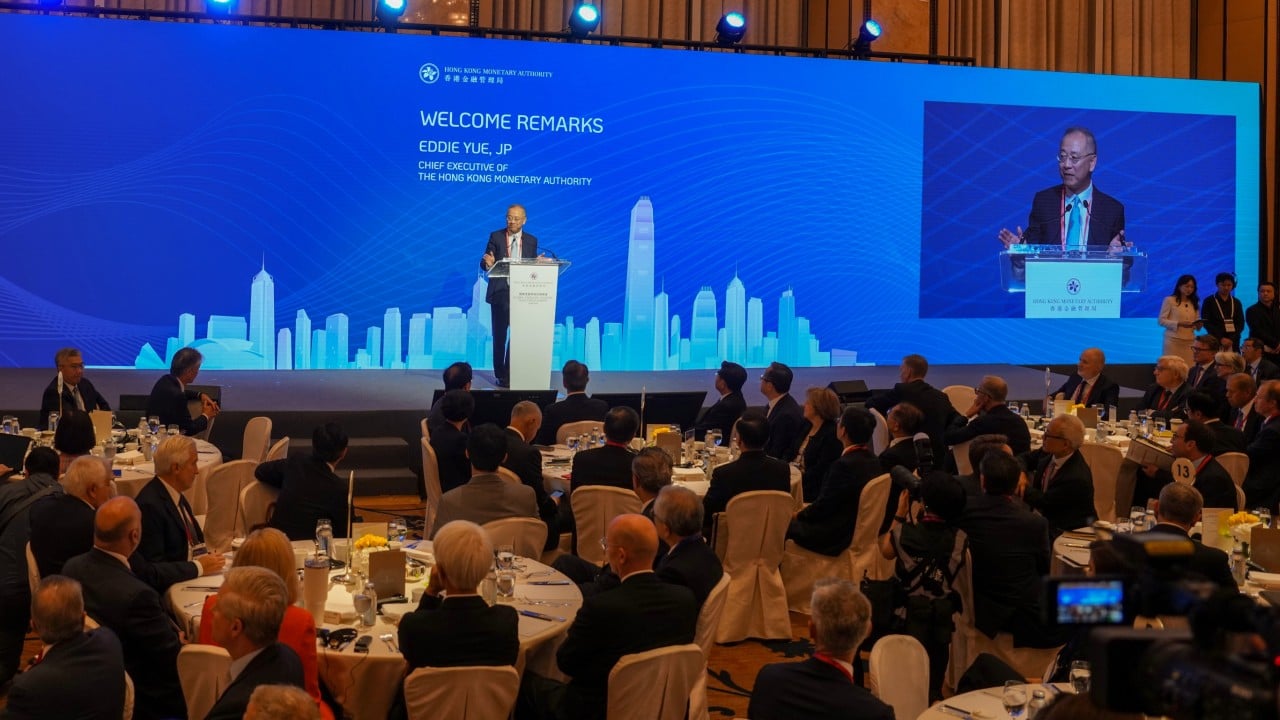
Every November, the global banking elite flies into Hong Kong, drinks vintage Champagne at the Global Financial Leaders’ Investment Summit, and recites the exact same script. They praise the city’s resilience. They applaud its status as Asia’s premier wealth management hub. And they carefully avoid saying the quiet part out loud.
The mainstream financial press eats it up. They frame this annual ritual as a delicate diplomatic dance where Wall Street executives tiptoe around Beijing’s regulatory scrutiny while celebrating a massive influx of private capital. In related updates, we also covered: L’accord automobile franco-allemand cache un plan social silencieux chez les équipementiers.
That narrative is dangerously naive.
The executives standing on those stages in Central are not ignoring Beijing’s asset scrutiny out of polite deference. They are ignoring it because the scrutiny itself is the very engine driving the capital inflows they are celebrating. Hong Kong is not experiencing an organic, free-market wealth boom. It is experiencing a structural containment event. The Economist has analyzed this important topic in great detail.
If you are allocating capital, managing a family office, or advising high-net-worth clients in Asia, mistaking a liquidity trap for a renaissance will cost you everything.
The Illusion of the "Super-Connector"
For decades, Hong Kong’s pitch to global finance was simple. It was the frictionless bridge between Western capital and Chinese growth. Money flowed in from New York and London, converted into mainland factories, tech startups, and real estate, and flowed back out as multiplied returns.
That bridge has been demolished and rebuilt as a one-way turnstile.
When Western financial journalists report on Hong Kong’s rising assets under management (AUM), they treat every dollar parked in the city as proof of renewed international confidence. Look closer at the ledger. The capital flooding into Hong Kong’s private banks and newly minted family offices is overwhelmingly domestic Chinese wealth seeking an exit—or at least a semi-permeable membrane—away from mainland jurisdiction.
Mainland entrepreneurs, terrified by years of regulatory crackdowns, common prosperity rhetoric, and erratic capital controls, have been desperate to move their net worth offshore. Yet Beijing’s strict capital account restrictions make moving billions directly to Zurich, New York, or even Singapore an administrative nightmare fraught with political peril.
Enter Hong Kong.
Through mechanisms like Wealth Management Connect, Stock Connect, and the Capital Investment Entrant Scheme, Beijing has created a controlled pressure valve. Mainland elites can move money into Hong Kong, buy dollar-denominated insurance policies, set up family offices, and feel as though they have diversified their geopolitical risk.
Meanwhile, Beijing keeps the money inside its sovereign orbit.
I have watched dozens of ultra-high-net-worth families fall for this exact trap over the last three years. They liquidated mainland real estate at a discount, jumped through regulatory hoops to establish a Hong Kong family office, and celebrated their newfound "offshore" freedom. Six months later, they realized their custodian bank answers to regulators who answer to the Mainland, and their assets remain entirely legible to the state.
Why Wall Street Plays Along
You might wonder why the CEOs of Goldman Sachs, Morgan Stanley, JPMorgan, and HSBC stand on stage in Hong Kong and applaud this arrangement. Are they blind to the loss of judicial independence? Do they not see the exodus of Western expats and regional headquarters?
They see it clearly. They just do not care, because the fee structure has never been better.
In a traditional open market, global investment banks have to compete fiercely on yield, innovation, and execution to win mandates. In a captive market, you just collect rent.
When billions of dollars in Chinese private wealth are funneled into a single city with limited exit ramps, that capital has to sit somewhere. It sits in private banking deposits. It buys structured notes. It pays management fees to asset managers who have set up local shop specifically to capture trapped liquidity.
Wall Street executives are not tiptoeing around Beijing’s asset scrutiny out of fear of offending their hosts. They are celebrating a regulatory moat that forces the world’s second-largest pool of private wealth to transact through their Hong Kong desks. Calling this a "wealth boom" is public relations spin designed to keep Western shareholders from asking uncomfortable questions about reputational risk and long-term structural decay.
Dismantling the Lazy Consensus on Asian Wealth
To understand how deeply the financial media misunderstands this dynamic, look at the questions investors actually ask when they try to make sense of the region. Every single premise is flawed.
"Is Hong Kong beating Singapore in the race for family offices?"
This is the favorite horse-race narrative of financial editors, and it completely misses the point. Hong Kong and Singapore are no longer competing for the same type of client.
Singapore has become the sanctuary for truly portable, politically unencumbered global and Asian capital. When an Indonesian tech founder, an Indian industrialist, or a Chinese billionaire who has already successfully exited the mainland system wants genuine asset protection, rule of law, and global mobility, they go to Singapore. They accept the Monetary Authority of Singapore’s grueling compliance checks and 18-month bank onboarding delays because the prize at the end is true sovereignty over their money.
Hong Kong has become the destination for capital that cannot leave the Chinese ecosystem. If your wealth is tied to mainland supply chains, state-owned enterprise contracts, or onshore renminbi assets that cannot clear strict foreign exchange quotas, Singapore is not an option for you. You go to Hong Kong because it is the only offshore window Beijing permits you to open.
Comparing their family office headcounts is like comparing a vault in Switzerland to a holding company in a special economic zone. They serve fundamentally different purposes.
"Does rising AUM prove Hong Kong’s financial system is immune to politics?"
The exact opposite is true. Rising AUM in Hong Kong is direct proof of how thoroughly politics now dictates capital flows.
In a healthy financial center, assets grow because of price appreciation, IPO activity, and cross-border dealmaking. Look at the Hong Kong Stock Exchange over the past few years. Primary listings dried up to a trickle compared to their historical peaks, and secondary market liquidity shriveled as international institutional investors systematically underweight Chinese equities.
If public markets are stagnant and foreign direct investment is retreating, where is the "wealth boom" coming from? It is coming from balance-sheet shuffling. Mainland entities are moving cash from onshore banks to Hong Kong subsidiaries, and mainland individuals are buying high-commission wealth products in Central. That is not organic wealth creation. That is capital seeking shelter from domestic deflation and political uncertainty.
"Should Western institutions keep expanding their Hong Kong headcount?"
Only if they are willing to build a completely ring-fenced, localized business that has zero operational overlap with their global franchises.
The days of running an integrated Asia-Pacific business out of Hong Kong are dead. Data localization laws, national security legislation, and cross-border compliance conflicts have made it impossible to seamlessly share research, client data, or risk models between Hong Kong and New York.
Consider a scenario where a global bank’s Hong Kong wealth division onboards a prominent mainland tech executive, and six months later, that executive falls out of favor with Beijing and has their assets frozen. Simultaneously, the bank’s US compliance team flags the same client due to shifting geopolitical sanctions. The bank is instantly caught between two irreconcilable legal regimes, where complying with one violates the laws of the other.
Smart institutions are not expanding blindly. They are quietly bifurcating their operations—turning Hong Kong into a standalone domestic China franchise while moving their actual regional decision-making, risk management, and international talent to Singapore, Tokyo, and Dubai.
The Anatomy of a Gilded Cage
If you want to survive in Asian wealth management right now, you have to stop listening to conference keynotes and start reading balance sheets and regulatory circulars. Here is the reality of how Hong Kong actually functions today, stripped of the marketing gloss.
- Liquidity is asymmetrical. Getting money into Hong Kong from the mainland is actively encouraged through official channels. Getting that same money out of Hong Kong and into Western assets—or bringing it back onshore if political winds shift—is increasingly monitored. Closed-loop systems like Wealth Management Connect strictly mandate that funds stay within approved financial products and return to the original onshore account upon redemption. The money visits Hong Kong; it does not escape.
- Talent has been replaced by distribution. A decade ago, Hong Kong was packed with elite dealmakers, restructuring specialists, and global macro traders. Today, the hiring boom is in relationship managers who speak fluent Mandarin and sell high-margin bancassurance and structured credit products to mainland visitors. The city has pivoted from an investment banking powerhouse to a retail and private wealth distribution hub.
- Due diligence is a one-way mirror. Western banks in Hong Kong love to boast about their strict Know Your Customer (KYC) and Anti-Money Laundering (AML) protocols. Yet when dealing with politically exposed persons from the mainland, Western compliance departments operate in the dark. They rely on sanitized corporate registries and state-approved disclosures. When Beijing decides to scrutinize an asset base, international banks are the last to know and the first to be forced into compliance.
The Contrarian Playbook for Capital Allocators
Acknowledging that Hong Kong is a closed-loop wealth hub does not mean you should abandon the market. Ignoring a pool of trillions of dollars in private wealth is terrible business. It simply means you have to stop treating Hong Kong like a Western financial center and start trading it for what it actually is.
If you run a fund, a family office, or an advisory practice in the region, make these three shifts immediately:
- Separate custody from management. Never confuse where your portfolio manager sits with where your assets are legally domiciled. You can utilize Hong Kong’s deep pool of equity analysts, China specialists, and deal sourcers to generate alpha, while ensuring your actual legal entity, prime brokerage, and asset custody sit in jurisdictions with uncompromised judicial independence.
- Follow the fee pool, not the equity index. Betting on a massive, sustained rebound in Hong Kong’s public equity markets is a value trap that has burned macro tourists repeatedly. Instead, look at the infrastructure capturing the trapped liquidity. Insurance giants, private credit funds structuring cross-border yield products, and corporate service providers setting up compliant mainland-to-Hong-Kong structures are collecting guaranteed tolls on capital that has nowhere else to go.
- Price in the exit tax. Whenever you evaluate an asset or a yield opportunity inside the Hong Kong ecosystem, apply an automatic haircut for liquidity friction. A 7% yield on a Hong Kong-domiciled credit instrument is worth far less than a 5% yield in US Treasuries if regulatory shifts suddenly delay your ability to repatriate the principal.
The Trade-Off Nobody Mentions
There is a massive catch to this contrarian posture, and you need to face it honestly before you restructure your operations.
If you aggressively ring-fence your capital, move your custody to Singapore or Zurich, and treat Hong Kong purely as a satellite office, you will lose access to the most lucrative onshore deals. Beijing rewards loyalty and physical presence. State-backed funds, mainland municipal guides, and the wealthiest onshore families prefer to deal with institutions that are fully committed to the Hong Kong ecosystem—skin in the game, heavy local headcount, and assets parked locally where regulators can see them.
By protecting your downside against geopolitical containment, you willingly cap your upside in China’s domestic wealth transfer. That is the fundamental trade-off of Asian finance in 2026. You can have maximum access, or you can have maximum sovereignty. You cannot have both.
Stop Confusing Applause with Safety
The next time you read a breathless headline about financial titans praising Hong Kong’s resilience, remember who is paying for the conference room.
Wall Street CEOs are paid to maximize quarterly fees within whatever regulatory reality exists today. They are not paid to warn you when the exits are quietly being bricked over. They will happily toast to Hong Kong’s wealth boom right up until the moment the capital controls tighten from a filter into a wall.
Stop reading the press releases. Audit where your assets are actually custodied, verify which courts hold final jurisdiction over your contracts, and move your core liquidity before you need permission to leave.



