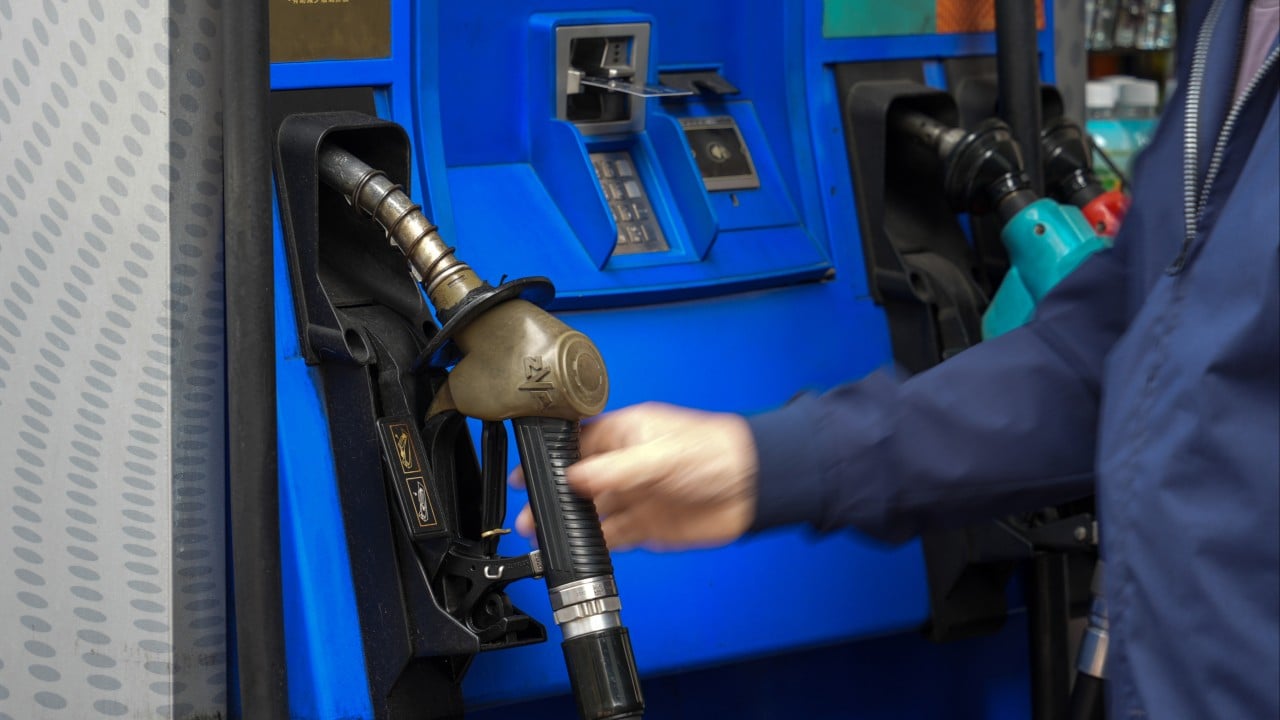
Every time global crude prices twitch upward, the local press dust off the exact same sob story. They send a reporter to a forecourt in Kowloon Tong, find a delivery van driver staring sadly at a digital meter ticking past a thousand Hong Kong dollars, and publish a piece about how high fuel costs are suffocating the city’s motorists.
It is lazy journalism. Worse, it is economically illiterate. You might also find this related coverage useful: Why the High Yield Credit Bloodbath Was Bound to Happen.
Hong Kong has the most expensive retail petrol on Earth. That is an undisputed mathematical fact. Yet the standard narrative—that oil companies and government taxmen are unfairly squeezing helpless commuters—completely misses the reality of how urban transport actually functions in one of the densest cities on the planet.
If you own a private car in Hong Kong and you are complaining about the price at the pump, you are asking the wrong question entirely. Fuel is not your financial problem. Your financial problem is that you bought a depreciating, heavily taxed luxury asset in a city built specifically to make driving redundant. As highlighted in latest coverage by The Economist, the results are widespread.
The Myth of the Captive Commuter
To understand why the "victimized motorist" trope falls apart, look at the actual numbers of how people move. According to the Hong Kong Transport Department, roughly 90 percent of all daily passenger journeys happen on public transit. The MTR, franchised buses, minibuses, ferries, and trams carry the overwhelming majority of the workforce every single morning.
When journalists frame rising fuel prices as a city-wide cost-of-living crisis for drivers, they are pretending that Hong Kong is Los Angeles or Houston. In North America, where suburban sprawl and gutted transit networks force working-class families to drive forty miles just to buy groceries, a spike in petrol prices is a genuine regressive tax on survival.
In Hong Kong, private car ownership is not a necessity. It is a status symbol.
With just over 600,000 licensed private cars serving a population of 7.5 million, fewer than one in ten residents owns a vehicle. To even put a car on the road, a buyer has to swallow the First Registration Tax—a progressive levy that starts at 46 percent on the first HK$150,000 of a vehicle's taxable value and rockets up to 132 percent on anything above HK$500,000. Add to that monthly residential parking spaces that routinely rent for HK$4,000 to HK$7,000, mandatory third-party insurance, annual license fees, and tunnel tolls.
Anyone clearing those financial hurdles is not "running on fumes" because petrol jumped two dollars a liter. Treating affluent weekend drivers as a vulnerable demographic is an insult to the people actually struggling with rent and food inflation.
Where the Pump Price Actually Goes
The standard media hit piece always targets the oil majors—Shell, Esso, Caltex, Sinopec, and PetroChina—accusing them of "rocket and feather" pricing. That is the industry term for when pump prices shoot up like a rocket the moment crude oil rises, then drift down like a feather when crude drops.
Does asymmetric pricing happen in Hong Kong? Yes. The Consumer Council has published multiple exhaustive reports documenting how local pump prices adjust faster to upward cost shocks than downward ones. I have sat across from downstream retail executives in Asia for fifteen years, and I know how they pad their margins during volatile quarters. They hide behind "inventory lag" when crude falls and cite "replacement cost" the second Brent crude ticks up by fifty cents.
However, blaming the oil companies for the headline price per liter ignores the elephant standing right next to the dispenser: the Hong Kong government.
Roughly a quarter to a third of the retail price of unleaded petrol in Hong Kong is pure, fixed government duty—currently sitting at HK$6.06 per liter. Unlike an ad valorem tax that scales with the price of oil, this is a flat volumetric excise. Even if global crude dropped to zero tomorrow, you would still pay over six dollars a liter just in duty, before the oil company pays a single cent for refining, shipping, storage, or the astronomical commercial land leases required to operate a gas station in urban Hong Kong.
Land costs in this city are brutal. Operating a forecourt in Wan Chai or Tsim Sha Tsui means paying prime real estate premiums for a business with thin underlying commodity margins. When you combine fixed fuel duty with the highest commercial real estate costs in Asia, high pump prices are baked into the structural cake.
Why Commercial Drivers Have a Completely Different Problem
There is one group that genuinely feels the squeeze when fuel spikes: commercial operators. Taxi drivers, red minibus operators, and logistics fleets do not have the luxury of taking the MTR to work.
Yet even here, the mainstream coverage gets the diagnosis backward.
Look at the fuel mix of Hong Kong's commercial fleet. Taxis and public light buses do not run on unleaded petrol. Almost the entire taxi fleet and a massive chunk of the minibus sector run on Liquefied Petroleum Gas (LPG). Meanwhile, heavy goods vehicles, delivery vans, and franchised buses run on ultra-low-sulfur diesel.
Comparing the headline price of 98-octane petrol to the plight of a working-class driver is comparing apples to jet fuel.
LPG prices are regulated by a dedicated government formula tied directly to international LPG contract prices, reviewed on a monthly or semi-annual basis depending on the station type. Dedicated LPG filling stations operate under strict price ceilings set by the Electrical and Mechanical Services Department (EMSD). Furthermore, commercial diesel carries zero fuel duty—the Hong Kong government reduced the duty rate on ultra-low-sulfur diesel to HK$0 per liter years ago specifically to protect the logistics and transport sectors from inflation.
When a taxi driver complains about margins, fuel is rarely the primary culprit. The real bloodletting happens in the taxi license market and daily vehicle rental rates. A taxi owner rents a cab to a shift driver for a fixed fee. When fuel spikes or passenger demand dips, the shift driver absorbs the volatility while the license holder collects guaranteed rent. Focusing exclusively on the pump price lets an archaic, monopolistic medallion system off the hook.
The Electric Vehicle Distortion Nobody Talks About
If you want to understand the real crisis brewing at Hong Kong’s petrol stations, stop looking at crude oil futures and start looking at Tesla and BYD showrooms.
Hong Kong has one of the fastest electric vehicle adoption rates in the world, driven by the government's "One-for-One Replacement" scheme that waived massive amounts of First Registration Tax for buyers scrapping an old internal combustion engine car for an EV. Today, more than six out of every ten newly registered private cars in Hong Kong are electric.
Here is the counter-intuitive consequence that media commentators completely miss: rapid EV adoption actually makes petrol more expensive for everyone left behind.
Think about the economics of running a retail fuel network. Building and maintaining underground storage tanks, vapor recovery systems, fire suppression infrastructure, and 24-hour staffing requires massive fixed capital expenditure. Those fixed costs have to be amortized across every liter of fuel sold.
As thousands of high-mileage private motorists ditch internal combustion engines for EVs, total retail petrol volume in Hong Kong is entering structural decline. Fewer liters sold through the same expensive real estate footprint means the fixed overhead cost per liter goes up. Oil companies are not charities. To maintain return on capital across a shrinking customer base, they have to widen their retail margin on every remaining liter of petrol pumped.
The drivers still clinging to petrol engines are effectively paying a stranded-asset surcharge.
Answering the Questions Drivers Actually Ask
When fuel prices dominate the headlines, motorists inevitably start searching for hacks to beat the system. Most of the advice floating around local forums is useless. Here is the unvarnished truth about the common fixes people try.
Do fuel discount cards actually save money?
No. They are a psychological shell game. Every major oil company in Hong Kong offers walk-in discounts of HK$4 to HK$7 per liter off the "pump price" through loyalty apps, credit card tie-ups, or fleet cards. Oil companies deliberately inflate the baseline board price so they can offer aggressive discounts that make drivers feel like savvy negotiators. You are not beating the market; you are just paying the real retail price after jumping through an administrative hoop. If you are paying the full board price without a card, you are simply paying an ignorance tax.
Does driving to Shenzhen to fill up make sense?
With the Northbound Travel for Hong Kong Vehicles scheme allowing single-plate Hong Kong cars into Guangdong via the Hong Kong-Zhuhai-Macau Bridge, filling up across the border has become a popular weekend talking point. Mainland petrol is roughly a third of the Hong Kong price.
On paper, saving HK$1,000 on a full tank sounds brilliant. In practice, the math barely works unless you were going to Zhuhai anyway. Factor in the bridge toll, mainland insurance, wear and tear, and three hours of your weekend burned sitting in border traffic, and your net hourly savings drop below minimum wage. Worse, fuel quality standards and octane ratings across different regional suppliers do not always match the strict Euro VI specifications calibrated for Hong Kong-market luxury engines. Saving five hundred dollars on petrol means nothing if you foul a high-pressure fuel injector on a German twin-turbo engine.
Can hypermiling or fuel additives cut consumption by 20 percent?
Forget fuel additives. Anything poured into your tank promising dramatic mileage gains is chemical snake oil. Modern direct-injection engines are precision-calibrated by teams of engineers; dumping aftermarket detergents into the tank does nothing to alter the laws of thermodynamics.
Driving behavior, however, moves the needle immediately. Stop-and-go congestion in Central or Causeway Bay destroys fuel economy because accelerating two tons of steel from a dead stop requires peak torque. Smoothing out throttle inputs, coasting early toward red lights, and keeping tire pressures strictly at the manufacturer's cold specification will realistically trim fuel consumption by 10 to 15 percent. Anything beyond that requires changing when and where you drive, not what you put in the tank.
The Contrarian Playbook for Hong Kong Motorists
I will be completely transparent about the flaw in my own argument: if you have a genuine mobility need—say, caring for elderly parents in a remote New Territories village with infrequent feeder buses, or hauling heavy equipment across construction sites at 4:00 AM—public transit will not save you. In those specific scenarios, a vehicle is a functional tool, and fuel costs directly hit your bottom line.
For everyone else, complaining about fuel prices while maintaining an internal combustion car in Hong Kong is a self-inflicted wound. If you want to stop bleeding cash to the energy sector, stop looking for cheaper petrol and change the asset class you are driving.
- Calculate your true cost per kilometer. Take your annual depreciation, insurance, licensing, parking, maintenance, and fuel, and divide by your annual mileage. Most Hong Kong private drivers put fewer than 10,000 kilometers a year on the odometer. When you run the numbers, you will realize that petrol accounts for less than 15 percent of your total cost of ownership. Obsessing over a two-dollar fluctuation at the pump while paying six grand a month for a concrete box to park in is financial theater.
- Exit internal combustion before residual values collapse. The used market for petrol cars in Hong Kong is already softening as charging infrastructure expands and government policy aggressively favors zero-emission vehicles. Holding onto a mid-tier petrol sedan hoping fuel prices will normalize is a losing trade. Trade out while the vehicle still commands viable resale value, or transition to a hybrid where regenerative braking neutralizes urban traffic inefficiencies.
- Treat ride-hailing as an on-demand fleet. If you drive fewer than three days a week, sell the car entirely. Put the capital into an index fund, cancel the parking lease, and take taxis or Uber Black everywhere you go. You could take two taxi rides every single day of the week and still spend less per month than the fixed overhead of owning a mid-range Japanese sedan in Hong Kong.
Stop Blaming the Pump
High petrol prices in Hong Kong are not a market failure. They are a deliberate policy outcome combined with brutal urban geography. A city of seven and a half million people squeezed onto steep mountainous terrain simply cannot function if everyone drives a private car. High fuel taxes and steep ownership costs are the congestion pricing mechanism that keeps the roads from locking into permanent gridlock.
The next time you see a headline whining about pump pressure in Hong Kong, ignore it. The market is working exactly as designed. Either switch to electric, take the train, or pay the luxury tax without pretending you are a victim.