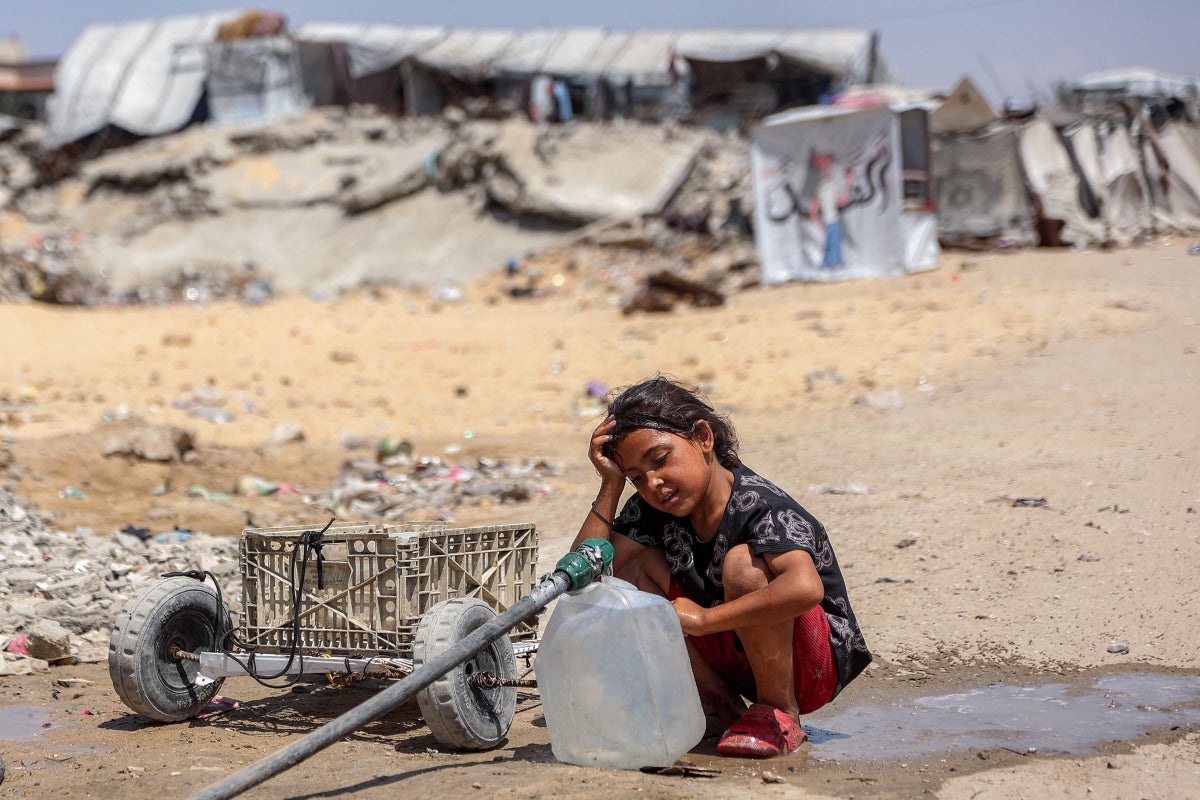
The weight of a concrete block is predictable. A ten-year-old boy knows this weight not by physics, but by the precise ache it leaves in the small of his lower back.
In the sun-baked expanse of Beit Hanoun, a child named Tariq—a name used here to represent thousands of real children living through this reality—bends down. He is looking for intact cement bricks or stones clean enough to sell to the men trying to rebuild shattered walls. For every fifty kilograms of rubble Tariq and his younger brother scrape from the dirt, they earn five shekels. That is just over one dollar.
A dollar does not buy much anymore. Food prices in Gaza have risen roughly 700 percent. A plate of pasta in a surviving downtown restaurant costs more than Tariq can earn in a week of breaking his hands over masonry.
This is the economy of survival. It has rewritten the rules of childhood.
The Arithmetic of an Empty Stomach
When we read data about conflict, the numbers feel abstract. Reports note that up to 40 percent of casualties are children, or that a staggering majority of households are severely food insecure. But the data looks much different on the ground. It looks like a mother wrapping crushed dates in gauze because her own malnourished body can no longer produce breast milk. It looks like a family deciding which child gets to eat a full meal today, and which one will wait until tomorrow.
The math is brutal and simple. When parents are injured, killed, or unable to find work in a decimated economy, the financial burden falls onto the smallest shoulders.
Consider what happens next: a child drops out of school. Formal education for hundreds of thousands of children has already vanished because schools are either rubble or overcrowded shelters. Without classrooms, the streets become the workplace. Children sell balloons outside hospitals, hawk single cigarettes on corners, or sift through contaminated debris for scrap metal.
They are not working for pocket money. They are working so their siblings do not starve.
The Permanent Scars of Scarcity
The human body is resilient, but it has strict limits. Pediatricians on the ground are witnessing an unprecedented influx of severe acute malnutrition. When a child under five goes months without adequate protein, vitamins, or clean water, the damage isn't just a temporary loss of weight.
The body begins to consume itself.
Muscles waste away. Immune systems collapse to the point where a common cold becomes a fatal diagnosis. Severe nutritional edema causes fluid to pool under the skin, making faces swell while the rest of the frame withers. Doctors tell stories of young girls losing their hair entirely to this condition, asking if they will ever look normal again.
But the real problem lies elsewhere. It is invisible.
The neurocognitive impact of prolonged starvation during formative years is largely irreversible. Brains require immense energy to develop logic, memory, and emotional regulation. When that energy is diverted just to keep the heart beating, cognitive growth stalls. Stunted physical growth leads to social isolation and profound shame. The biological trauma etches itself so deeply into the child's physiology that researchers warn of intergenerational harm—epigenetic scars that could affect children who haven't even been born yet.
The Weight of Grown-Up Thoughts
It is easy to look at child labor as a purely physical crisis. The blisters, the heavy lifting, the chronic exhaustion. Yet the mental transformation is far more devastating.
When a ten-year-old spends his days calculatedly hunting for pennies to buy bread, the concept of play dies. The capacity for wonder is replaced by hyper-vigilance. These children wake up screaming from nightmares, not just from the memory of explosions, but from the terrifying responsibility of keeping their families alive.
They speak with the cadences of tired, middle-aged adults. They know the price of flour by heart. They know which aid distribution points are too dangerous to approach. They have been stripped of the right to be vulnerable.
We often talk about a "lost generation" in terms of missing school years or future economic productivity. But the loss is more immediate than that. It is the disappearance of childhood itself.
Tariq does not look at a bicycle and think of racing down a street. He looks at a bicycle and calculates how much scrap metal he could haul on the frame if he managed to find one. That shift in perspective is a quiet, permanent tragedy.
The evening sun goes down over the gray landscape of broken stone, and the market stalls pack away what little they have left. Tariq counts his five shekels, wiping gray dust from his forehead with a torn sleeve. He walks home to a tent or a crowded room where people are waiting to see what his hands managed to salvage from the ruins. He will wake up tomorrow morning and do the exact same thing.