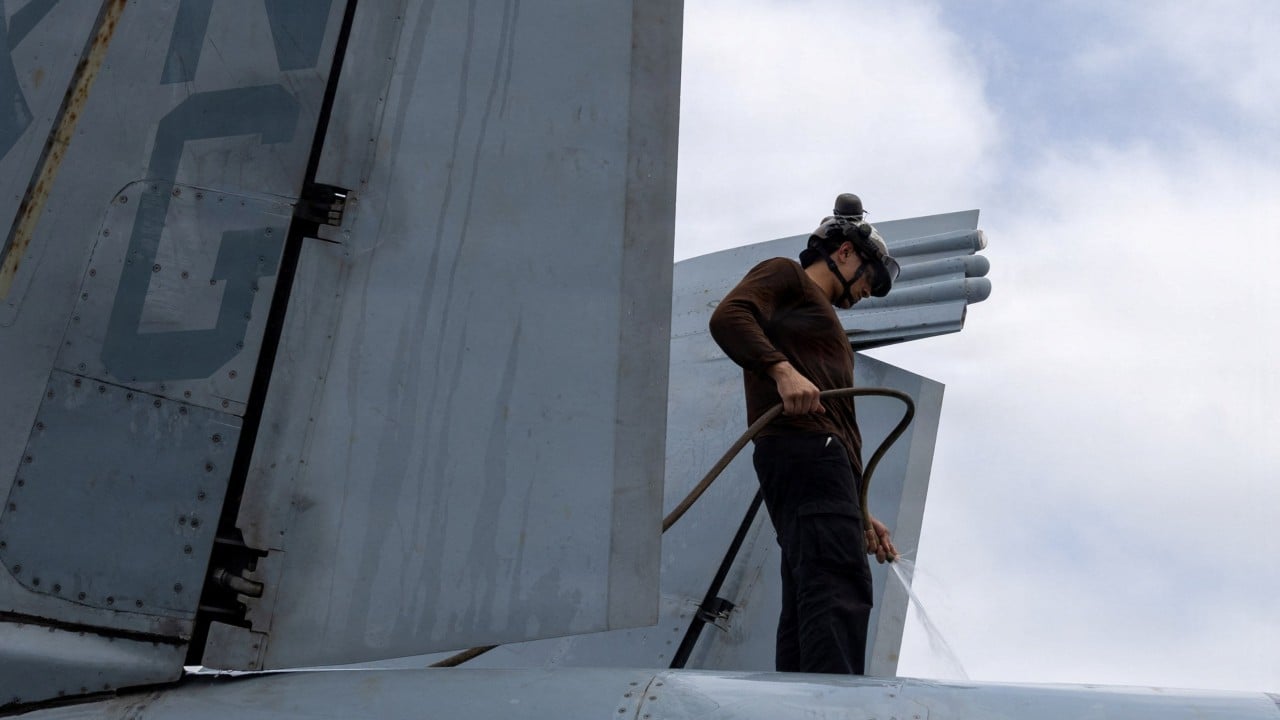
When the USS Abraham Lincoln recently signaled its return home, the official narrative focused on the successful completion of a mission and the awe-inspiring resilience of its crew. Admiral Brad Cooper, commander of U.S. Central Command, publicly praised the sailors, noting that the ship maintained one of the lowest rates of mental health incidents in the fleet. This sounds reassuring. It misses the reality of life aboard a vessel that has spent over 260 consecutive days at sea without a port call.
The true crisis is not found in a spreadsheet of reported cases but in the structural impossibility of sustaining a 5,000-person community in a high-intensity combat zone for nine months without reprieve. When service members report incidents of crew attempting to jump overboard, the disconnect between military leadership and the human experience becomes undeniable.
Operating a carrier strike group in the Middle East during an active conflict is a grueling endeavor. It demands round-the-clock vigilance, where sleep is fragmented, noise is constant, and privacy is non-existent. For junior enlisted sailors, this environment is often compounded by substandard living conditions. Reports from families of crew members paint a picture of moldy showers, broken plumbing, and erratic supply chains. When the basic requirements of hygiene and nutrition become a daily struggle, the psychological toll shifts from manageable stress to institutional failure.
Leadership often conflates resilience with the ability to endure suffering. In military culture, grit is a badge of honor. However, there is a distinct difference between resilience and the mere capacity to remain at one's post while internal distress mounts. Relying on chaplains and onboard counselors is a standard protocol, but these measures function as reactive band-aids for a systemic injury. When the ship itself—the living space, the workspace, and the social sphere—is under constant, long-term strain, the standard support infrastructure is overwhelmed.
The danger of extended deployments is the erosion of certainty. In a typical deployment cycle, sailors count down the days to a port visit or an anticipated return date. When those timelines shift, the psychological anchor slips. Uncertainty breeds despair. A sailor who expects to be home in seven months but finds their tenure stretched to nine experiences a specific form of trauma that affects morale more than any single combat incident.
This isn't merely about plumbing or hot meals. It is about the fundamental management of human capital. The military relies on the assumption that personnel will adapt to any circumstance. Yet, the current operational tempo against Iran highlights a limitation in that doctrine. When a vessel remains at sea for more than 200 days, the physical and mental degradation of the crew impacts readiness. Fatigue-induced errors on a flight deck or in an engine room are not just personal tragedies; they are operational risks.
The dismissive rhetoric from some high-level officials, who categorize reports of distress as misrepresentations, suggests a dangerous detachment from the deck plates. A commander may see a successful mission, but that success is built on the exhaustion of the human element. If the metrics being cited are "low case numbers," the military must ask if these numbers reflect reality or a culture where sailors fear that seeking help could jeopardize their careers. Many sailors report that they hide their struggle, terrified that a mental health intervention will lead to a discharge, ruining years of service.
The solution requires more than a visit from a commander or a press release regarding mental health as a priority. It necessitates a hard look at the cadence of the Navy’s deployment schedule. If the goal is to maintain a presence in the Middle East, the cost should not be the internal disintegration of the crews tasked with that mission. Shorter deployments, more frequent rotations, and a significant improvement in the quality of life on aging vessels are not just requests from concerned families; they are requirements for an effective force.
Every military institution eventually faces a moment where the reliance on the extraordinary endurance of its personnel hits a wall. The current state of the USS Abraham Lincoln crew serves as a warning. The capacity for a soldier or sailor to sacrifice is not infinite. When the system ignores the basic human needs of its workforce, it risks more than just morale. It risks the integrity of the mission itself. The reliance on willpower as a strategic resource is an expensive gamble that the Navy can no longer afford to take.