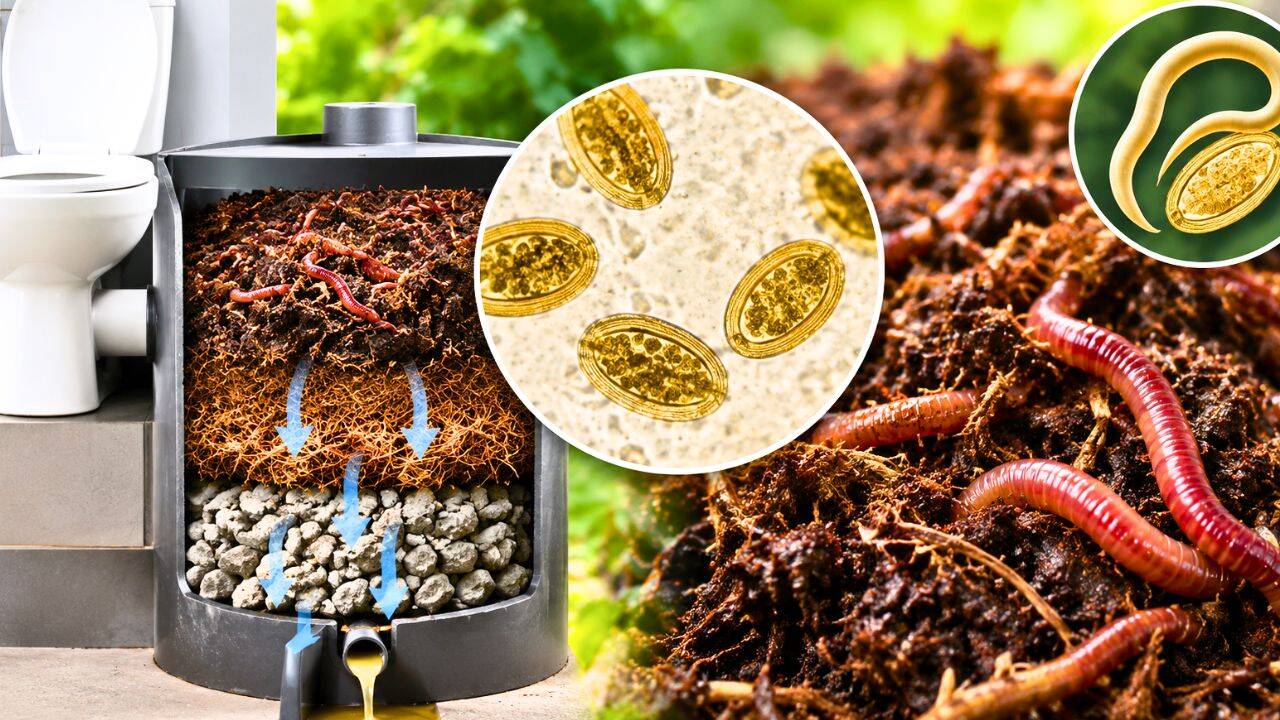
Human waste composting promises an ecological revolution. But a microscopic passenger threatens to turn well-intentioned sustainability into a public health liability.
For decades, eco-conscious municipalities and off-grid homesteaders have championed ecological sanitation. The pitch is simple. Divert human excreta, feed it to earthworms or process it through thermal composting, and transform a biological liability into rich, nutrient-dense fertilizer. Vermicomposting relies on Eisenia fetida, commonly known as red wigglers, to break down organic matter into high-grade soil amendments. Yet, beneath the rich, earthy scent of finished humus lies an uncomfortable biological reality. Pathogens, particularly parasitic worm eggs, survive standard breakdown procedures with alarming resilience.
When dealing with human excrement, known in technical circles as nightsoil or humanure, the margin for error narrows to zero. Ascaris lumbricoides, the large roundworm, produces eggs encased in a multi-layered shell of chitin and protein. This armor protects the embryo from extreme temperatures, chemical disinfectants, and the digestive tracts of composting earthworms. Worms do not neutralize these hazards. They merely process the organic bulk while the resilient ova pass through their systems untouched or remain viable scattered throughout the worm castings.
Understanding the biology of these parasites requires looking past standard environmental enthusiasm. Ascaris infection affects over a billion people globally, primarily in regions with poor sanitation, but low-level transmission persists in localized agricultural settings. The eggs can survive in soil for years, waiting for a host. When home gardeners harvest their vermicompost to fertilize root vegetables or leafy greens, microscopic parasite ova cling to the produce surfaces. A single unwashed radish harvested from a poorly managed humanure pile can introduce thousands of infectious eggs into a domestic kitchen.
The mechanics of vermicomposting create a false sense of security. Red wigglers thrive in temperatures between 15 and 25 degrees Celsius. These moderate conditions, ideal for earthworm metabolism, are precisely the temperatures at which parasitic ova enter a state of suspended animation rather than decay. Mesophilic composting processes, which happen at ambient outdoor temperatures, completely fail to provide the thermal lethality required to rupture the lipid layer of nematode eggs.
The Thermal Illusion
Proponents often point to the heat generated by microbial activity as a natural sanitizer. This argument collapses under scrutiny.
Standard backyard compost bins rarely maintain the uniform core temperature of 55 to 60 degrees Celsius required for pathogen destruction over a sustained three-day window. Thermal pockets form irregularly. Material on the outer edges of a bin stays cool, functioning as a survival sanctuary for hardy cysts and helminth eggs. Worms actively avoid the center of active, high-heat thermophilic compost piles because the temperatures will kill them. They retreat to the cooler perimeter, carrying or leaving untreated pathogens in zones that eventually yield finished compost.
Municipal sludge management systems use alkaline stabilization, high-pressure thermal hydrolysis, or prolonged anaerobic digestion to mitigate these risks. Even then, mechanical failures happen. In decentralized backyard systems, oversight is nonexistent. The operator relies on smell and texture to determine safety. Pathogens do not smell foul, and parasite eggs are invisible to the naked eye.
Consider a hypothetical suburban household utilizing a multi-chamber vermicomposting system for household waste. The family introduces processed humanure alongside kitchen scraps to accelerate breakdown. The red wigglers churn through the mixture efficiently. Within months, the bin yields dark, crumbly castings that smell like a forest floor. The visual and olfactory indicators are pristine. Laboratory analysis of that exact batch, however, reveals viable hookworm and Ascaris ova. The sensory feedback loop of organic gardening completely fails to register microbiological threats.
Regulatory Blind Spots and DIY Dangers
Public health agencies view home humanure systems with cautious skepticism, while municipal regulators often enforce outright bans due to vector control concerns.
The legal frameworks governing waste reuse were written for livestock manure, which carries different epidemiological risks than human waste. Human pathogens are adapted specifically to exploit human physiology. When a backyard practitioner applies untreated or semi-processed human waste to food crops, they bridge a sanitary gap that public health infrastructure spent the last two centuries closing.
The push for localized circular economies often glosses over these vectors in favor of optimistic narratives. Permaculture literature frequently downplays pathogen survival rates, suggesting that time alone heals all biological hazards. Time does reduce risk, but for Ascaris eggs, that timeline spans up to a decade in optimal soil conditions. A standard six-month compost cycle is a blip in the lifecycle of a resilient parasite.
Agricultural extension offices receive frequent inquiries from homesteaders wanting to close the loop on personal nutrient cycles. The standard institutional response is defensive rather than educational. Agencies issue blanket warnings against using human waste on food gardens without providing the rigorous protocols required to make it safe. This vacuum leaves DIY practitioners to rely on internet forums where anecdotal success stories override epidemiological science.
Engineering Real Biological Safety
Mitigating these risks demands a shift from passive composting to active, verifiable pathogen destruction.
If human waste must be recycled on a localized scale, the process cannot rely on earthworms alone. Vermicomposting must serve as a secondary stage, following a rigorous primary thermal phase. Achieving true pathogen reduction requires a dedicated pasteurization step where the entire mass reaches sustained high heat before any worm is introduced to the medium.
Advanced solar thermal sanitizers use concentrated panels to bake waste material in sealed steel containers, driving internal temperatures past the threshold where protein denaturation occurs. This destroys worm eggs, bacterial spores, and viral particles. Only after this thermal shock does the material cool down enough for vermin processing and nutrient conditioning.
We must also confront the reality of heavy metals and pharmaceutical residues. Human waste is not just organic matter; it is a repository for everything modern society ingests. Hormones, synthetic drugs, and microplastics pass through the human body and concentrate in the resulting sludge. Earthworms do not break down synthetic compounds. They bioaccumulate heavy metals in their tissue, passing toxins up the food chain to birds, small mammals, and garden soil ecosystems.
Ignoring these biochemical realities in pursuit of ecological purity creates a new class of environmental hazards. Sustainable practices must be anchored in rigorous microbiology rather than romantic ideals. Closing the sanitation loop safely requires acknowledging that human waste demands industrial-grade respect, strict temperature monitoring, and a healthy distrust of simple backyard fixes.