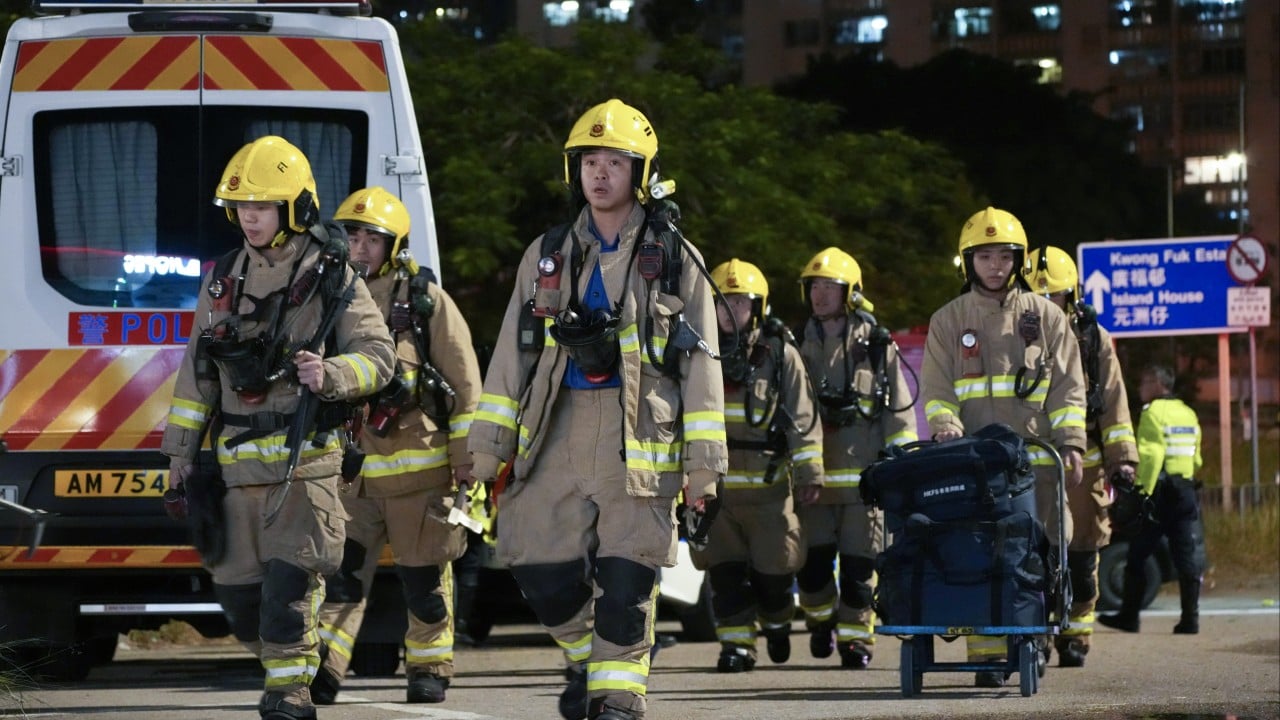
Smoke does not leave when the hoses are rolled up. It settles into the wool of a turnout coat, clings to the skin beneath the fingernails, and lingers in the quiet spaces of a firehouse long after the television cameras have packed their tripods and gone home.
In Hong Kong, the men and women of the Fire Services Department know this intimately. For decades, they have occupied a rare, almost sacred space in the city’s public consciousness. When typhoons tear scaffolding from skyscrapers or hillside brush ignites in the dry autumn winds, they are the ones running toward the heat while everyone else runs away. They are praised as heroes. Their discipline is legendary. Their sacrifice is rarely questioned.
Until a report lands on a desk, and the ink feels heavier than water.
Consider what happens in the aftermath of a major blaze in a dense district like Tai Po. The flames are extinguished. Lives are pulled from the dark. The headlines the next morning celebrate courage under impossible conditions. Then, weeks or months later, the official post-incident review arrives. Measured in calm, fluorescent-lit boardrooms by people who were not breathing superheated air, the document dissects every radio transmission, every water pressure drop, every split-second decision made at three in the morning. Praise sits on page one. Criticism waits quietly on page fourteen.
And suddenly, the people who risked everything find themselves caught in a strange, bruising contradiction. How do you hold a medal in one hand and a reprimand in the other?
The Anatomy of a Split Second
To understand why an internal or public fire report cuts so deeply, you have to understand what happens inside a burning building in the New Territories.
Imagine—as a hypothetical illustration of a very real operational reality—a senior station officer we will call Chan. It is past midnight in Tai Po. The call comes in for a fire in an older residential block or a subdivided industrial unit, the kind of labyrinthine structure common across Hong Kong’s older districts where narrow stairwells, locked security gates, and unauthorized alterations turn a standard floor plan into a trap.
Chan arrives within minutes. Visibility is zero. Not dim—zero. Like opening your eyes inside a bucket of black paint. The heat radiates through layers of protective gear, pressing against his mask like a physical weight. Somewhere behind a steel door, people are coughing. Somewhere above him, timber and wiring are groaning under thermal stress.
He has four seconds to make a choice.
Does he order his breathing-apparatus team to force entry immediately, risking a backdraft that could incinerate them in the corridor, or does he wait ninety seconds for the second pump crew to establish a charged backup line? If he waits and someone inside dies of smoke inhalation, he is hesitant. If he pushes forward and a ceiling collapses, he is reckless.
In that hallway, there is no pause button. There is no aerial diagram hovering in the air. There is only the roar of fire, the hiss of compressed air, and the terrifying math of human survival.
Yet when a review board reconstructs that night, time slows down. Ninety seconds becomes an eternity on a printed timeline. A radio call that got garbled by concrete walls looks like a communication breakdown. A delay caused by an illegally parked van blocking a hydrant becomes a logistical footnote that somehow stains the response time of the entire brigade.
Where Heroism Meets Bureaucracy
This is the quiet fault line running through modern emergency services, and it is nowhere more visible than in the reaction to the Tai Po fire report.
Firefighters do not expect immunity from scrutiny. Every seasoned officer will tell you that after-action reviews save lives. You study what went wrong so the next crew comes home intact. In the history of firefighting—from the devastating tenement fires of the twentieth century to high-rise infernos in London and Hong Kong—hard lessons written in ink have prevented tragedies written in blood.
The friction does not come from accountability itself. It comes from the tone, the framing, and the invisible gap between those who fight fires and those who audit them.
When a report simultaneously applauds frontline bravery while faulting tactical coordination, equipment deployment, or command structure, it creates a psychological whiplash inside the ranks. Rank-and-file firefighters hear one message: You did everything right, except when you didn’t.
To a junior firefighter who carried an unconscious neighbor down eight flights of pitch-black stairs, bureaucratic critique can feel like a betrayal. They remember the blistered ears, the failing flashlight beams, the sheer terror of losing contact with their partner in thick smoke. Reading that response protocols "exhibited room for improvement" sounds less like constructive engineering and more like Monday-morning quarterbacking from people who have never felt their helmet visor begin to warp from heat.
At the same time, senior commanders face a different kind of pressure. They are caught between the fierce loyalty they owe their crews and the institutional demand to show transparency to the public, lawmakers, and grieving families. If they defend every single action on the ground, they appear defensive and resistant to reform. If they accept the report’s criticisms too readily, their own troops feel thrown under the bus.
Silence fills the canteen. Conversations stop when a senior officer walks past. The camaraderie that keeps a watch together during a twenty-four-hour shift begins to fray at the edges.
The Invisible Hazards Nobody Audits
There is another layer to this tension that rarely makes the front page, though every firefighter in Tai Po knows it by heart.
Firefighters do not design the buildings they enter. They do not issue the permits for subdivided flats, nor do they enforce the rules against blocked fire exits, padlocked rooftop doors, or illegally stored hazardous materials in industrial estates. They do not widen narrow rural roads in Tai Po where village houses sit inches apart and water mains struggle to deliver adequate pressure during peak demand.
Think of firefighting like emergency surgery performed in the middle of a moving train. The surgeon is judged on the stitches, yet nobody asks why the tracks were broken, why the lights went out, or why the patient was locked inside a compartment with no doors.
In Hong Kong, urban density and aging infrastructure create structural risks long before a single spark is struck. Many older buildings in Tai Po and across the New Territories predate modern sprinkler mandates. Alleyways are choked with delivery trucks and market stalls. Village clusters near the hills sit beside dense vegetation that turns into tinder during dry winter monsoons.
When a fire breaks out under those conditions, firefighters are asked to perform miracles to compensate for decades of systemic vulnerabilities. And when the report focuses heavily on tactical execution during the blaze while treating chronic enforcement failures as background scenery, the people holding the hoses understandably feel they are being made to carry someone else’s burden.
Why Public Praise Can Feel Hollow
We love simple stories. The public wants villains or heroes, tragedy or triumph. When a major blaze hits the news cycle, the narrative is comforting in its clarity: ordinary citizens were in danger, brave firefighters stepped into the breach, order was restored.
That public admiration is genuine. People bring fruit baskets to local fire stations. Children wave at the red engines passing through Tai Po Market. Online forums overflow with gratitude.
Yet for the firefighters reading the fine print of an official investigation, public praise can feel strangely disconnected from their actual daily reality. Compliments do not fix aging radio repeaters that drop signals inside reinforced concrete basements. Applause does not add extra breathing apparatus sets to an understaffed appliance, nor does it clear a blocked access lane at two in the morning.
Worse, when praise is paired with quiet disciplinary pressure or defensive policy memos, it breeds cynicism. Firefighters begin to wonder whether the word "hero" is simply a polite currency used to pay them off while systemic problems remain untouched.
Consider what happens when morale erodes in a profession built entirely on trust. Firefighting is not an individual sport. When you crawl into a burning room, your life is tethered to the person holding your shoulder and the pump operator watching the pressure gauge outside. You do not hesitate because you trust that the system—and the leadership above you—has your back.
If that trust cracks, hesitation creeps in. Not cowardice, never cowardice, but a subtle, corrosive second-guessing. If I make the aggressive call to save this room, and something goes wrong, will my commander stand behind me? Or will I become a bullet point in the next review?
That question is far more dangerous than smoke.
Rebuilding Trust Without Losing the Truth
So how does an institution honor its people while still telling the unvarnished truth about what needs to improve?
The answer lies in distinguishing between human error under extreme duress and systemic failure by design.
In aviation—another high-stakes field where split-second decisions carry life-or-death weight—investigators learned decades ago that blaming pilots for reacting poorly to confusing cockpit alerts or flawed procedures solves nothing. Instead, modern safety culture asks a different question: Why did that decision make sense to a trained professional in that exact moment?
If a crew in Tai Po struggled with water supply, the question is not why they didn't lay hose faster; it is why the municipal hydrant network or building riser failed to deliver under load. If command communication frayed during a multi-alarm escalation, the issue is rarely a lack of effort by officers on the ground; it is whether the command post had adequate digital tracking tools and dedicated signal channels to handle twenty converging units at once.
When investigations frame findings around fixing the environment rather than faulting the operator, something remarkable happens. Frontline crews stop feeling attacked. Instead of closing ranks in defensive silence, they step forward with the exact, gritty operational insights that no outside consultant could ever discover. They tell you which stairwell doors jam under heat expansion. They tell you which radio dead zones exist behind the housing estates. They become the architects of their own safety.
The Gear Still Hanging by the Door
Walk into any fire station in Tai Po tonight, and you will not see people brooding over headlines. You will see hoses hanging in the drying tower, gleaming brass couplings lined up with military precision, and boots tucked neatly inside rolled-down bunker pants, ready to be stepped into in under forty seconds.
The bell does not care about committee reports. It does not wait for union statements or press briefings to be resolved. When the alarm sounds across the district, the doors roll up, the sirens wail into the humid night air, and the exact same men and women climb into the cab.
They will go back into the dark because that is who they are. Whether the system protects them as fiercely as they protect the city remains an open question—one written not in commendations, but in the quiet weight of a locker door clicking shut before the next alarm rings.