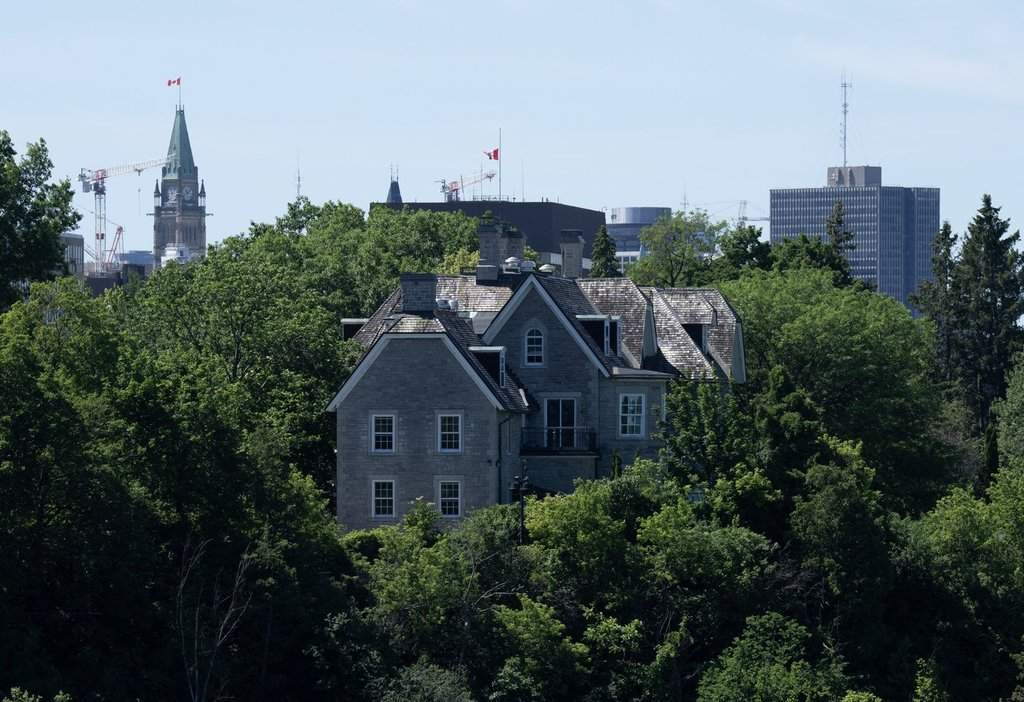
The wind off the Ottawa River does not care about national pride. In the dead of January, it whips over the limestone cliffs, carrying a chill that bites straight to the bone. If you stand outside the wrought-iron gates of 24 Sussex Drive, the cold feels symbolic. For more than a decade, this house—the official residence of Canada’s prime ministers—has stood dark, empty, and rotting from the inside out.
It is a national embarrassment wrapped in a bureaucratic nightmare.
Step inside, mentally at least, because no one is legally allowed to live there anymore. The air is thick with the scent of dead rodents, mold, and old asbestos. The wiring is a fire hazard. The plumbing is a joke. While other G7 nations host world leaders in historic estates that project power and stability, Canada’s premier address has been reduced to a literal ghost house, abandoned because decades of politicians were too terrified of the voter backlash to spend the money required to fix it.
But a shift is happening. Mark Carney, the chair of the federal government’s economic advisory council and a man no stranger to high-stakes restorations, recently confirmed what many had given up hoping for. The house will be saved. An international design competition is launching to reimagine the property.
This is not a story about real estate. It is a story about how a nation views its own heritage, and whether we have the courage to build something meant to last.
The Cost of Looking Cheap
Consider what happens when a country decides that maintaining its own symbols is a luxury it cannot afford.
For generations, Canadian politicians operated under a unspoken rule of martyrdom. To spend money on 24 Sussex was seen as politically fatal. The logic went like this: the average voter in Red Deer or Chicoutimi is struggling with their mortgage, so how dare the government spend millions on a mansion for the prime minister?
So, they patched the leaks with duct tape. They ignored the drafts. They let the stone crumble.
This performative frugality achieved exactly what it deserved. It turned a manageable maintenance checklist into a multi-million-dollar catastrophe. By the time Justin Trudeau was elected in 2015, the National Capital Commission essentially told him that moving his family into the home was a safety risk. He declined to live there, opting instead for Rideau Cottage on the Governor General's estate.
The house was left to die in the dark.
This neglect sends a strange message to the world. When a foreign dignitary visits Washington, they see the White House. In London, they see 10 Downing Street. These buildings are not just offices; they are the physical manifestations of a nation's history and continuity. When the world looks at Ottawa, they see a boarded-up mid-Victorian mansion wrapped in tarps. It looks less like a middle power with a booming economy and more like an abandoned mining town.
The Man with the Blueprint
Enter Mark Carney. To understand why his announcement matters, you have to understand the specific brand of pragmatism he represents. As the former governor of both the Bank of Canada and the Bank of England, Carney is a man who deals in cold, hard balances. He is not a romantic poet given to fits of nostalgia.
When Carney spoke at a recent press conference, he didn't just talk about heritage stonemasonry or historical preservation. He talked about the future. He framed the restoration not as a nostalgic look backward, but as a statement of intent.
The strategy hinges on an international design competition. The goal is to invite the best architectural minds on the planet to look at the site—not just the existing, dilapidated structure, but the entire cliffside property—and propose a vision that balances historical respect with 21st-century reality.
Think of it as an architectural reboot. The bones of the 1868 structure, originally built by lumber baron Joseph Merrill Currier, possess a rugged, understated dignity. The competition aims to preserve that historic shell while inserting a modern, secure, and environmentally sustainable core. It needs to be a home where a family can eat breakfast, a high-security bunker where a crisis can be managed, and a grand diplomatic stage where treaties can be toasted.
Why This Fight Matters to You
It is easy to remain cynical about this. It is easy to say that millions of dollars would be better spent elsewhere.
But the real problem lies elsewhere. The decay of 24 Sussex is a symptom of a deeper, more pervasive cultural anxiety. We are a country that often struggles to celebrate itself. We confuse modesty with a lack of ambition.
When we allow our historic spaces to rot, we are practicing a form of cultural amnesia. Every prime minister from Louis St. Laurent to Stephen Harper walked those halls. Winston Churchill looked out those windows. The walls heard the private debates that shaped the modern Canadian identity—healthcare, the Charter of Rights, the response to global conflicts. To bulldoze it, or to let it quietly collapse into the Ottawa River, is to say that those moments don't matter enough to keep their memory alive.
Fixing the house is an act of confidence. It is an admission that Canada is a permanent project, a country that plans to be around for centuries to come, requiring a worthy stage for its leadership.
The Architecture of Tomorrow
The upcoming competition faces a brutal tightrope walk. Modern security requirements for a world leader are vastly different than they were in the 1950s when the house was first converted into the official residence. The glass must be bulletproof. The perimeter must be secure against drone threats and electronic eavesdropping. The carbon footprint must be net-zero to align with modern climate targets.
This cannot be a stuffy museum. It cannot be a sterile bunker either.
The best architecture tells a story about the people who use it. The new 24 Sussex will likely feature indigenous design elements, locally sourced Canadian timber, and technology that showcases the country's clean-tech sector. It should be a living billboard for what this nation can achieve.
The political gridlock that paralyzed this project for decades appears to be cracking. By turning the restoration into an open, international competition, the government is shifting the conversation away from partisan bickering and toward creative excellence. It takes the target off any single politician's back and places the focus where it belongs: on the legacy we leave for the next generation.
The workmen will eventually arrive. The scaffolding will rise against the grey Ottawa sky. The toxic insulation will be scraped away, the old wires pulled from the walls, and the stone sandblasted back to its original pale gleam.
When the lights finally turn back on at 24 Sussex Drive, it won't just be because the heaters are working again. It will be because a country remembered how to value its own story.


