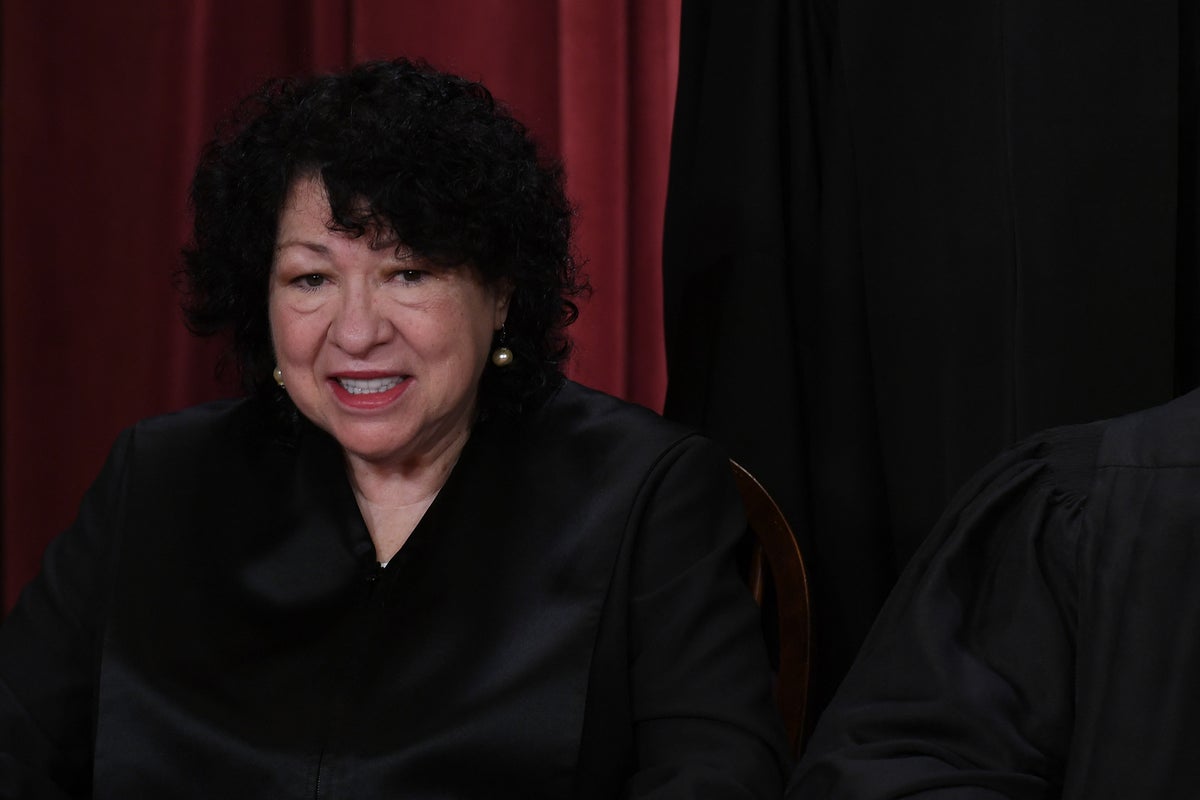
The air inside the Supreme Court doesn’t move like the air outside. It is heavy, filtered through centuries of precedent and the silent weight of velvet curtains. People expect the nine justices to exist as statues, or perhaps as warring philosophies in robes, clashing over the future of a nation with nothing but law books as their shields. We forget that they eat lunch together. We forget that they walk the same narrow hallways, their heels clicking against the stone in a rhythmic, shared pace.
When Sonia Sotomayor stood before a crowd recently, she didn’t lead with a legal brief or a lecture on the Constitution. She led with a confession. She spoke about a moment that had soured, a set of comments directed at her colleague, Brett Kavanaugh, that had crossed a line. It wasn’t a scripted PR move. It was an apology.
In an era where the public square has become a scorched-earth battlefield, the act of saying "I am sorry" feels like a glitch in the system. It is a rare, quiet frequency in a world tuned to high-volume vitriol. Sotomayor’s public olive branch to Kavanaugh wasn't just about professional courtesy; it was a glimpse into the internal machinery of a broken institution trying to keep its heart beating.
The Friction of the Bench
Imagine the dinner table from hell. You are seated next to someone whose fundamental view of the world—how people should live, what they should own, how they should be governed—is diametrically opposed to your own. Now, imagine you have to sit at that table for the rest of your life.
That is the reality of the Supreme Court.
Sotomayor and Kavanaugh represent two wildly different Americas. One was forged in the housing projects of the Bronx, a "Nuyorican" firebrand who views the law as a tool for equity and social protection. The other is a product of the D.C. elite, a jurist who believes in originalism and a strict, often traditionalist interpretation of executive and judicial power. Their backgrounds didn't just clash; they collided during Kavanaugh’s 2018 confirmation, a period that left the Court—and the country—trembling under the weight of partisan fury.
When Sotomayor admitted that she had made "hurtful comments" regarding Kavanaugh, she wasn't talking about his rulings. She was talking about the person. In the high-stakes environment of the highest court, the line between attacking an idea and attacking a human being is paper-thin. When that line is crossed, the damage isn't just personal. It’s institutional.
The Supreme Court relies on a fragile, unwritten code of "collegiality." It’s a word that sounds dusty and academic, but it’s actually the only thing preventing the marble pillars from crumbling. If the justices stop seeing each other as humans, they stop being a court and start being a committee of ideological executioners. Sotomayor’s apology was an attempt to pull the emergency brake.
Beyond the Black Robes
We often view these figures through the lens of a television screen, flattened into two-dimensional characters. Sotomayor is the "People’s Justice," the empathetic liberal. Kavanaugh is the "Conservative Stalwart." But behind the bench, there is a different reality.
There are birthdays. There are sick family members. There are shared jokes in the robing room before the doors swing open to the public.
Sotomayor’s comments, which she characterized as unfair and deeply personal, hit a nerve because they broke the sanctuary of that private space. She recognized that the vitriol of the outside world had seeped into the one place that is supposed to be insulated from it. Her apology was a public admission of a private failure. She was saying, essentially, that she had let the tribalism of the 21st century win for a moment.
This isn't to say their legal disagreements have softened. They haven't. They shouldn't. The beauty of a functional court is the ability to disagree with ferocity while maintaining a baseline of respect. It is the "loyal opposition." When that loyalty to the human being on the other side of the aisle vanishes, the law becomes nothing more than a weapon.
Consider the mechanics of the apology itself. In the legal world, words are the only currency. Every "whereas" and "heretofore" is calculated. For a Justice to publicly say, "I was wrong to speak that way," is a massive expenditure of social capital. It signals to the other justices—and to the public—that the preservation of the institution’s soul is more important than being "right" in a Twitter thread.
The Invisible Stakes of Grace
Why does this matter to someone who isn't a lawyer or a political junkie?
It matters because we are currently living in a culture that views apology as a sign of weakness. We have been taught that to admit fault is to hand your opponent a victory. We see it in our politics, our workplaces, and our social media feeds. The "double down" has become the default setting for human interaction.
Sotomayor’s move was a counter-cultural act. It suggested that there is something more valuable than winning an argument: the ability to live alongside those we disagree with.
If two people who are literally tasked with deciding the most divisive issues in modern history—abortion, gun rights, executive power, environmental regulation—can find a way to reconcile a personal slight, what does that mean for the rest of us? It suggests that the "great divide" we are told is unbridgeable might actually have a few rickety footbridges left.
The friction between the justices is a microcosm of the friction in every American city. We are a nation of neighbors who have stopped talking and started shouting. We look at the "other side" not as people with different ideas, but as existential threats. Sotomayor’s apology forces us to look at the "threat" and see a colleague.
The Weight of the Word
There is a specific kind of bravery in being the one to lower the shield first.
Sotomayor’s admission didn't come because a court order forced her to. It didn't come from a fear of being "canceled." It came from a realization that her words had caused a wound that hindered the collective work of the group.
In her public remarks, she spoke about the need for the Court to function as a family—not a family that always agrees (no such thing exists), but a family that remains committed to the house they share.
Kavanaugh’s response, while less public, has been noted by insiders as one of quiet acceptance. This isn't a Hollywood ending where they walk off into the sunset holding hands. They will likely go back to writing scathing dissents against each other's opinions tomorrow. They will still use sharp, legalistic language to dismantle each other's logic.
But the air in the hallway might be a little lighter.
The "hurtful comments" weren't specified in detail, and in a way, they don't need to be. We all know the shape of those comments. We've all said them. We’ve all felt the heat rise in our chests when someone challenges our core beliefs, and we’ve all reached for the jagged word that we know will leave a scar.
The difference is that Sotomayor reached back.
The Echo in the Hallway
The Supreme Court is a place of rituals. The "conference handshake" is one of the most famous—before every private meeting where they discuss cases, every justice shakes the hand of every other justice. That’s 36 handshakes every time they meet. It’s a physical reminder that before they are adversaries, they are a team.
For a while, those handshakes probably felt cold. They probably felt like a chore, a hollow performance of a tradition that had lost its meaning.
By apologizing, Sotomayor put the blood back into the handshake. She reminded the room that the robes are just fabric. Underneath them are people who are capable of being petty, angry, and wrong—but also people who are capable of restoration.
We are watching an experiment in real-time. Can an institution survive when its members truly dislike each other? The answer, Sotomayor seems to suggest, is no. It can only survive if they choose to like each other, or at the very least, choose to value the person over the partisan.
The marble walls of the Supreme Court are built to last for centuries. They are thick and imposing. But they aren't what holds the building up. What holds it up is the fragile, terrifyingly human decision to say "I'm sorry" when the world is screaming at you to never back down.
The next time the heavy bronze doors of the courtroom swing open, Sotomayor and Kavanaugh will take their seats. They will sit on opposite ends of the ideological spectrum. They will disagree on the future of the republic. But for a brief moment, the shadow of a personal grievance has been lifted, replaced by the quiet dignity of a mistake owned and a bridge rebuilt.
The law is made of paper and ink. But a court is made of people. And sometimes, the most important thing a judge can do isn't to hand down a ruling, but to offer a hand.