On November 19, 2026, the International Court of Justice did something it had never done in the seventy-eight-year history of the Genocide Convention. By a nine-to-six margin, the United Nations' highest judicial body ruled that the state of Myanmar committed genocide against the Rohingya Muslim minority during its 2017 military operations in northern Rakhine State. The ruling confirms that Myanmar must provide restitution, pay financial reparations, and prosecute the architects of the violence. Yet for the more than 1.2 million Rohingya survivors trapped in sprawling refugee camps across the border in Bangladesh—or living under apartheid-like conditions inside Myanmar—the historic verdict delivers zero immediate safety, citizenship, or territory.
The gap between a binding legal victory in the Netherlands and physical survival in Southeast Asia is vast. Courts issue paper. Armies hold ground.
A Historic Verdict Built on a Razor-Thin Legal Standard
To understand why the judgment in The Gambia v. Myanmar matters—and why its real-world impact remains severely constrained—you have to look at what the judges actually decided inside the Peace Palace. Since the 1948 Genocide Convention was adopted in the aftermath of the Holocaust, the International Court of Justice (ICJ) had never held a sovereign state directly responsible for committing genocide. In previous landmark cases, such as the 2007 ruling involving Bosnia and Herzegovina against Serbia, the court found that a state failed to prevent genocide, stopping short of ruling that the state itself executed the crime.
That precedent shattered when ICJ President Yuji Iwasawa read the operative clauses. The court established that during the 2017 "clearance operations," Myanmar's security forces killed at least 10,000 Rohingya, raped at least 1,834 women and girls, burned hundreds of villages to the ground, and drove more than 700,000 people into Bangladesh.
Numbers alone do not prove genocide under international law. The legal bottleneck has always been dolus specialis—the specific intent to destroy, in whole or in part, a national, ethnical, racial, or religious group. For seven years, Myanmar's legal team argued that the 2017 offensive was a legitimate, albeit brutal, counter-insurgency campaign aimed at neutralising militants from the Arakan Rohingya Salvation Army (ARSA).
The nine-judge majority rejected that defense. Looking at the totality of the evidence—including systematic sexual violence, the deliberate destruction of food supplies, decades of state-sponsored dehumanization, and the stripping of citizenship—Judge Iwasawa stated that the only reasonable inference was an intent to destroy a substantial part of the Rohingya population in northern Rakhine State.
The six dissenting judges, including Vice-President Julia Sebutinde and Judges Peter Tomka and Xue Hanqin, did not deny the atrocities. They agreed that Myanmar's military committed grave violations of international humanitarian law and probable crimes against humanity. Where they broke with the majority was over evidentiary inference—arguing that a pattern of massacres combined with mass expulsion still left room for an intent to displace rather than physically destroy.
That narrow 9–6 split reveals a profound shift in international jurisprudence. By lowering the barrier to inferring genocidal intent from circumstantial patterns rather than requiring a smoking-gun extermination order, the court fundamentally altered the legal exposure for states fighting asymmetric wars in densely populated areas—a fact immediately noted by legal observers watching South Africa's parallel genocide case against Israel.
The Enforcement Vacuum in Naypyidaw
Winning a case at the ICJ is one thing. Enforcing it is an entirely different sport.
The ICJ possesses no police force, no peacekeeping troops, and no mechanism to seize sovereign assets on its own authority. Under Article 94 of the United Nations Charter, if a state refuses to comply with an ICJ judgment, the injured party can appeal to the UN Security Council to take measures to give effect to the decision.
Here is where legal theory collides with geopolitical reality. Any enforcement resolution brought before the Security Council runs straight into the veto power of China and Russia.
Both Beijing and Moscow have shielded Myanmar's military junta, the Tatmadaw, from meaningful international sanctions for years. China views Myanmar as a strategic corridor connecting its landlocked southwestern provinces to the Indian Ocean, pouring billions into deep-sea ports and oil-and-gas pipelines directly across Rakhine State. Russia remains the junta's primary supplier of fighter jets, attack helicopters, and heavy weaponry. Neither power has any strategic incentive to enforce an ICJ order that would dismantle the military apparatus protecting their investments and arms contracts.
Furthermore, the government that defended Myanmar in The Hague is not even the same political configuration that existed when The Gambia filed the lawsuit in November 2019. In 2019, civilian leader Aung San Suu Kyi personally appeared at the Peace Palace to defend the generals who had once imprisoned her. In February 2021, those very generals overthrew her government in a coup d'état, plunging the entire country into a multi-front civil war.
The junta ruling from Naypyidaw today is an international pariah already operating outside global banking systems and Western diplomatic norms. When the ICJ issued binding provisional measures in January 2020 ordering Myanmar to protect the remaining Rohingya and preserve evidence of crimes, the military simply ignored them—a breach the court formally confirmed in its November 2026 judgment. Expecting Senior General Min Aung Hlaing to suddenly surrender his commanders for prosecution or wire billions in reparations to a minority his regime refuses to recognize as citizens is pure fantasy.
Why Rakhine State Is No Longer Under the Junta's Control
Even if the generals in Naypyidaw woke up tomorrow with a sudden commitment to international law, they could not fulfill the court's order to safely repatriate the Rohingya. They no longer control the ground.
Most Western coverage of the ICJ verdict treats Rakhine State as if it were frozen in 2017. It is not. Over the past two years, Myanmar's military has suffered catastrophic territorial losses to ethnic armed organizations across the country. In Rakhine State, the Arakan Army (AA)—a powerful ethnic Rakhine insurgent force fighting for autonomy from the central Bamar-dominated state—has systematically overrun junta bases, captured key townships, and seized control of the borderlands adjacent to Bangladesh.
This creates a treacherous new reality for Rohingya refugees hoping to return home.
- The Arakan Army is not a neutral party. While the AA fights the same military junta that persecuted the Rohingya, relations between the ethnic Rakhine majority and the Rohingya Muslim minority in northern Rakhine have been poisoned by decades of divide-and-rule tactics engineered by the Tatmadaw.
- Forced conscription has deepened the rift. Desperate for manpower as its front lines collapsed, the Myanmar military forcibly conscripted thousands of stateless Rohingya men, throwing them into combat against the Arakan Army and burning Rakhine villages to reignite communal hatred.
- The ICJ ruling binds only the state. Under international law, the ICJ's judgment applies strictly to the Republic of the Union of Myanmar. Non-state armed groups like the Arakan Army are not parties to the Genocide Convention and are not legally bound by the court's restitution orders.
Returning hundreds of thousands of Rohingya refugees into an active war zone governed by an insurgent army that views them with deep suspicion—and where landmines, destroyed infrastructure, and zero citizenship rights remain the baseline—would be a death sentence.
The Slow Collapse of Cox's Bazar
While diplomats in The Hague celebrated the triumph of international justice, the humanitarian infrastructure keeping the Rohingya alive in Bangladesh is buckling.
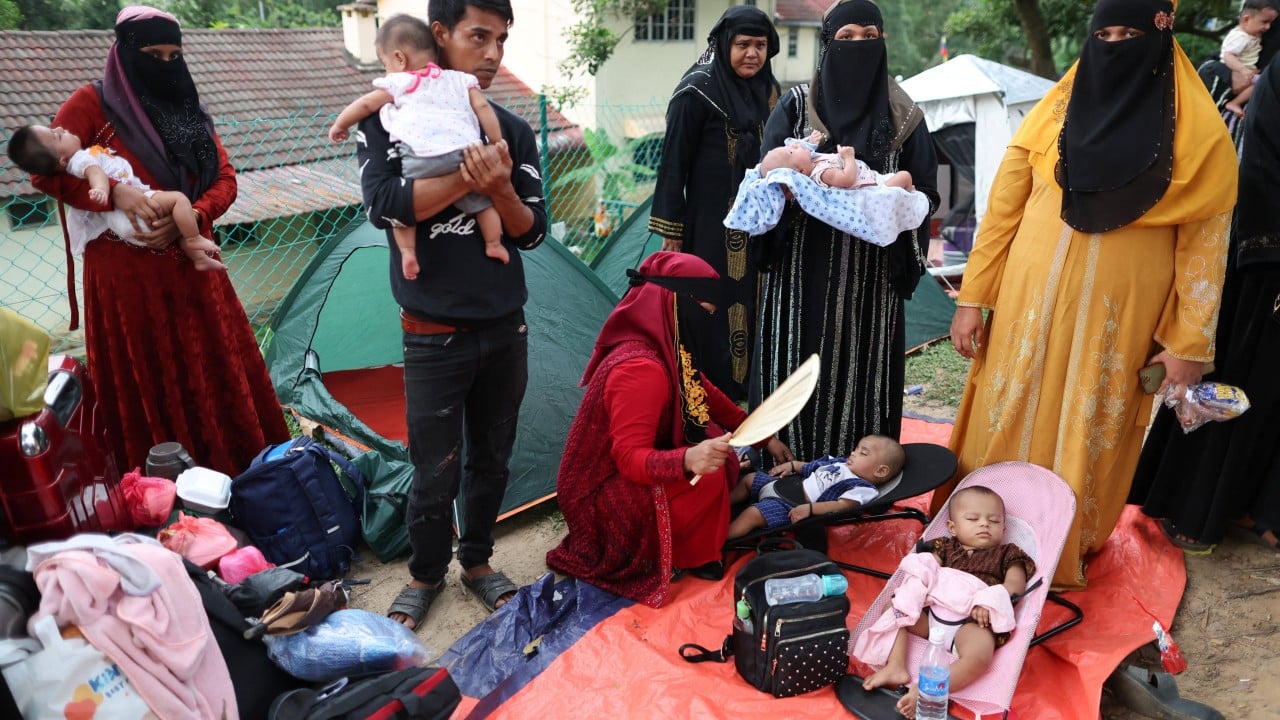
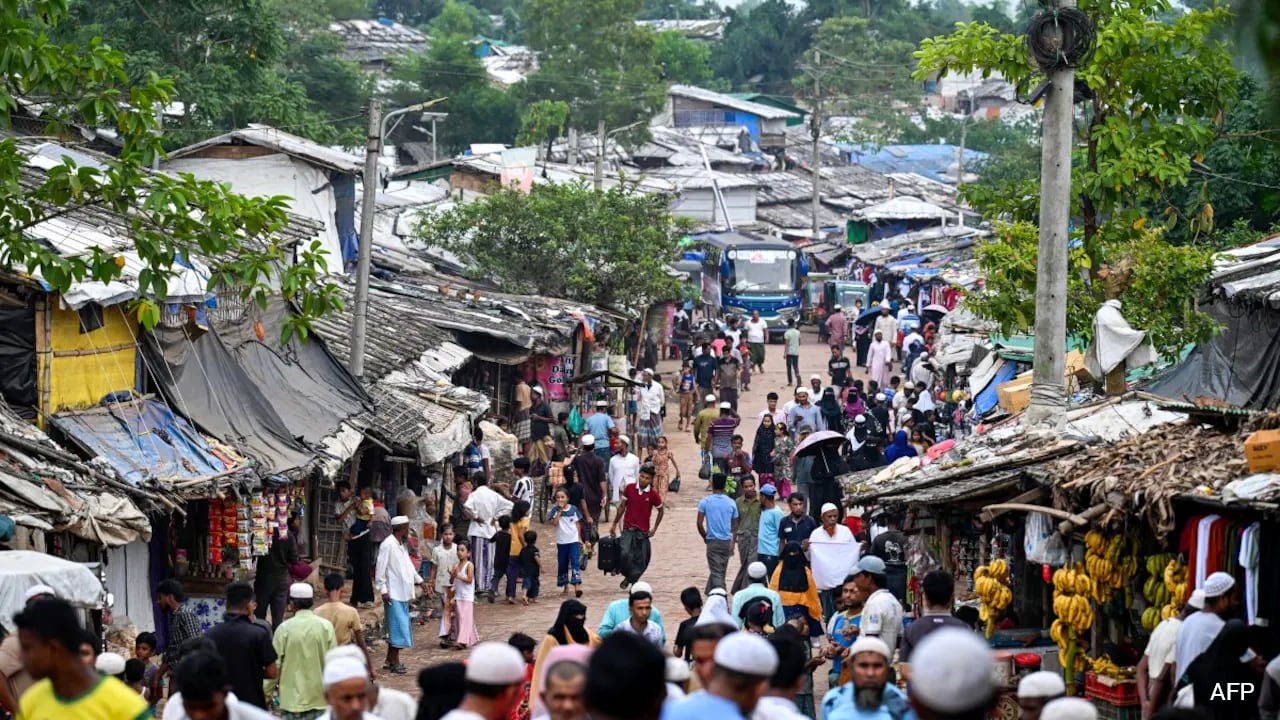
More than 1.2 million Rohingya now live in the Cox's Bazar district of southeastern Bangladesh, packed into the world's largest refugee settlement. They are legally barred from working, restricted from traveling outside the fenced camps, and denied formal education beyond basic camp schooling. For nine years, an entire generation has grown up in bamboo-and-tarpaulin shacks, completely dependent on international aid.
That aid is drying up. Distracted by wars in Ukraine, Gaza, and Sudan, global donors have repeatedly failed to meet the UN's Joint Response Plan funding targets for the Rohingya crisis. In recent years, the World Food Programme was forced to slash food rations to bare-minimum levels, triggering spikes in acute malnutrition, child stunting, and desperate boat journeys across the Andaman Sea.
Inside the camps, the security vacuum has bred violent criminal gangs and militant factions that extort refugees, kidnap community leaders, and battle Bangladeshi security forces. Bangladesh, struggling with its own economic pressures and domestic political upheaval, has made it unmistakably clear that permanent local integration is off the table.
For a mother in Kutupalong camp trying to feed four children on dwindling rations, an ICJ ruling ordering Myanmar to pay future reparations is an abstraction. You cannot eat a legal precedent.
What the Ruling Actually Changes
Dismissing the ICJ judgment as useless, however, misses how international pressure actually grinds down rogue regimes over decades. Legal victories rarely liberate people overnight, yet they permanently alter the diplomatic, financial, and political terrain on which those regimes operate.
1. The Death of Diplomatic Denial
For nearly a decade, Myanmar's officials—and their apologists abroad—insisted that the 2017 violence was merely a messy counter-terrorism operation exaggerated by Western media. That narrative is dead. When the UN's highest court establishes as judicial fact that a state committed genocide, every foreign ministry, multilateral development bank, and multinational corporation must treat that finding as settled law. It becomes vastly harder for regional neighbors in ASEAN to normalize relations with the junta or quietly push for premature, unsafe refugee repatriations.
2. Universal Jurisdiction and Frozen Assets
The ICJ judgment hands prosecutors in third-party countries a powerful evidentiary foundation. Under the principle of universal jurisdiction, national courts in countries like Germany, Argentina, and the United Kingdom can prosecute individuals for genocide regardless of where the crime occurred or the nationality of the perpetrators. Armed with the ICJ's factual findings, prosecutors can issue international arrest warrants that trap Myanmar's generals inside their own borders for life. Furthermore, the court's formal order requiring financial compensation gives legal advocates fresh leverage to pursue frozen Myanmar central bank reserves held abroad, potentially redirecting those funds toward victim restitution.
3. Fuel for the International Criminal Court
The ICJ settles disputes between states, whereas the International Criminal Court (ICC) prosecutes individuals. While Myanmar is not a state party to the ICC, the court previously ruled that it has jurisdiction over the deportation of the Rohingya because the crime was completed on the territory of Bangladesh, which is a member. The ICJ's authoritative determination of genocidal intent removes the single hardest prosecutorial hurdle for ICC investigators building individual criminal cases against Senior General Min Aung Hlaing and his top brass.
4. Leverage Over Myanmar's Opposition
Perhaps the most overlooked consequence lies not with the junta, but with Myanmar's pro-democracy opposition—specifically the National Unity Government (NUG) and the ethnic armed organizations fighting to build a post-junta federal democracy. If these opposition forces want Western diplomatic recognition, financial backing, and seats at the UN, they cannot simply blame the Tatmadaw and move on. Because state responsibility attaches to the country of Myanmar regardless of who governs it, any future legitimate government inherits the legal obligation to repeal the discriminatory 1982 Citizenship Law, restore Rohingya land rights, and comply with the ICJ's restitution orders. The ruling locks Rohingya rights into the price of admission for Myanmar's return to the international community.
The Hard Truth About International Justice
The ICJ ruling in The Gambia v. Myanmar proves that small nations can drag powerful militaries before the world's highest court and win. It validates the testimony of thousands of survivors who watched their villages burn and their families slaughtered while the world looked away.
Yet validation is not liberation. The law has done everything it can do from a courtroom in Europe. Until donor nations fully fund the camps in Bangladesh, enforce targeted sanctions on the junta's aviation fuel and banking networks, and condition future recognition of Myanmar's opposition on full citizenship for the Rohingya, the survivors of Asia's twenty-first-century genocide will remain prisoners of a verdict the world refuses to enforce.