The air inside Shanghai’s premier tech hubs always smells slightly of ozone and expensive espresso. In early 2024, it also smelled of quiet desperation.
Consider a hypothetical engineer named Zhou. He doesn't work for a global conglomerate; he runs a mid-sized AI startup in Zhangjiang High-Tech Park, hunting for the compute power required to train a medical diagnostic model. For months, Zhou’s team has been forced to rent fragmented server time through complex, expensive cloud proxies. They are starving for chips. Specifically, they are starving for Nvidia graphics processing units, the foundational bedrock upon which the modern artificial intelligence boom was built.
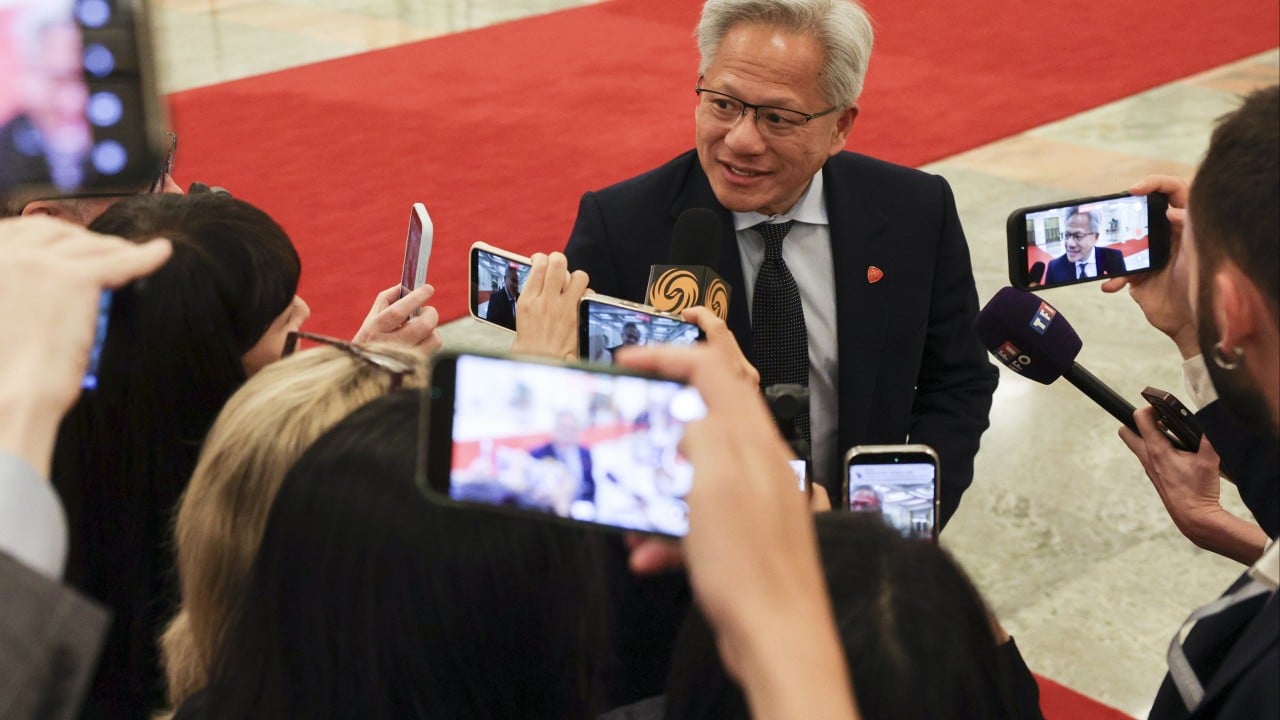
Then came Jensen Huang’s sudden, quiet tour through China.
The Nvidia CEO traded his signature black leather jacket for a traditional flowered vest, dancing with employees at company New Year parties in Shanghai, Shenzhen, and Beijing. It was a charm offensive wrapped in a corporate morale boost. But beneath the celebratory confetti lay a stark, uncomfortable commercial reality. Nvidia is fighting to hold onto its most volatile market, and the weapon they have brought to the fight is a deliberately slowed-down engine.
The math of international geopolitics is brutal. United States export controls explicitly prohibit Nvidia from shipping its top-tier AI processors, the H100 and the newer B200 architectures, to Chinese clients. The fear in Washington is clear: advanced AI could supercharge military and surveillance capabilities.
Nvidia’s response was the H200’s specialized regional sibling: the H20.
To understand what the H20 represents, you have to look past the spec sheets and understand the architecture of frustration. The H20 is a masterpiece of regulatory compliance. It sits exactly on the razor’s edge of what US law allows to cross the Pacific. Nvidia stripped out the raw processing muscle—the mathematical horse-power used to compute complex algorithms—reducing its performance to a mere fraction of what the standard H100 can achieve.
Yet, in a brilliant engineering compromise, they left the memory bandwidth wide open.
Think of it like a highway network. The US government forced Nvidia to replace the high-speed sports cars on that highway with delivery trucks that have strict speed governors. However, Nvidia made sure the highway itself had twelve lanes. Because AI training requires massive amounts of data to pass back and forth constantly, that wide-open memory pipeline means that if a company chains thousands of these slowed-down H20 chips together, they can still achieve remarkable results.
But that brings us back to Zhou, standing in his server room, looking at the bill. Chaining thousands of lowered-performance chips together requires a massive amount of physical space. It demands immense electrical power. Most importantly, it costs a fortune.
For the first time in a decade, Chinese tech firms are looking at Nvidia and asking a question that used to be unthinkable.
Is it worth it?
The alternative is no longer a blank space on a map. Domestic options, most notably Huawei’s Ascend 910B, are waiting in the wings. For years, domestic Chinese chips were treated like the backup option you hoped you would never have to use. They suffered from software ecosystems that were notoriously difficult to program for, lacking the elegant, universal software language that made Nvidia king.
But necessity is an incredible accelerator. Huawei has poured immense resources into improving its software stack. More crucially, the Ascend 910B boasts raw computing power that, on paper, outpaces Nvidia's downgraded H20.
A quiet shift in momentum is altering the industry. Major Chinese tech giants—the companies that used to buy Nvidia silicon by the truckload—are diversifying. They are buying just enough H20 chips to keep their existing software systems running smoothly, while shifting an increasing percentage of their budgets to local alternatives. They are building insurance policies against future export restrictions. If Washington tightens the screws again, even the H20 might disappear overnight. Relying on it entirely feels like building a house on a shifting sandbank.
This leaves Jensen Huang in a precarious position. Nvidia’s data center revenue has skyrocketed globally, driven by an insatiable appetite for AI in the West. They do not need China to survive today. But business history is littered with the ghosts of dominant empires that abandoned a market, only to watch a hyper-competitive local rival grow so strong in that vacuum that it eventually challenged them everywhere else.
The dilemma isn't just about corporate balance sheets; it is a profound cultural friction. Silicon Valley operates on the principle of relentless, uncompromised optimization—building the fastest, most powerful machine possible, every single year. The H20 represents the exact opposite: an engineered ceiling. It is technology designed not to push boundaries, but to respect borders.
Back in Shanghai, Zhou makes his decision. He signs a contract for a hybrid cloud cluster. It uses some older, hoarded Nvidia hardware, a few new H20 nodes, and a significant block of domestic silicon. It is messy. It requires his engineers to rewrite chunks of code that used to run flawlessly.
The era of seamless, universal tech infrastructure is fractured. The silicon curtain has fallen, and players on both sides are learning to live in the shadows it casts.