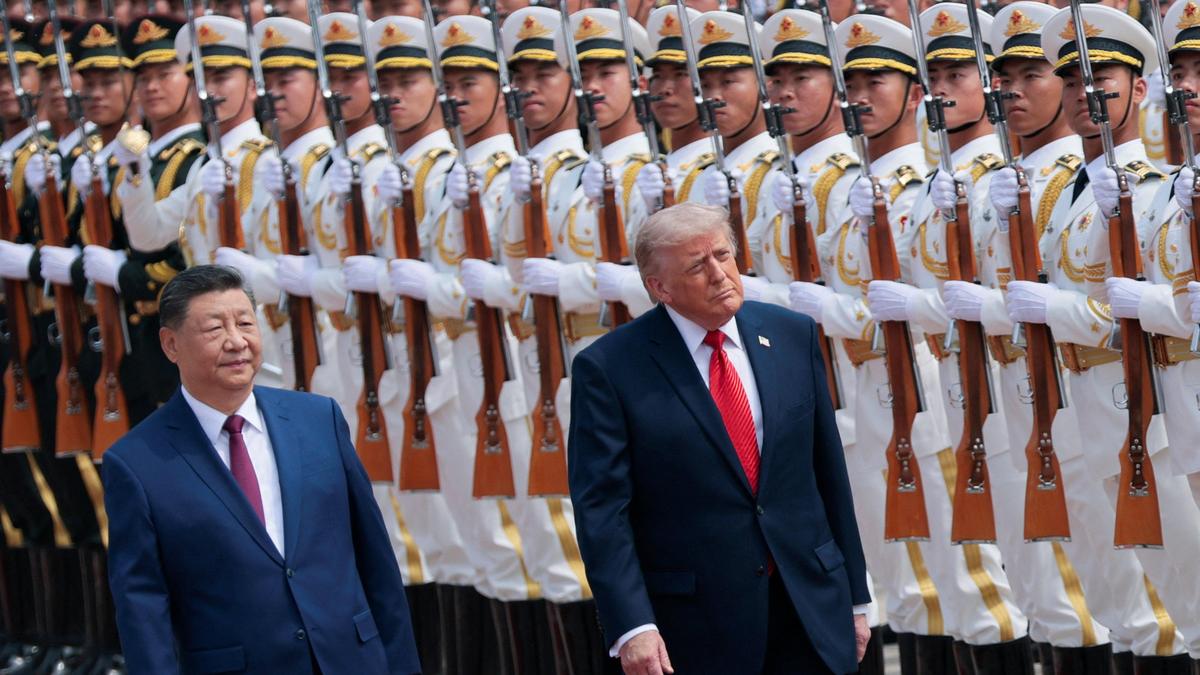
Chinese President Xi Jinping recently signaled that 2026 will serve as a "historic, landmark year" for China-US relations. On the surface, this phrasing suggests a thawing of the diplomatic permafrost that has defined the 2020s. However, a deeper investigation into Beijing’s internal policy shifts and Washington’s tightening export controls reveals a far more complex reality. The "landmark" nature of 2026 is not about a return to the status quo of global integration; rather, it marks the point where both superpowers have finalized their respective "fortress" economies, making the path toward permanent fragmentation irreversible.
While official statements emphasize cooperation, the structural mechanics of both nations are grinding toward self-sufficiency. For Xi, 2026 represents the deadline for several critical milestones in the "Made in China 2025" evolution and the 14th Five-Year Plan. It is the year Beijing expects to prove it can survive—and thrive—without the Western silicon and financial plumbing it has relied on for forty years. For another view, see: this related article.
The Silicon Sovereignty Deadline
The primary driver behind the 2026 timeline is the race for semiconductor independence. For decades, the global tech industry operated on a simple logic: design in the West, manufacture in the East. That logic is dead. The US Department of Commerce has effectively ring-fenced China’s ability to acquire high-end logic chips and the lithography equipment needed to make them.
Beijing has responded by pouring hundreds of billions of yuan into the "Big Fund" and localized supply chains. By 2026, Chinese state-backed firms like SMIC and CXMT are projected to achieve stable yields on 7nm and even 5nm processes using older DUV (Deep Ultraviolet) equipment pushed to its physical limits. This isn't just about making phones. It is about the hardware required for the autonomous systems and logistics networks that will define mid-century power. Related coverage on this matter has been published by Al Jazeera.
This pursuit of technical sovereignty creates a paradox. While Xi talks of "landmark" relations, his administration is actively scrubbing American technology from government "white lists." This "Delete-A" (Delete America) strategy aims to replace Intel, AMD, and Microsoft with domestic alternatives by 2026. If the dependency is gone, the leverage the US holds over China evaporates. That is the true "historic" shift.
The Currency War in the Shadows
Money moves faster than chips. The financial architecture of the world is currently built on the SWIFT system and the dominance of the US dollar. Beijing views this as a strategic vulnerability, a "financial nuclear option" that Washington can trigger at any moment, as seen in the sanctions against Russia.
The landmark year of 2026 coincides with the projected maturity of the Digital Yuan (e-CNY) and the expansion of the mBridge project—a multi-central bank digital currency platform. This system allows for cross-border payments that bypass the US banking system entirely.
- Trade in Yuan: China is successfully pushing for commodity trades (oil, gas, minerals) to be settled in CNY.
- Alternative Liquidity: The development of the CIPS (Cross-Border Interbank Payment System) provides a direct rival to Western-led clearinghouses.
- Gold Accumulation: The People's Bank of China has been one of the world’s most aggressive buyers of gold, diversifying away from US Treasuries at a record pace.
When Xi speaks of a new era of relations, he is speaking as a leader who no longer needs to ask permission to participate in the global financial market. He is building a parallel room where he holds the keys.
The Battle for the Global South
The US-China relationship is no longer a bilateral conversation. It is a competition for the patronage of the "Global South"—nations in Southeast Asia, Africa, and Latin America that are tired of being caught in the crossfire.
By 2026, the second generation of "Belt and Road" projects will come online. These aren't just roads and bridges anymore. They are "Digital Silk Road" projects: 5G networks, data centers, and smart city surveillance systems built with Chinese hardware and managed with Chinese software. This creates a "vendor lock-in" at a national scale.
Washington has struggled to provide a competitive alternative. The "Build Back Better World" and other Western initiatives have lacked the sheer capital and speed of Chinese state-owned enterprises. In 2026, many emerging economies will face a hard choice: align with the transparency and strings-attached aid of the West, or the fast-tracked, infrastructure-heavy, "non-interference" model offered by Beijing. Most are choosing the latter, effectively shrinking the Western sphere of influence without a single shot being fired.
Green Energy as a Geopolitical Weapon
We must look at the climate transition through the lens of power, not just ecology. China currently controls over 80% of the global supply chain for solar panels and nearly 60% of electric vehicle (EV) battery production.
The US and EU are scrambling to build their own gigafactories, but they are behind. Significant industrial policy takes years to bear fruit. By 2026, the gap between Chinese production costs and Western production costs will be at its widest point. If the West wants to meet its 2030 climate goals, it must buy from China. If it wants to protect its domestic car industries, it must block China.
This creates a massive friction point. Xi knows that "historic cooperation" in 2026 likely means the West admitting it cannot go green without Chinese lithium and processed graphite. It is a masterclass in using the "green transition" to secure a permanent industrial advantage.
The Military Brinkmanship of 2026
Military analysts have long pointed to the late 2020s as a "window of vulnerability" in the Taiwan Strait. The 2026 date is significant because it marks the completion of several major PLA (People's Liberation Army) modernization cycles.
The US Navy is currently in a "trough" of ship numbers as older hulls are retired faster than new ones are built. Conversely, China’s shipbuilding capacity is now several times larger than that of the United States. In 2026, the balance of power in the First Island Chain will look significantly different than it did in 2020.
Modernization Milestones
- Carrier Strike Groups: The third aircraft carrier, Fujian, will likely be fully operational with advanced electromagnetic catapults.
- Hypersonic Integration: Widespread deployment of DF-17 missiles designed to neutralize carrier groups.
- Space Dominance: The expansion of the Tiangong space station and the BeiDou satellite constellation, ensuring independent targeting and communications.
Diplomacy often follows the lead of military capability. Xi’s confidence in 2026 likely stems from the assessment that the cost of US intervention in his "core interests" will become prohibitively high by that year.
Domestic Pressure and the Social Contract
No analysis of Xi's timing is complete without looking inside the Great Firewall. The Chinese economy is facing systemic headwinds: a real estate crisis that won't quit, a shrinking workforce, and high youth unemployment.
The social contract in China has always been "growth in exchange for political compliance." With growth slowing, Xi needs a different narrative. That narrative is "National Rejuvenation." By framing 2026 as a landmark year of standing up to the West, he can deflect domestic economic frustration toward a shared goal of national pride.
The risk is that if the "landmark" year doesn't yield tangible victories—be they economic concessions from the US or a breakthrough in tech—the domestic pressure could force the CCP into more aggressive external actions to maintain legitimacy.
A Divergent Future
The idea that 2026 will be a year of "landmark" relations is technically true, but the word "landmark" is doing a lot of heavy lifting. It will be the year when the two greatest powers on Earth finally stop pretending they are moving toward the same destination.
We are seeing the birth of a bipolar world where the internet is split, currencies are divided, and supply chains are weaponized. The "landmark" is a border post, not a bridge. Businesses and investors waiting for a return to the "Globalism 1.0" of the 1990s are looking at a map that no longer exists.
Prepare for a world where "historic cooperation" is merely the polite language used to manage an inevitable and permanent separation. The real work for global leaders in 2026 won't be about getting back together; it will be about figuring out how to stay apart without starting a war that neither side can truly win.